
We read your photo as:
What are the definitions and examples of self-management, grooming, abilities, strengths, and weaknesses?
ScanSolve AI Answer
Answer
Bargaining
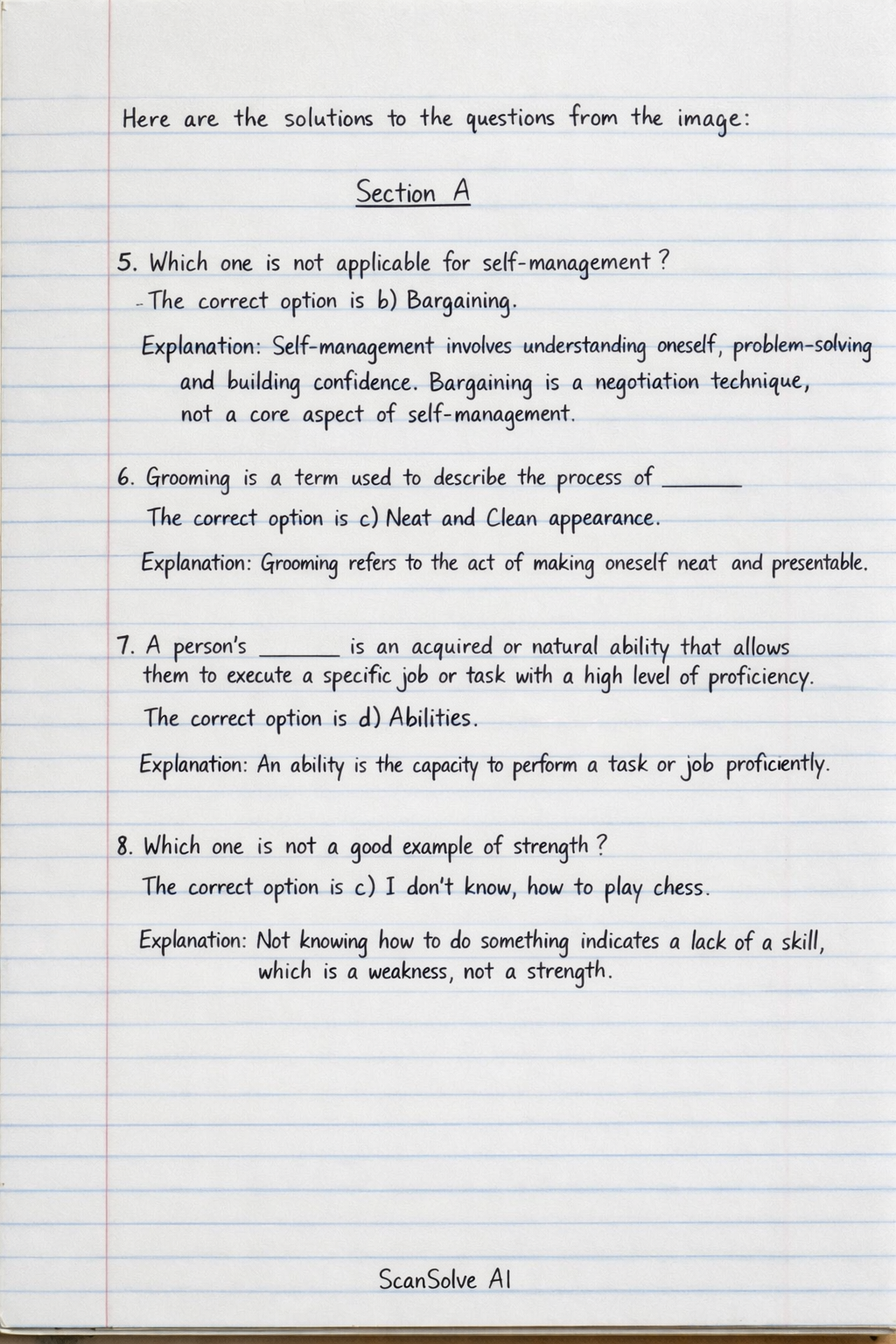
Here are the solutions to the questions from the image:
Section A
-
Which one is not applicable for self-management?
- The correct option is b) Bargaining.
- Explanation: Self-management involves understanding oneself, problem-solving, and building confidence. Bargaining is a negotiation technique, not a core aspect of self-management.
-
Grooming is a term used to describe the process of _____
- The correct option is c) Neat and Clean appearance.
- Explanation: Grooming refers to the act of making oneself neat and presentable.
-
A person's _____ is an acquired or natural ability that allows them to execute a specific job or task with a high level of proficiency.
- The correct option is d) Abilities.
- Explanation: An ability is the capacity to perform a task or job proficiently.
-
Which one is not a good example of strength?
- The correct option is c) I don't know, how to play chess.
- Explanation: Not knowing how to do something indicates a lack of a skill, which is a weakness, not a strength.
-
_____ often known as 'areas for improvement', refers to the things we don't do well or aren't very good at.
- The correct option is a) Weaknesses.
- Explanation: Weaknesses are areas where one needs to improve.
-
When we believe in our ability to achieve in anything we undertake in life, we develop the quality of _____
- The correct option is a) Self-confidence.
- Explanation: Self-confidence is the belief in one's own abilities and judgment.
-
You can develop your self-confidence through changes in _____
- The correct option is c) Both a) and b).
- Explanation: Both a positive attitude and consistent practice contribute significantly to developing self-confidence.
Section B
Q.1 Write The Sort Notes On Any Two.
-
A. Self Awareness:
- Self-awareness is the conscious knowledge of one's own character, feelings, motives, and desires. It involves understanding your strengths, weaknesses, values, and goals, which is crucial for personal growth and effective decision-making.
-
B. Grooming:
- Grooming refers to the process of making oneself neat and attractive. It encompasses personal hygiene, dressing appropriately for different occasions, and maintaining a presentable appearance, which contributes to a positive self-image and professional impression.
Q.2 Attempt Any 4 Questions.
-
Describes 7's C Concept? The 7 C's of effective communication are:
- Clarity: The message should be clear and easy to understand.
- Conciseness: Get to the point without unnecessary words.
- Concreteness: Be specific, factual, and vivid.
- Correctness: Ensure accuracy in facts, grammar, and spelling.
- Coherence: The message should be logical and well-organized.
- Completeness: Provide all necessary information.
- Courtesy: Be polite, friendly, and respectful.
-
Write a Notes on Barriers of Communication? Barriers to communication are obstacles that hinder the effective transmission and reception of messages. Common barriers include:
- Physical Barriers: Noise, distance, faulty equipment.
- Semantic Barriers: Different interpretations of words, jargon, or ambiguous language.
- Psychological Barriers: Emotions, attitudes, perceptions, lack of attention, or distrust.
- Organizational Barriers: Hierarchical structures, complex rules, or poor communication channels within an organization.
- Cultural Barriers: Differences in beliefs, values, customs, or social norms.
-
Draw a Diagram on Communication Cycles? The communication cycle involves several key components:
- Sender: The person who initiates the message.
- Encoding: The process of converting thoughts into a message (words, gestures).
- Message: The information being conveyed.
- Channel: The medium through which the message is sent (e.g., verbal, written, non-verbal).
- Decoding: The process by which the receiver interprets the message.
- Receiver: The person who receives and interprets the message.
- Feedback: The receiver's response to the sender, indicating understanding.
- Noise: Any interference that distorts or disrupts the message at any stage.
-
Write the Two Advantages and Disadvantages on Verbal Communication?
- Advantages:
- Immediate Feedback: Allows for instant clarification and discussion.
- Conveys Emotion: Tone of voice and facial expressions can add depth and meaning.
- Disadvantages:
- No Permanent Record: Difficult to refer back to unless recorded.
- Prone to Misinterpretation: Can be misunderstood if not clear or if there are distractions.
- Advantages:
-
Describes the Stress and Stress management?
- Stress: Stress is a state of mental or emotional strain or tension resulting from adverse or demanding circumstances. It is the body's natural reaction to challenges, pressures, or threats, triggering a "fight or flight" response.
- Stress Management: Stress management refers to a range of techniques and programs designed to help individuals cope more effectively with stress in their lives. This includes strategies like exercise, meditation, time management, relaxation techniques, and seeking social support to reduce the physical and emotional impact of stress.
Try one yourself
A new problem that tests the same skill.
Still stuck on this one?
Ask a follow-up, and the answer starts from this question.
More Business/Management Questions
Handwritten Step-by-Step Solution
Get this as a handwritten image on WhatsApp — like a tutor wrote it for you.
Try on WhatsApp