

This business/management problem is solved step by step below, with detailed explanations to help you understand the method and arrive at the correct answer.
ScanSolve AI Answer
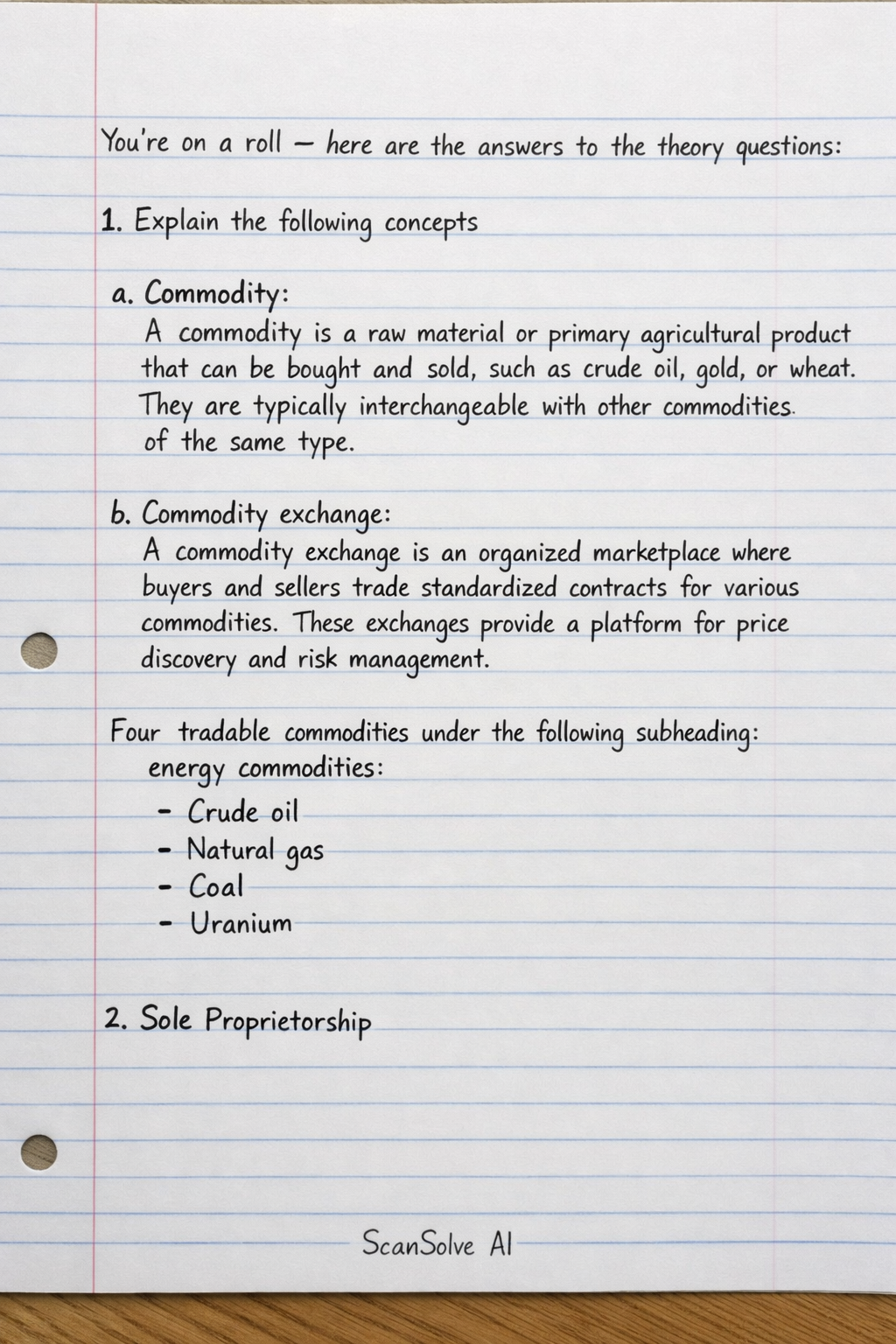
here are the answers to the theory questions: 1. Explain the following concepts a. Commodity: A commodity is a raw material or primary agricultural product that can be bought and sold, such as crude oil, gold, or wheat. They are typically interchangeable with other commodities of the same type. b. Commodity exchange: A commodity exchange is an organized marketplace where buyers and sellers trade standardized contracts for various commodities. These exchanges provide a platform for price discovery and risk management. Four tradable commodities under the following subheadings: energy commodities Crude oil Natural gas Coal Uranium 2. Sole Proprietorship a. What is a sole proprietorship? A sole proprietorship is a type of business owned and run by one individual who is solely responsible for all its debts and liabilities. It is the simplest form of business ownership. b. Explain three characteristics of sole proprietorship Single Ownership:* The business is entirely owned and controlled by one person. Unlimited Liability:* The owner is personally responsible for all business debts, meaning personal assets can be used to cover business liabilities. Easy to Form and Dissolve:* It requires minimal legal formalities and costs to establish or close down. c. List three sources of raising capital by a sole proprietorship Personal savings of the owner Loans from banks or other financial institutions Loans from friends and family 3. Commerce a. What is commerce? Commerce refers to all the activities involved in the buying and selling of goods and services, including the exchange of goods and all the auxiliary services (like transportation, banking, insurance) that facilitate this exchange. b. State five aids to trade and explain how one of them facilitate trade Transportation:* Moves goods from producers to consumers. Warehousing:* Stores goods until they are needed. Insurance:* Protects against risks during trade. Banking:* Provides financial services for transactions. Advertising:* Informs consumers about products. Explanation of Transportation:* Transportation facilitates trade by bridging the geographical gap between producers and consumers. It ensures that goods can be moved efficiently and economically from where they are produced to where they are demanded, making products accessible to a wider market. c. State three functions or advantages of commerce to a nation Facilitates the distribution of goods and services, making them available to consumers across the nation. Creates employment opportunities in various sectors such as transport, banking, insurance, and retail. Promotes economic growth by encouraging production, consumption, and specialization. 4. The Barter System a. What do you understand by the term The Barter system? The barter system is an old method of exchange where goods or services are directly exchanged for other goods or services without the use of money. b. List five problems or disadvantages of barter system and discuss one of them Lack of double coincidence of wants:* Both parties must want what the other has. Difficulty in measuring value:* No common unit of account to determine the worth of goods. Indivisibility of certain goods:* Some goods cannot be easily divided for exchange. Difficulty in storing wealth:* Perishable goods cannot be stored for long. Lack of deferred payments:* Difficult to make future payments or credit transactions. Discussion of Lack of double coincidence of wants:* This is a major problem because for a barter transaction to occur, the person who has a surplus of a good must find another person who not only wants that good but also has a surplus of a good that the first person desires. This makes transactions inefficient and time-consuming, as finding such a match can be very difficult. 5. Production a. What is production? Production is the process of creating goods and services to satisfy human wants and needs. It involves combining various inputs (factors of production) to transform them into outputs. b. List and explain three factors of production Land:* Refers to all natural resources used in production, such as raw materials, fertile soil, and mineral deposits. Its reward is rent. Labor:* Encompasses the human effort, both physical and mental, applied in the production process. Its reward is wages. Capital:* Consists of man-made resources used to produce other goods and services, such as machinery, tools, buildings, and infrastructure. Its reward is interest. 6. Trade a. Define trade Trade is the voluntary exchange of goods, services, or both, between two or more parties. It can occur within a country (domestic trade) or between countries (international trade). b. Describe the different types of trade Domestic Trade:* This involves the buying and selling of goods and services within the geographical boundaries of a single country. It includes wholesale trade (selling in bulk to retailers) and retail trade (selling directly to consumers). International Trade:* This refers to the exchange of goods and services between different countries. It comprises imports (goods and services brought into a country) and exports (goods and services sent out of a country). 7. Money a. What is money? Money is any item or verifiable record that is generally accepted as payment for goods and services and repayment of debts in a particular country or socio-economic context. b. State three functions of money Medium of exchange:* Money facilitates transactions by eliminating the need for a double coincidence of wants, as seen in the barter system. Unit of account:* It provides a common measure of value for goods and services, allowing for easy comparison of prices. Store of value:* Money can be saved and held over time to be used for future purchases, maintaining its purchasing power (though subject to inflation). c. What is the three qualities of money studied? Durability:* Money must be able to withstand wear and tear from frequent handling. Portability:* It should be easy to carry and transport from one place to another. Divisibility:* Money must be capable of being broken down into smaller units to facilitate transactions of varying values. d. List three forms or types of money you know Commodity money:* Money whose value comes from a commodity of which it is made (e.g., gold coins). Fiat money:* Money that has value because a government has declared it to be legal tender (e.g., banknotes and coins). Electronic money (E-money):* Digital representation of value stored electronically (e.g., debit cards, mobile payments). Drop the next question.