
We read your photo as:
What are the key components and structure of a professional report based on team observations?
ScanSolve AI Answer
Step-by-step solution
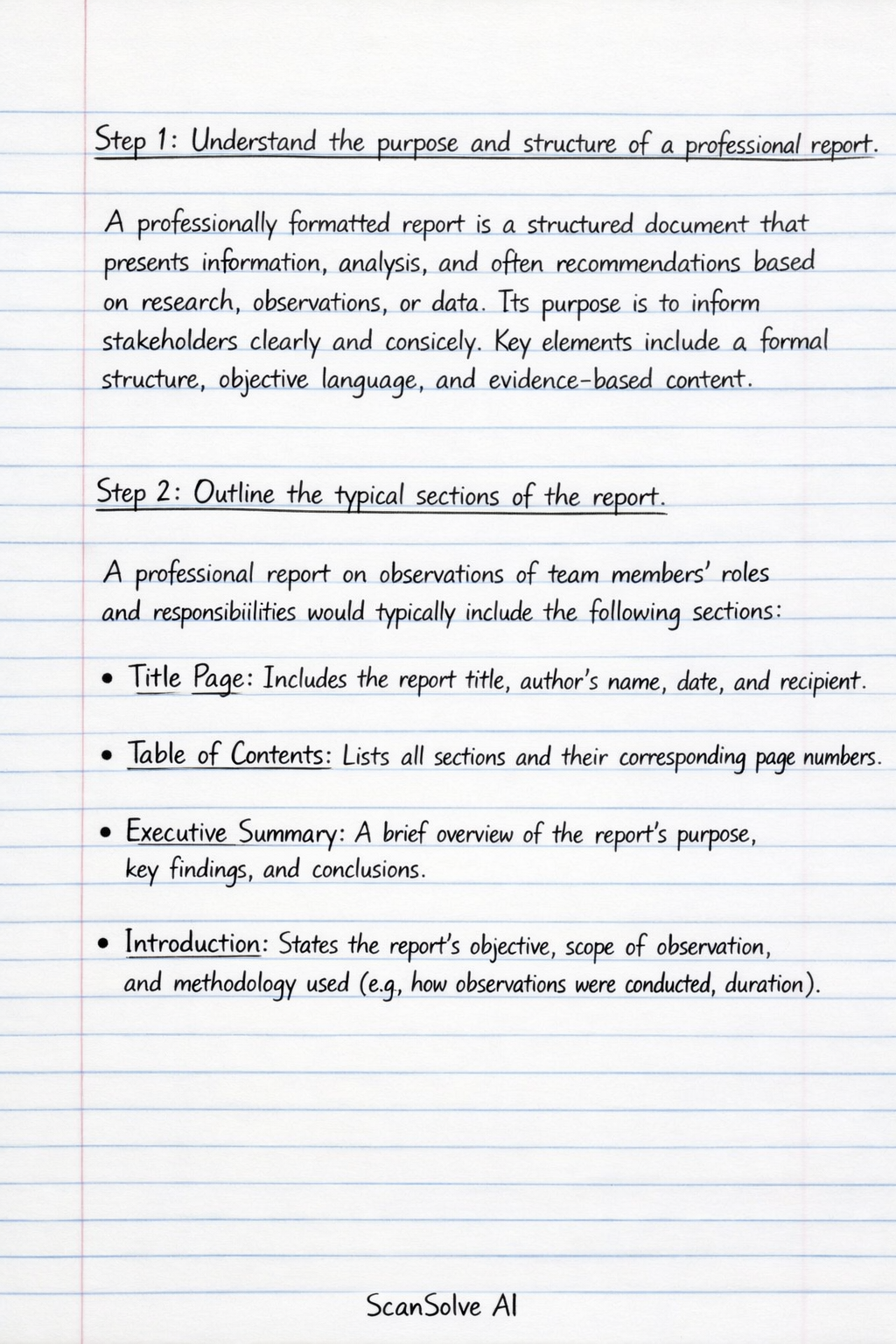
4 stepsUnderstand the purpose and structure of a professional report.
A professional formatted report is a structured document that presents information, analysis, and often recommendations based on research, observations, or data. Its purpose is to inform stakeholders clearly and concisely. Key elements include a formal structure, objective language, and evidence-based content.
Outline the typical sections of the report.
A professional report on observations of team members' roles and responsibilities would typically include the following sections:
- Title Page: Includes the report title, author's name, date, and recipient.
- Table of Contents: Lists all sections and their corresponding page numbers.
- Executive Summary: A brief overview of the report's purpose, key findings, and conclusions.
- Introduction: States the report's objective, scope of observation, and methodology used (e.g., how observations were conducted, duration).
- Findings/Observations: This is the core section where the observed roles and responsibilities of each team member are detailed.
- Analysis: Discusses the implications of the findings, such as efficiency, collaboration, or areas for improvement.
- Conclusion: Summarizes the main points derived from the observations.
- Recommendations: Suggests actions based on the findings and analysis to improve team performance or clarify roles.
- Appendices: Any supporting documents, such as observation checklists or interview transcripts.
Detail the content for "roles and responsibilities of the team members observed."
In the Findings/Observations section, for each team member or role observed, the report would:
- Identify the team member/role: Clearly state who was observed (e.g., "Team Lead," "Marketing Specialist," "Project Coordinator").
- Describe primary duties: Detail the main tasks and functions performed by that individual or role.
- Outline specific responsibilities: List the areas for which the individual is accountable, including decision-making authority, resource management, and outcomes.
- Note interactions and collaborations: Describe how the individual interacts with other team members, departments, or external parties.
- Document observed behaviors: Provide objective descriptions of how responsibilities are carried out, including communication styles, problem-solving approaches, and time management.
- Identify any discrepancies: Note any differences between stated roles/responsibilities and actual observed practices.
Emphasize professional formatting and language.
The report must adhere to professional formatting standards, including:
- Clear headings and subheadings: To organize content logically.
- Consistent formatting: For fonts, spacing, and bullet points.
- Objective and formal language: Avoid jargon, slang, or emotional language.
- Grammar and spelling accuracy: Proofread thoroughly.
- Data presentation: Use tables, charts, or bullet points to present complex information clearly.
Still stuck on this one?
Ask a follow-up, and the answer starts from this question.
More Business/Management Questions
Handwritten Step-by-Step Solution
Get this as a handwritten image on WhatsApp — like a tutor wrote it for you.
Try on WhatsApp