
We read your photo as:
True or False: A rail consignment note can be used as a contract of carriage between consignor and carrier but can not be negotiable.
ScanSolve AI Answer
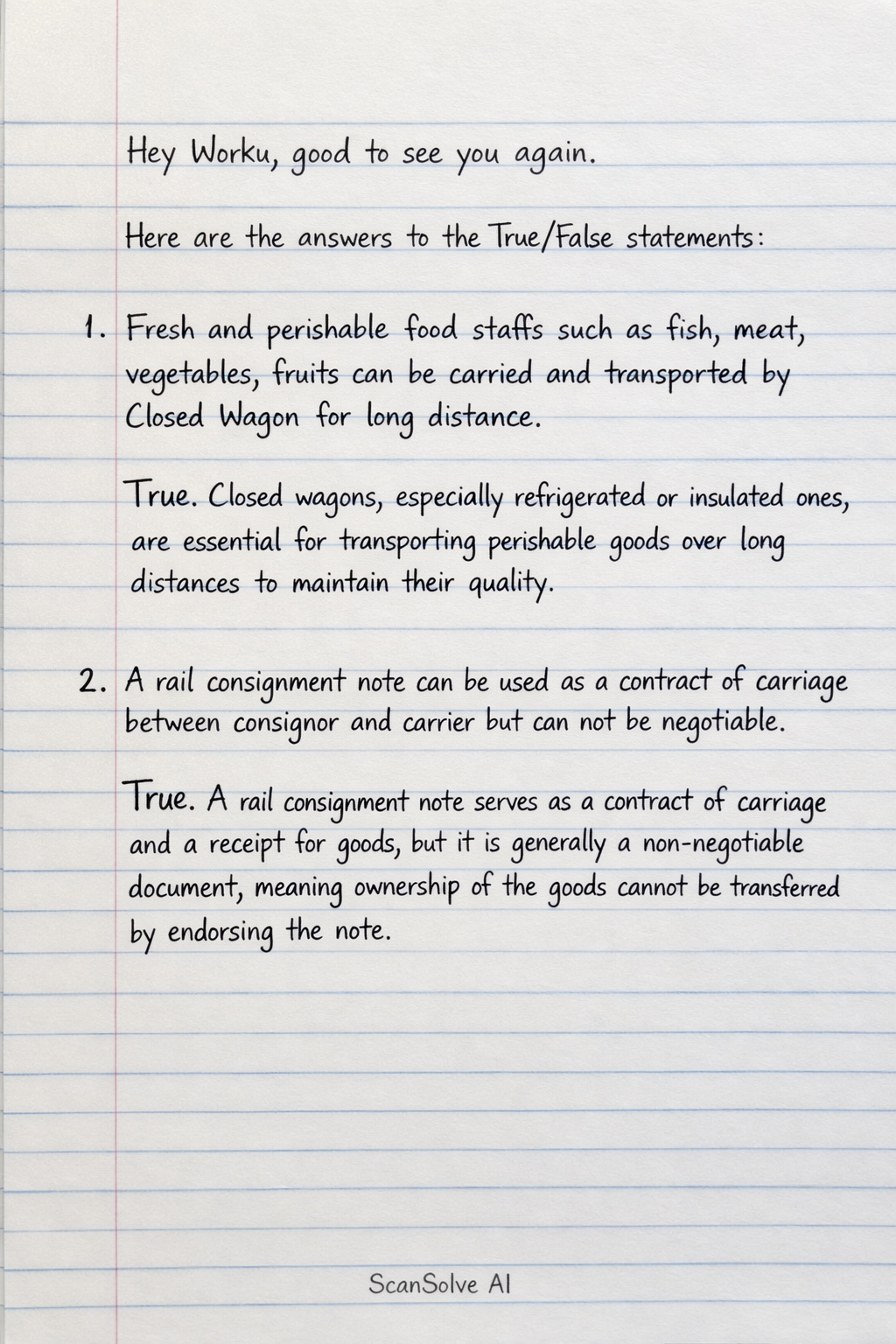
Here are the answers to the True/False statements:
-
Fresh and perishable food staffs such as fish, meat, vegetable, fruits can be carried and transported by Closed Wagon for long distance.
- True. Closed wagons, especially refrigerated or insulated ones, are essential for transporting perishable goods over long distances to maintain their quality.
-
A rail consignment note can be used as a contract of carriage between consignor and carrier but can not be negotiable.
- True. A rail consignment note serves as a contract of carriage and a receipt for goods, but it is generally a non-negotiable document, meaning ownership of the goods cannot be transferred by endorsing the note.
-
Liner train is train composition with frequent stops, where boxes are loaded and/or unloaded in a sequence of terminals A consignment note must be made for each wagon of heterogeneous type of cargo.
- False. A liner train (or block train) typically operates between two specific points without intermediate stops for loading or unloading. Trains with frequent stops are characteristic of other types of rail services.
-
The vast majority of railway lines in Africa link inland area with other inland areas & coastal areas.
- False. Historically, many railway lines in Africa were primarily built to connect resource-rich inland areas to coastal ports for export, rather than forming extensive inland-to-inland networks.
-
A consignment note must be made for each wagon of heterogeneous type of cargo.
- True. A consignment note is required for each distinct consignment. If a wagon carries a specific type of cargo that constitutes a separate consignment, then a consignment note is needed for that wagon's contents.
-
Intermodal transport is a system of transport whereby two or more modes of transport are used to transport the same loading unit or truck in an integrated manner, with loading or unloading goods in changing modes.
- False. A key characteristic of intermodal transport is that the loading unit (e.g., container, swap body) is transferred between modes without handling the goods themselves at the transshipment points. The goods remain sealed within the unit.
-
Couchette carriages that are used as comfortable place to sleep during the trip to driver is made available by accompanied transport.
- False. Couchette carriages are designed for passengers to sleep during a journey. Drivers of accompanied transport (where vehicles are transported by train) typically travel in separate passenger coaches or their own vehicle, not in couchettes specifically provided for them as part of the accompanied transport service.
-
The DIUM contains the railway distances between two internal stations of a country.
- True. The DIUM (Distance International Union of Railways) is a comprehensive publication that provides official railway distances, including those between internal stations within a country, which are often part of international routes or used for tariff calculations.
-
ETT tariff is a tariff that can be applied to rail freight traffic between two OS member countries but no need to transit via the territory of any other member country.
- True. The ETT (European Through Tariff) is designed for direct international rail freight traffic between member countries, without necessarily requiring transit through a third member country.
Still stuck on this one?
Ask a follow-up, and the answer starts from this question.
More Business/Management Questions
Handwritten Step-by-Step Solution
Get this as a handwritten image on WhatsApp — like a tutor wrote it for you.
Try on WhatsApp