
We read your photo as:
Worksheet on tanks and containers, including multiple choice, true/false, fill-in-the-blank, and short answer questions about tank types, safety standards, and hazards.
ScanSolve AI Answer
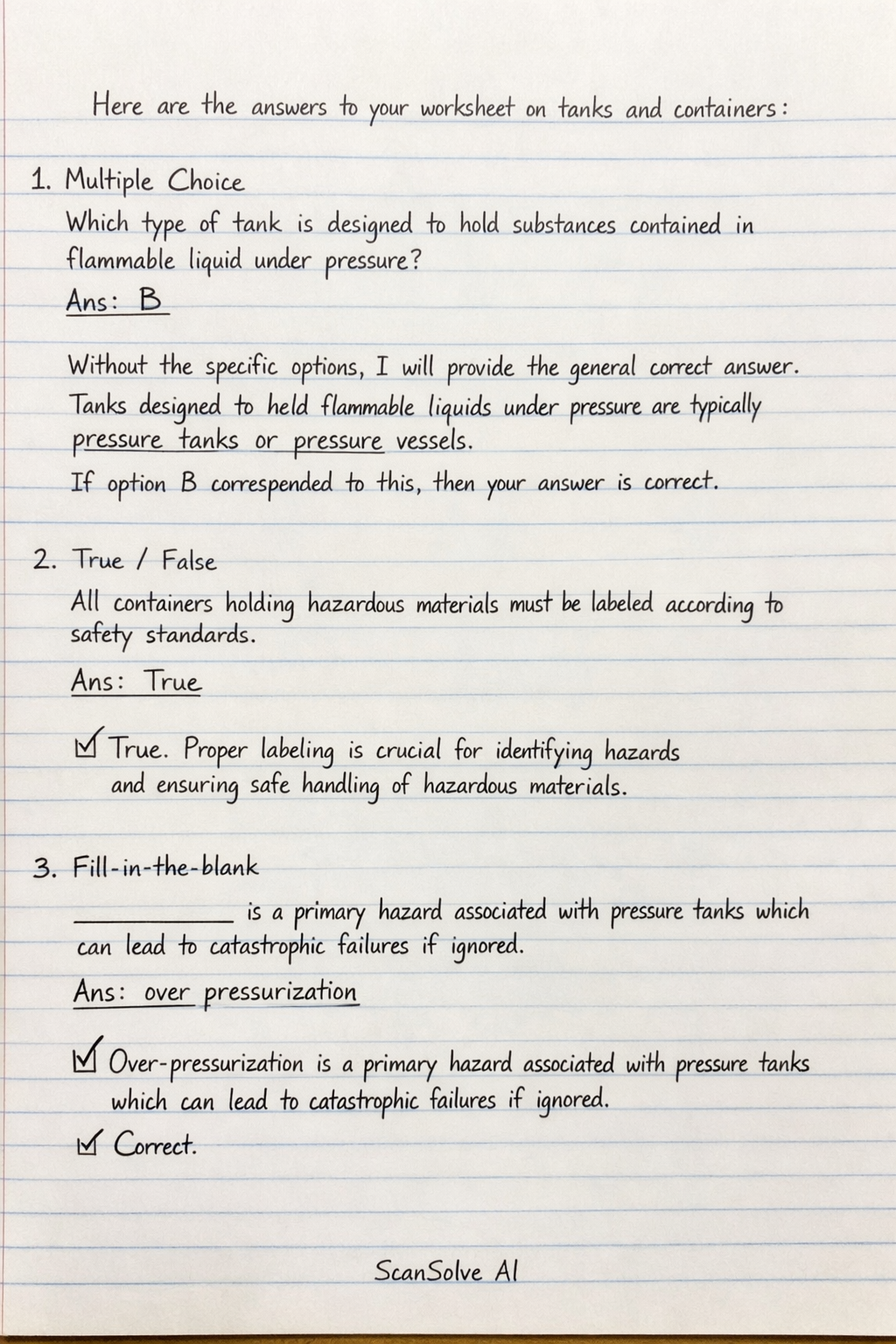
Here are the answers to your worksheet on tanks and containers:
1. Multiple Choice
Which type of tank is designed to hold substances contained in flammable liquid under pressure?
- Ans is = B Without the specific options, I will provide the general correct answer. Tanks designed to hold flammable liquids under pressure are typically pressure tanks or pressure vessels. If option B corresponded to this, then your answer is correct.
2. True / False
All containers holding hazardous materials must be labeled according to safety standards.
- Ans is = True ✅ True. Proper labeling is crucial for identifying hazards and ensuring safe handling of hazardous materials.
3. Fill-in-the-blank
________________________________ is a primary hazard associated with pressure tanks which can lead to catastrophic failures if ignored.
- Ans is = over pressurization Over-pressurization is a primary hazard associated with pressure tanks which can lead to catastrophic failures if ignored. ✅ Correct.
4. Short Answer
What are the key safety measures to observe when working with fumes and contaminants?
When working with fumes and contaminants, key safety measures include:
- Ensuring adequate ventilation (local exhaust ventilation or general dilution ventilation).
- Using appropriate Personal Protective Equipment (PPE), such as respirators, gloves, and eye protection.
- Conducting atmospheric monitoring to detect hazardous levels of fumes or contaminants.
- Following safe work procedures and material safety data sheet (MSDS) guidelines for handling and storage.
5. Read and explain (Scenario-Based)
You have noticed a small leak in a storage tank that contains flammable liquid. What steps should you take to address this issue?
If you notice a small leak in a storage tank containing flammable liquid, you should take the following steps:
- Step 1: Ensure Safety. Immediately ensure your own safety and the safety of others by moving away from the immediate vicinity of the leak if there's a risk of exposure or ignition. Do not attempt to stop the leak directly without proper training and equipment.
- Step 2: Alert and Report. Immediately report the leak to your supervisor, emergency services, or the designated safety personnel. Provide clear details about the location, size of the leak, and the type of liquid if known.
- Step 3: Isolate the Area. If safe to do so, isolate the area around the leak to prevent unauthorized access and potential ignition sources. This might involve setting up barriers or warning signs.
- Step 4: Contain the Spill. If possible and safe, try to contain the spilled liquid to prevent it from spreading, reaching drains, or contaminating the environment. Use absorbent materials, spill kits, or create temporary barriers.
- Step 5: Eliminate Ignition Sources. Ensure all potential ignition sources (e.g., open flames, sparks, electrical equipment) are removed or shut down in the vicinity of the leak to prevent a fire or explosion.
- Step 6: Await Professional Help. Do not attempt to repair the leak yourself unless you are specifically trained and authorized to do so. Wait for trained emergency responders or maintenance personnel to arrive and handle the situation.
Still stuck on this one?
Ask a follow-up, and the answer starts from this question.
More Business/Management Questions
Handwritten Step-by-Step Solution
Get this as a handwritten image on WhatsApp — like a tutor wrote it for you.
Try on WhatsApp