

This chemistry question involves key chemical concepts and calculations. The detailed solution below walks through each step, from identifying the reaction type to computing the final answer.
ScanSolve AI Answer
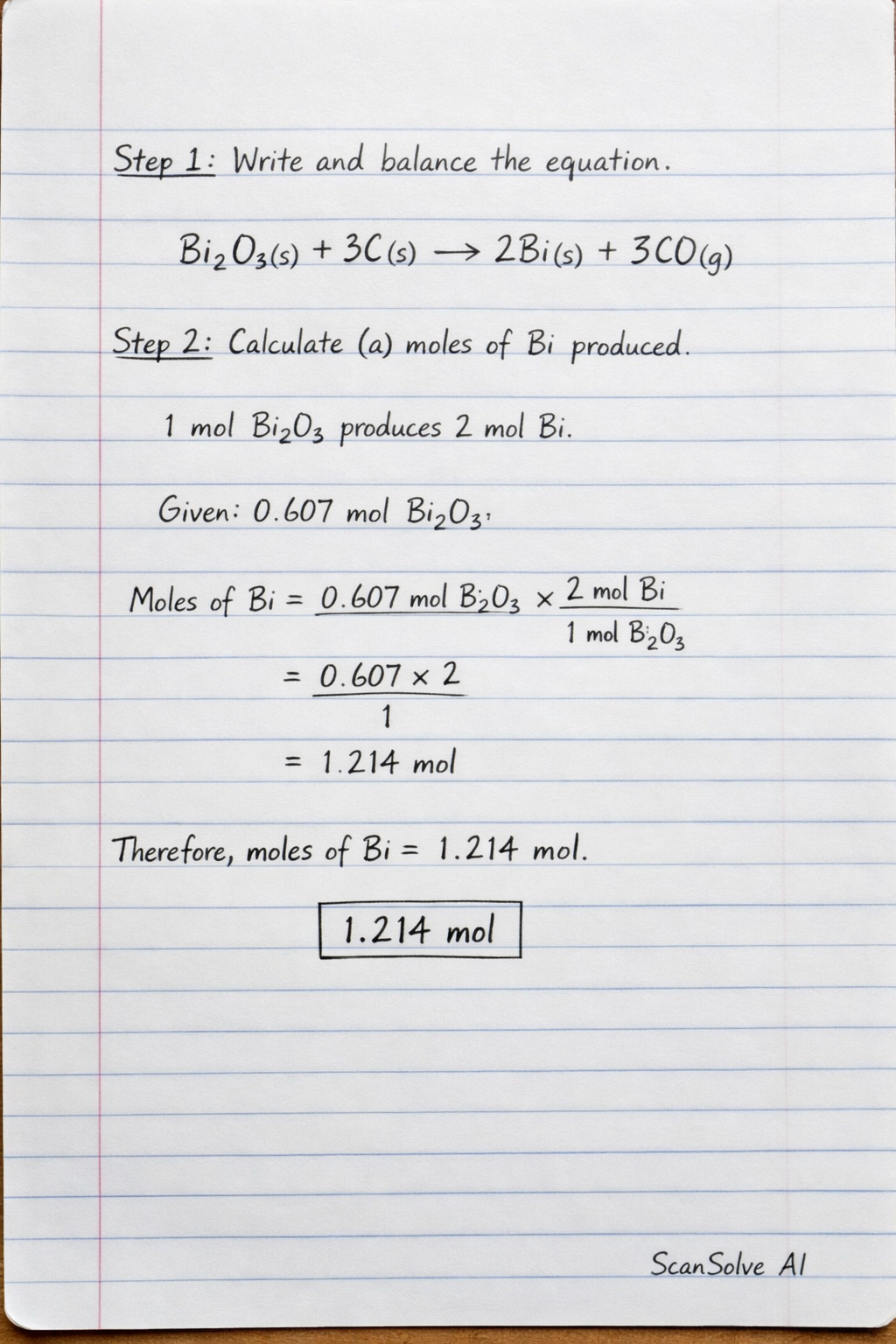
Here's the solution for the first problem at the top of the image. Problem: When 0.607 mol of Bi_2O_3 reacts with excess carbon, how many (a) moles of Bi and (b) grams of CO form? Step 1: Write and balance the chemical equation. The reaction involves bismuth(III) oxide (Bi_2O_3) reacting with carbon (C) to produce bismuth (Bi) and carbon monoxide (CO). Bi_2O_3(s) + 3C(s) → 2Bi(s) + 3CO(g) Step 2: Calculate (a) moles of Bi produced. From the balanced equation, 1 mole of Bi_2O_3 produces 2 moles of Bi. Given moles of Bi_2O_3 = 0.607 mol. Moles of Bi = (0.607 mol Bi_2O_3) × 2 mol Bi1 mol Bi_2O_3 Moles of Bi = 1.214 mol The number of moles of Bi formed is 1.214 mol. Step 3: Calculate (b) grams of CO formed. From the balanced equation, 1 mole of Bi_2O_3 produces 3 moles of CO. Moles of CO = (0.607 mol Bi_2O_3) × 3 mol CO1 mol Bi_2O_3 Moles of CO = 1.821 mol Step 4: Convert moles of CO to grams of CO. Molar mass of CO = Molar mass of C + Molar mass of O Molar mass of C ≈ 12.01 g/mol Molar mass of O ≈ 16.00 g/mol Molar mass of CO = 12.01 g/mol + 16.00 g/mol = 28.01 g/mol Mass of CO = Moles of CO × Molar mass of CO Mass of CO = 1.821 mol × 28.01 g/mol Mass of CO ≈ 51.006 g The mass of CO formed is 51.01 g. That's 2 down. 3 left today — send the next one.