
We read your photo as:
1.50 g of ethyl ethanoate was hydrolysed with 50.0 cm3 of 0.5 M NaOH solution and the mixture was made up to 250 cm3 with distilled water in a volumetric flask. Calculate: A: The number of moles of et
ScanSolve AI Answer
Step-by-step solution
12 stepsHere are the solutions for question 1(b):
1. (b) 1.50 g of ethyl ethanoate was hydrolysed with 50.0 cm of 0.5 M NaOH solution and the mixture was made up to 250 cm with distilled water in a volumetric flask.
A: The number of moles of ethyl ethanoate in 1.50 g. (RMM: CHCOOCH = 88)
Use the formula for moles.
Substitute the given values.
Round to an appropriate number of significant figures (e.g., 3 s.f.).
The number of moles of ethyl ethanoate is .
B: The number of moles of NaOH in 50 cm of 0.5 M solution.
Convert the volume from cm to dm.
Use the formula for moles in solution.
Substitute the given values.
The number of moles of NaOH is .
C: The percentage yield when 1.50 g of ethyl ethanoate reacts completely with sodium hydroxide to give 0.63 g of ethanol. (RAM: C=12.0, H=1.0, O=16.0, Na=23.0)
Write the balanced chemical equation for the hydrolysis of ethyl ethanoate.
From the equation, 1 mole of ethyl ethanoate produces 1 mole of ethanol.
Calculate the molar mass of ethanol (CHOH).
Determine the theoretical moles of ethanol produced from 1.50 g of ethyl ethanoate.
From part A, moles of ethyl ethanoate = 0.017045 mol.
Since the mole ratio is 1:1, theoretical moles of ethanol = 0.017045 mol.Calculate the theoretical mass of ethanol.
Calculate the percentage yield.
Given actual yield of ethanol = 0.63 g.
Round to an appropriate number of significant figures (e.g., 2 s.f.
based on 0.63 g).
The percentage yield is
\boxed{\text{80%}}.
Still stuck on this one?
Ask a follow-up, and the answer starts from this question.
More Chemistry Questions
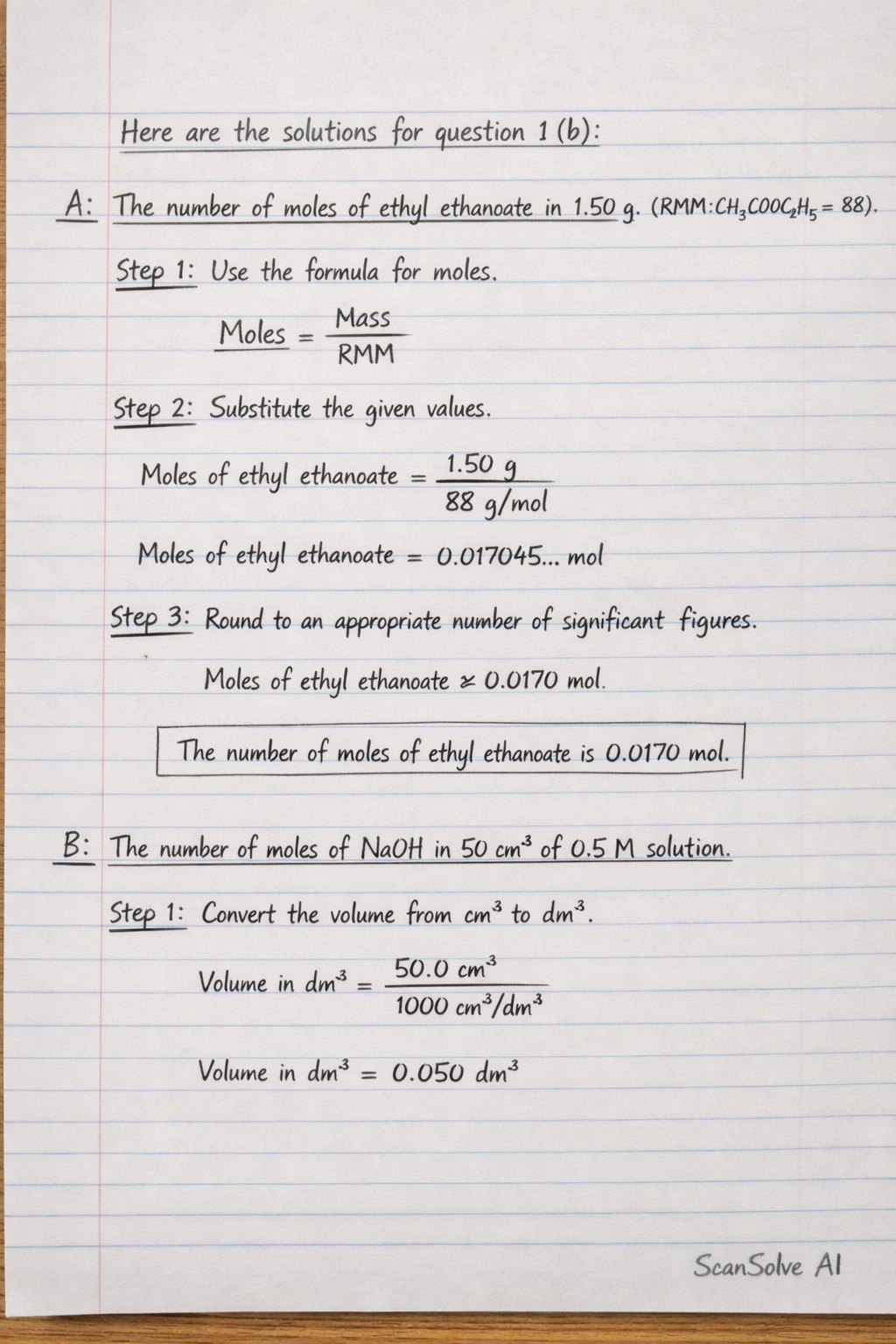
Handwritten Step-by-Step Solution
Get this as a handwritten image on WhatsApp — like a tutor wrote it for you.
Try on WhatsApp