
We read your photo as:
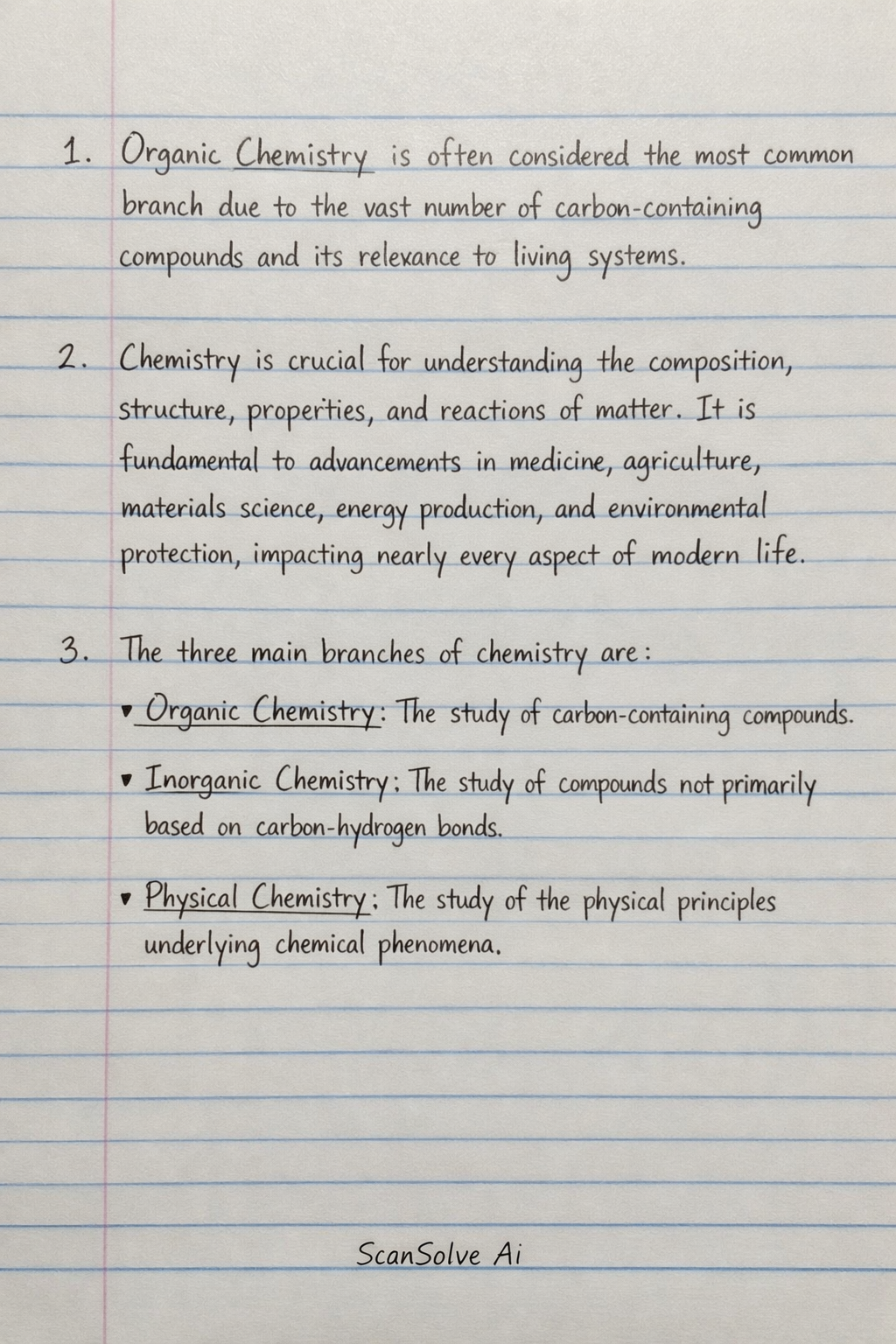
Organic Chemistry is often considered the most common branch due to the vast number of carbon-containing compounds and its relevance to living systems.
ScanSolve AI Answer
Here are the answers to the questions based on the image provided:
-
Organic Chemistry is often considered the most common branch due to the vast number of carbon-containing compounds and its relevance to living systems.
-
Chemistry is crucial for understanding the composition, structure, properties, and reactions of matter. It is fundamental to advancements in medicine, agriculture, materials science, energy production, and environmental protection, impacting nearly every aspect of modern life.
-
The three main branches of chemistry are:
- Organic Chemistry: The study of carbon-containing compounds.
- Inorganic Chemistry: The study of compounds not primarily based on carbon-hydrogen bonds.
- Physical Chemistry: The study of the physical principles underlying chemical phenomena.
-
Two ways chemistry is applied in the manufacturing industry are:
- Production of materials: Chemistry is essential for manufacturing plastics, polymers, metals, ceramics, and textiles with specific properties.
- Pharmaceuticals and drugs: The synthesis and development of medicines and vaccines rely entirely on chemical principles and processes.
-
a) Define some terms of chemistry:
- Element: A pure substance consisting only of atoms that all have the same numbers of protons in their atomic nuclei. Examples include oxygen (O) and iron (Fe).
- Compound: A substance formed when two or more different chemical elements are chemically bonded together in a fixed ratio. Examples include water () and carbon dioxide ().
b) Write short notes on writing chemical formulas:
Chemical formulas represent the types and numbers of atoms in a molecule or compound.- Use element symbols (e.g., H for hydrogen, O for oxygen).
- Use subscripts to indicate the number of atoms of each element (e.g., means two hydrogen atoms and one oxygen atom).
- For ionic compounds, the formula represents the simplest whole-number ratio of ions, ensuring the overall charge is neutral.
- Parentheses are used when a polyatomic ion is present more than once (e.g., ).
-
Define a term giving its observations and details: We will define Chemical Reaction.
- Chemical Reaction: A process that involves the rearrangement of the atomic structure of substances, resulting in the formation of new substances with different properties.
- Observations: Common observations include a change in color, the formation of a precipitate (solid), the evolution of gas (bubbles), a change in temperature (heat absorbed or released), or the emission of light.
- Details: Chemical reactions involve reactants transforming into products. They are often represented by chemical equations, which show the initial substances (reactants) and the final substances (products), along with their stoichiometric ratios and physical states. Energy changes (exothermic or endothermic) are also key details.
Still stuck on this one?
Ask a follow-up, and the answer starts from this question.
More Chemistry Questions
Handwritten Step-by-Step Solution
Get this as a handwritten image on WhatsApp — like a tutor wrote it for you.
Try on WhatsApp