This chemistry question involves key chemical concepts and calculations. The detailed solution below walks through each step, from identifying the reaction type to computing the final answer.
ScanSolve AI Answer
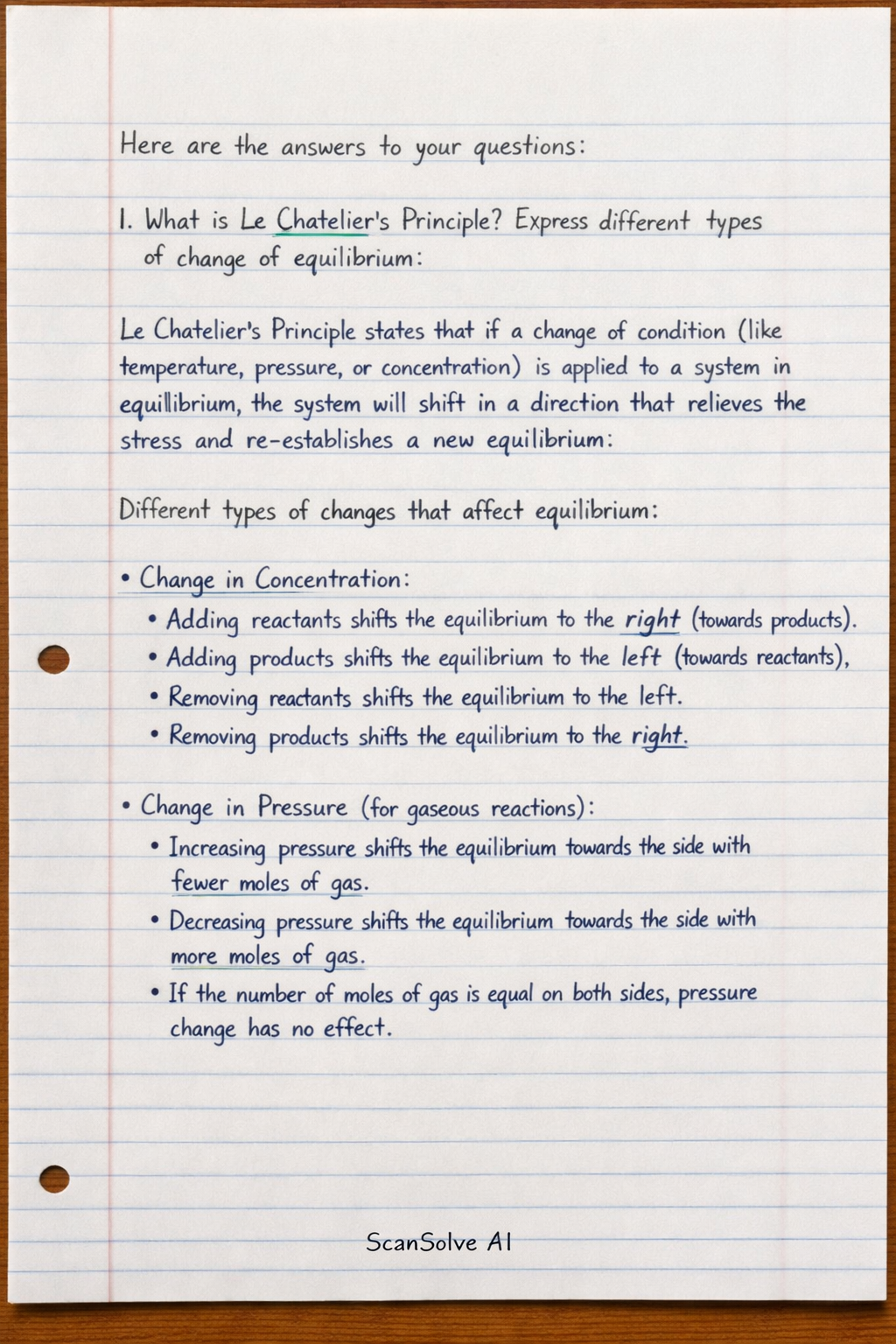
Here are the answers to your questions:
1. What is Le Chatelier's Principle? Express different types of change of equilibrium.
Le Chatelier's Principle states that if a change of condition (like temperature, pressure, or concentration) is applied to a system in equilibrium, the system will shift in a direction that relieves the stress and re-establishes a new equilibrium.
Different types of changes that affect equilibrium:
Change in Concentration:
Adding reactants shifts the equilibrium to the right* (towards products).
Adding products shifts the equilibrium to the left* (towards reactants).
Removing reactants shifts the equilibrium to the left*.
Removing products shifts the equilibrium to the right*.
Change in Pressure (for gaseous reactions):
Increasing pressure shifts the equilibrium towards the side with fewer moles of gas*.
Decreasing pressure shifts the equilibrium towards the side with more moles of gas*.
If the number of moles of gas is equal on both sides, pressure change has no effect.
Change in Temperature:
For an endothermic reaction ($\Delta H > 0$), increasing temperature shifts the equilibrium to the right (favors products). Decreasing temperature shifts it to the left*.
For an exothermic reaction ($\Delta H < 0$), increasing temperature shifts the equilibrium to the left (favors reactants). Decreasing temperature shifts it to the right*.
Addition of an Inert Gas: Adding an inert gas at constant volume has no effect on the equilibrium position. Adding an inert gas at constant pressure increases the total volume, which is equivalent to decreasing the partial pressures of all reactants and products, shifting the equilibrium towards the side with more moles of gas*.
Addition of a Catalyst: A catalyst does not shift* the equilibrium position. It only increases the rate at which equilibrium is achieved by lowering the activation energy for both forward and reverse reactions equally.
2. What is Ostwald's Dilution Law? Express the derivation.
Ostwald's Dilution Law relates the dissociation constant of a weak electrolyte to its degree of dissociation and concentration. It states that for a weak electrolyte, the degree of dissociation is inversely proportional to the square root of its concentration.
Derivation for a weak acid (HA):
Consider the dissociation of a weak acid HA in water:
$$ \text{HA} (aq) \rightleftharpoons \text{H}^+ (aq) + \text{A}^- (aq) $$
Let the initial concentration of the weak acid be $C$ mol/L.
Let $\alpha$ be the degree of dissociation.
Initial concentrations:
$$ [\text{HA}] = C $$
$$ [\text{H}^+] = 0 $$
$$ [\text{A}^-] = 0 $$
At equilibrium:
$$ [\text{HA}] = C(1 - \alpha) $$
$$ [\text{H}^+] = C\alpha $$
$$ [\text{A}^-] = C\alpha $$
The acid dissociation constant, $K_a$, is given by:
$$ K_a = \frac{[\text{H}^+][\text{A}^-]}{[\text{HA}]} $$
Substitute the equilibrium concentrations:
$$ K_a = \frac{(C\alpha)(C\alpha)}{C(1 - \alpha)} $$
$$ K_a = \frac{C^2\alpha^2}{C(1 - \alpha)} $$
$$ K_a = \frac{C\alpha^2}{1 - \alpha} $$
For very weak acids, $\alpha$ is very small compared to 1, so $1 - \alpha \approx 1$.
Therefore, the equation simplifies to:
$$ K_a \approx C\alpha^2 $$
Rearranging for $\alpha$:
$$ \alpha^2 \approx \frac{K_a}{C} $$
$$ \alpha \approx \sqrt{\frac{K_a}{C}} $$
This is Ostwald's Dilution Law. It shows that the degree of dissociation ($\alpha$) of a weak electrolyte increases upon dilution (as $C$ decreases).
3. What is physical and chemical equilibrium? What are the properties of equilibrium?
Physical Equilibrium: This type of equilibrium involves a reversible process where only the physical state of a substance changes, but its chemical composition remains the same.
Example:* Ice melting into water in a closed container at $0^\circ\text{C}$ and 1 atm pressure. The rate of melting of ice equals the rate of freezing of water.
$$ \text{H}_2\text{O} (s) \rightleftharpoons \text{H}_2\text{O} (l) $$
Chemical Equilibrium: This type of equilibrium involves a reversible chemical reaction where the rates of the forward and reverse reactions become equal, and the concentrations of reactants and products remain constant over time.
Example:* The Haber process for ammonia synthesis.
$$ \text{N}_2 (g) + 3\text{H}_2 (g) \rightleftharpoons 2\text{NH}_3 (g) $$
Properties of Equilibrium:
Dynamic Nature: Equilibrium is dynamic, meaning that the forward and reverse processes continue to occur at equal rates, even though macroscopic properties appear constant.
Constant Macroscopic Properties: At equilibrium, observable properties like concentration, pressure, temperature, density, and color remain constant over time.
Attainable from Either Direction: Equilibrium can be reached starting from either the reactants or the products.
Requires a Closed System: For most systems, equilibrium can only be established in a closed system where no matter can enter or leave.
Catalyst Does Not Affect Equilibrium Position: A catalyst only speeds up the attainment of equilibrium but does not change the equilibrium concentrations of reactants and products.
Temperature Dependence: The position of equilibrium is dependent on temperature. The equilibrium constant ($K$) changes with temperature.
4. What is equilibrium? What express the states of equilibrium?
What is equilibrium?
Equilibrium is a state in a reversible process where the rates of the forward and reverse processes are equal, resulting in no net change in the concentrations of reactants and products (for chemical equilibrium) or the amounts of different phases (for physical equilibrium) over time. It is a state of balance.
What express the states of equilibrium?
The "states of equilibrium" refer to the conditions or characteristics that define a system at equilibrium. These are essentially the properties of equilibrium mentioned in question 3:
Constant Macroscopic Properties: The system's observable properties (like concentration, pressure, temperature, color, density) remain constant.
Dynamic Balance: The forward and reverse processes are occurring continuously at equal rates.
Equilibrium Constant ($K$): For chemical equilibrium, the ratio of product concentrations to reactant concentrations (each raised to the power of their stoichiometric coefficients) is constant at a given temperature. This constant, $K$, quantifies the extent of the reaction at equilibrium.
Minimum Gibbs Free Energy: At constant temperature and pressure, a system reaches equilibrium when its Gibbs free energy ($\Delta G$) is at a minimum, and $\Delta G = 0$ for the reaction.
Q
1. What is Le Chatelier's Principle? Express different types of change of equilibrium.
|Chemistry
1. What is Le Chatelier's Principle? Express different types of change of equilibrium.
ScanSolve AI Answer
Here are the answers to your questions:
1. What is Le Chatelier's Principle? Express different types of change of equilibrium.
Le Chatelier's Principle states that if a change of condition (like temperature, pressure, or concentration) is applied to a system in equilibrium, the system will shift in a direction that relieves the stress and re-establishes a new equilibrium.
Different types of changes that affect equilibrium:
Change in Concentration:
Adding reactants shifts the equilibrium to the right (towards products).
Adding products shifts the equilibrium to the left (towards reactants).
Removing reactants shifts the equilibrium to the left.
Removing products shifts the equilibrium to the right.
Change in Pressure (for gaseous reactions):
Increasing pressure shifts the equilibrium towards the side with fewer moles of gas.
Decreasing pressure shifts the equilibrium towards the side with more moles of gas.
If the number of moles of gas is equal on both sides, pressure change has no effect.
Change in Temperature:
For an endothermic reaction (ΔH>0), increasing temperature shifts the equilibrium to the right (favors products). Decreasing temperature shifts it to the left.
For an exothermic reaction (ΔH<0), increasing temperature shifts the equilibrium to the left (favors reactants). Decreasing temperature shifts it to the right.
Addition of an Inert Gas: Adding an inert gas at constant volume has no effect on the equilibrium position. Adding an inert gas at constant pressure increases the total volume, which is equivalent to decreasing the partial pressures of all reactants and products, shifting the equilibrium towards the side with more moles of gas.
Addition of a Catalyst: A catalyst does not shift the equilibrium position. It only increases the rate at which equilibrium is achieved by lowering the activation energy for both forward and reverse reactions equally.
2. What is Ostwald's Dilution Law? Express the derivation.
Ostwald's Dilution Law relates the dissociation constant of a weak electrolyte to its degree of dissociation and concentration. It states that for a weak electrolyte, the degree of dissociation is inversely proportional to the square root of its concentration.
Derivation for a weak acid (HA):
Consider the dissociation of a weak acid HA in water:
HA(aq)⇌H+(aq)+A−(aq)
Let the initial concentration of the weak acid be C mol/L.
Let α be the degree of dissociation.
Initial concentrations:
[HA]=C[H+]=0[A−]=0
At equilibrium:
[HA]=C(1−α)[H+]=Cα[A−]=Cα
The acid dissociation constant, Ka, is given by:
Ka=[HA][H+][A−]
Substitute the equilibrium concentrations:
Ka=C(1−α)(Cα)(Cα)Ka=C(1−α)C2α2Ka=1−αCα2
For very weak acids, α is very small compared to 1, so 1−α≈1.
Therefore, the equation simplifies to:
Ka≈Cα2
Rearranging for α:
α2≈CKaα≈CKa
This is Ostwald's Dilution Law. It shows that the degree of dissociation (α) of a weak electrolyte increases upon dilution (as C decreases).
3. What is physical and chemical equilibrium? What are the properties of equilibrium?
Physical Equilibrium: This type of equilibrium involves a reversible process where only the physical state of a substance changes, but its chemical composition remains the same.
Example: Ice melting into water in a closed container at 0∘C and 1 atm pressure. The rate of melting of ice equals the rate of freezing of water.
H2O(s)⇌H2O(l)
Chemical Equilibrium: This type of equilibrium involves a reversible chemical reaction where the rates of the forward and reverse reactions become equal, and the concentrations of reactants and products remain constant over time.
Example: The Haber process for ammonia synthesis.
N2(g)+3H2(g)⇌2NH3(g)
Properties of Equilibrium:
Dynamic Nature: Equilibrium is dynamic, meaning that the forward and reverse processes continue to occur at equal rates, even though macroscopic properties appear constant.
Constant Macroscopic Properties: At equilibrium, observable properties like concentration, pressure, temperature, density, and color remain constant over time.
Attainable from Either Direction: Equilibrium can be reached starting from either the reactants or the products.
Requires a Closed System: For most systems, equilibrium can only be established in a closed system where no matter can enter or leave.
Catalyst Does Not Affect Equilibrium Position: A catalyst only speeds up the attainment of equilibrium but does not change the equilibrium concentrations of reactants and products.
Temperature Dependence: The position of equilibrium is dependent on temperature. The equilibrium constant (K) changes with temperature.
4. What is equilibrium? What express the states of equilibrium?
What is equilibrium?
Equilibrium is a state in a reversible process where the rates of the forward and reverse processes are equal, resulting in no net change in the concentrations of reactants and products (for chemical equilibrium) or the amounts of different phases (for physical equilibrium) over time. It is a state of balance.
What express the states of equilibrium?
The "states of equilibrium" refer to the conditions or characteristics that define a system at equilibrium. These are essentially the properties of equilibrium mentioned in question 3:
Dynamic Balance: The forward and reverse processes are occurring continuously at equal rates.
Equilibrium Constant (K): For chemical equilibrium, the ratio of product concentrations to reactant concentrations (each raised to the power of their stoichiometric coefficients) is constant at a given temperature. This constant, K, quantifies the extent of the reaction at equilibrium.
Minimum Gibbs Free Energy: At constant temperature and pressure, a system reaches equilibrium when its Gibbs free energy (ΔG) is at a minimum, and ΔG=0 for the reaction.
Need help with your own homework?
Get instant step-by-step solutions to any question. Free to start.