

This chemistry question involves key chemical concepts and calculations. The detailed solution below walks through each step, from identifying the reaction type to computing the final answer.
ScanSolve AI Answer
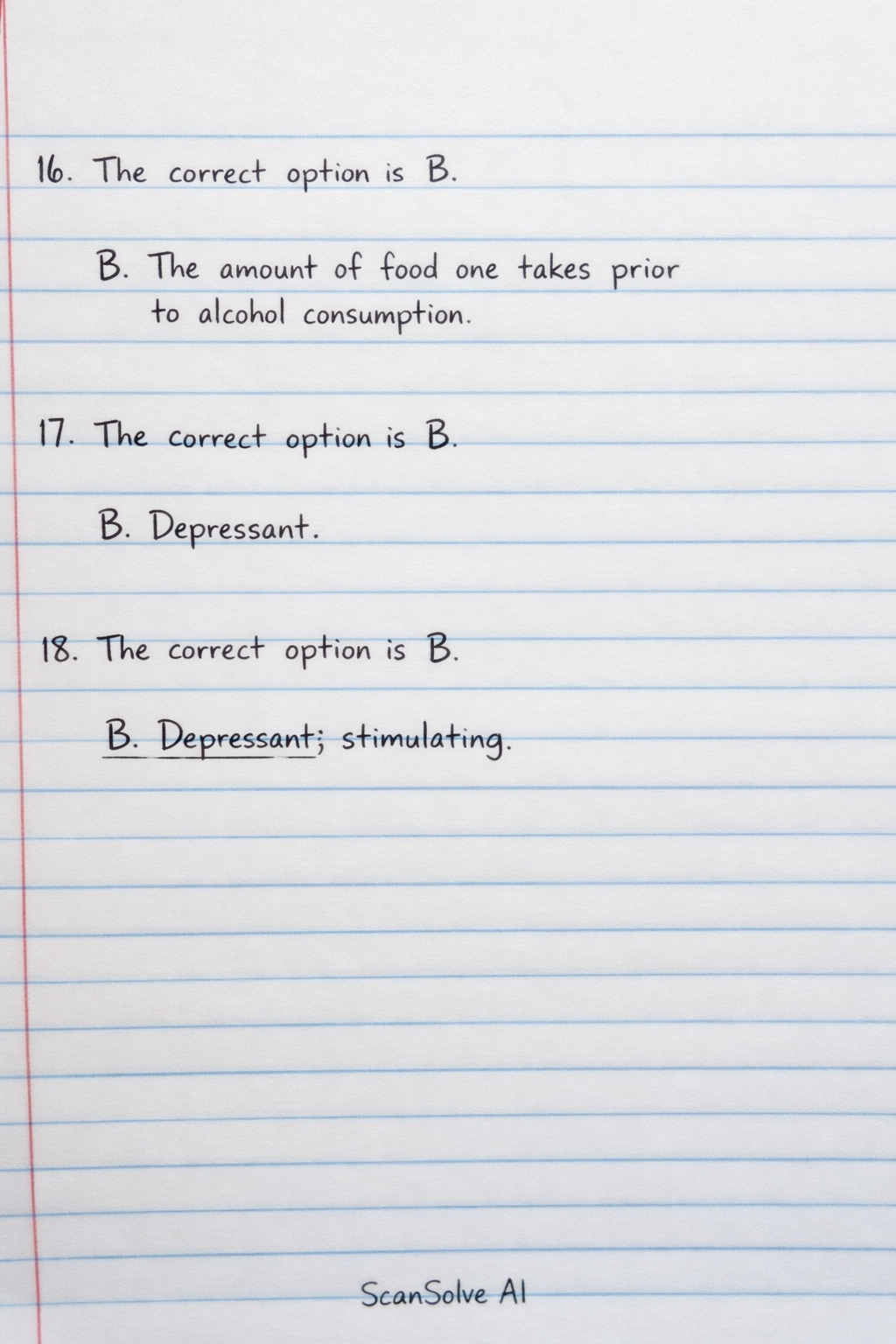
16. The removal of alcohol from the body is primarily dependent on the amount of alcohol dehydrogenase (the enzyme that metabolizes alcohol) and the proportion of body fat (which affects distribution). The gender of the consumer also plays a role due to differences in enzyme activity and body composition. The amount of food consumed prior to alcohol consumption affects the rate of absorption, but not the rate of removal once absorbed and metabolized. The correct option is B. B. The amount of food one takes prior to alcohol consumption 17. Alcohol is classified as a depressant because it slows down the central nervous system, leading to reduced brain activity, impaired coordination, and sedation. The correct option is B. B. Depressant 18. Alcohol is a depressant, but its initial effects can often feel stimulating due to its disinhibiting properties, which can lead to increased talkativeness and a sense of euphoria before the more pronounced depressant effects take over. The correct option is B. B. Depressant; stimulating 19. Blood Alcohol Level (BAL) is typically calculated as the number of milligrams of alcohol present in 100 millilitres of blood. This is often expressed as a percentage (e.g., 0.08% BAL means 80 mg of alcohol per 100 mL of blood). The correct option is C. C. Milligrams of alcohol are present in 100 millilitres of blood 20. Alcohol begins to significantly affect driving ability at a Blood Alcohol Level (BAL) of .02%. While legal limits for driving under the influence are often higher (e.g., .08% in many places), impairment in judgment, coordination, and reaction time can begin at much lower BALs. The correct option is B. B. .02