
We read your photo as:
2.1.1 A DNA molecule is a double helix structure. It consists of two polynucleotide strands coiled around each other. Each strand has a sugar-phosphate backbone* and nitrogenous bases (aden
ScanSolve AI Answer
Step-by-step solution
4 steps-
2.1.1 A DNA molecule is a double helix structure. It consists of two polynucleotide strands coiled around each other. Each strand has a sugar-phosphate backbone and nitrogenous bases (adenine, guanine, cytosine, and thymine) projecting inwards. The two strands are held together by hydrogen bonds between complementary base pairs: adenine (A) pairs with thymine (T), and guanine (G) pairs with cytosine (C).
-
2.1.2 DNA is suited as a carrier of the genetic code because its double helix structure provides stability, protecting the genetic information. The sequence of its nitrogenous bases forms the genetic code, allowing for a vast amount of information to be stored. Its ability to unzip and replicate ensures accurate transmission of genetic information to daughter cells.
-
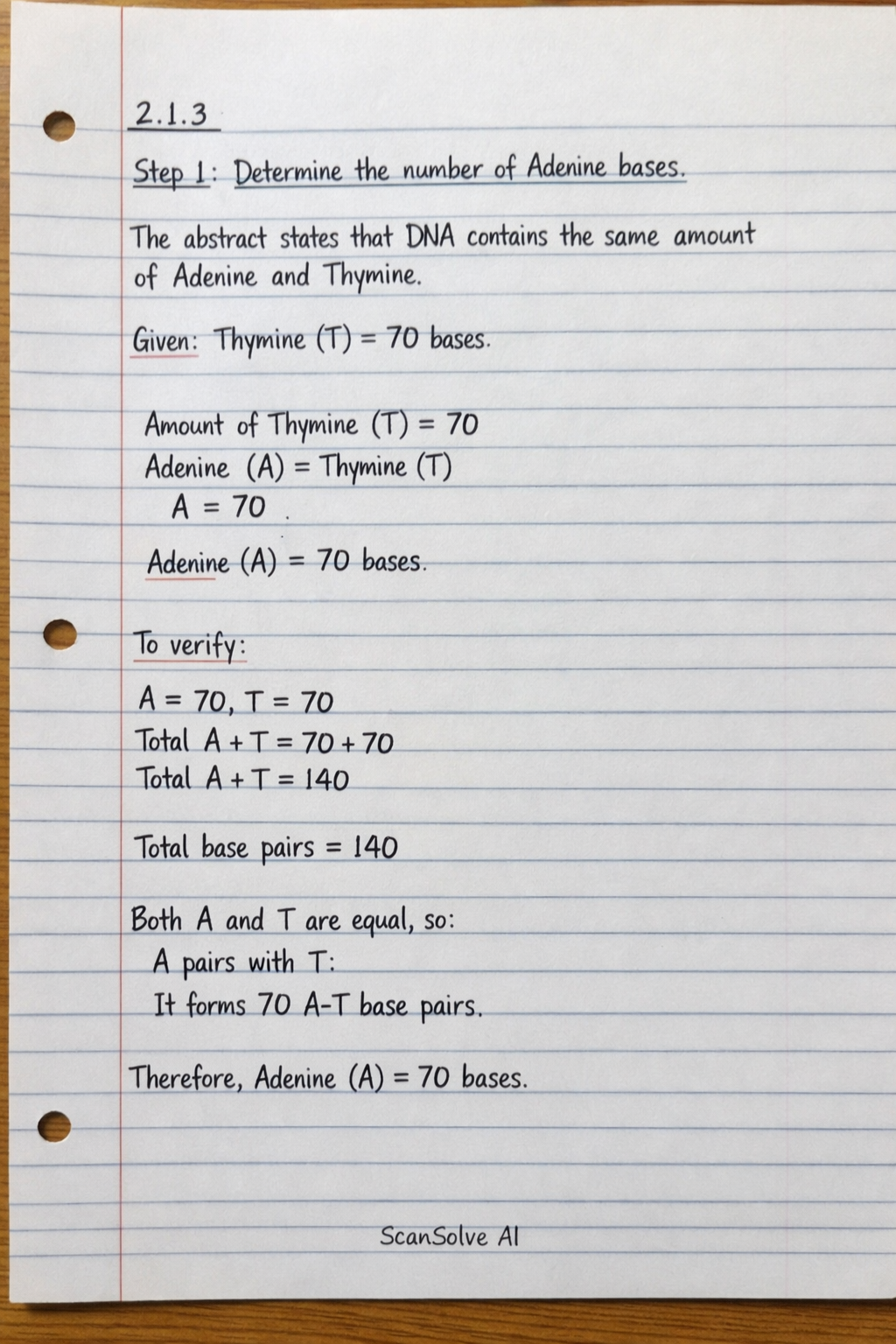
2.1.3
Determine the number of Adenine bases.
The abstract states that DNA contains the same amount of Adenine and Thymine.
Given Thymine (T) = 70 bases.
Therefore, Adenine (A) = 70 bases.Calculate the total number of Adenine and Thymine bases.
Total A + T = 70 + 70 = 140 bases.
Calculate the remaining bases, which must be Guanine and Cytosine.
Total bases = 270.
Total G + C = Total bases - (A + T)
Total G + C = 270 - 140 = 130 bases.Determine the number of Guanine bases.
The abstract states that DNA contains the same amount of Cytosine to Guanine.
Therefore, Guanine (G) = Cytosine (C).
G = (Total G + C) / 2
G = 130 / 2 = 65 bases.The sample contains 65 bases of Guanine. This is explained by Chargaff's rules, mentioned in the abstract, which state that the amount of Adenine equals Thymine, and the amount of Guanine equals Cytosine.
Still stuck on this one?
Ask a follow-up, and the answer starts from this question.
More Chemistry Questions
Handwritten Step-by-Step Solution
Get this as a handwritten image on WhatsApp — like a tutor wrote it for you.
Try on WhatsApp