We read your photo as:

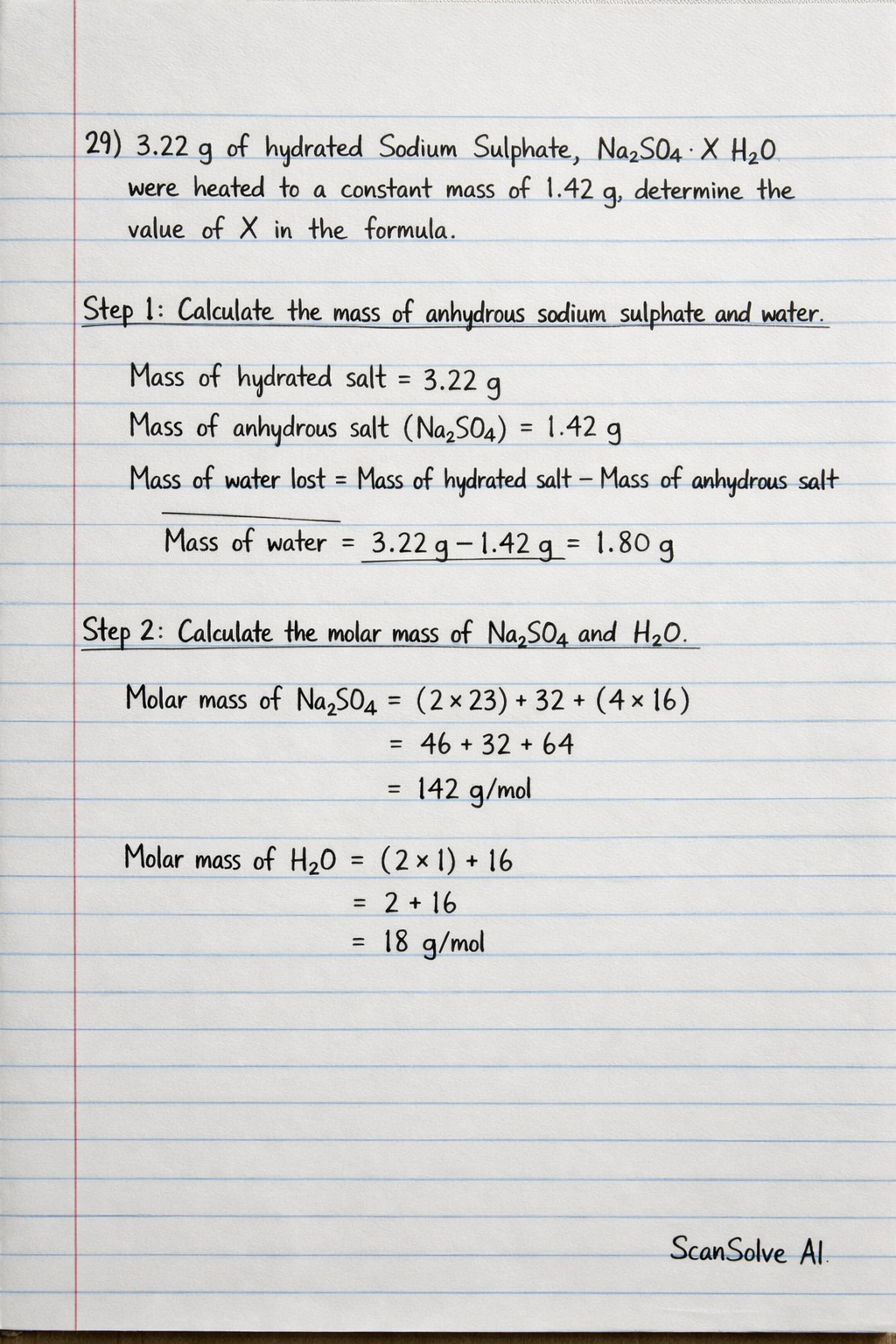
22g of hydrated Sodium Sulphate, Na2SO4 · X H2O were heated to a constant mass of 1.42g, determine the value of X in the formula.

Chemistry

ScanSolve AI Answer

Answer

10

23 g/mol23 \text{ g/mol}

Step-by-step solution

9 steps

29) 3.22g of hydrated Sodium Sulphate, Na2SO4⋅X H2O\text{Na}_2\text{SO}_4 \cdot \text{X H}_2\text{O} were heated to a constant mass of 1.42g, determine the value of X in the formula. (Na=23,S=32,O=16,H=1\text{Na} = 23, \text{S} = 32, \text{O} = 16, \text{H} = 1).

  1. Calculate the mass of anhydrous sodium sulphate and water.

    Mass of hydrated salt = 3.22 g3.22 \text{ g}
    Mass of anhydrous salt (Na2SO4\text{Na}_2\text{SO}_4) = 1.42 g1.42 \text{ g}
    Mass of water lost = Mass of hydrated salt - Mass of anhydrous salt

    Mass of water=3.22 g−1.42 g=1.80 g\text{Mass of water} = 3.22 \text{ g} - 1.42 \text{ g} = 1.80 \text{ g}
  2. Calculate the molar mass of Na2SO4\text{Na}_2\text{SO}_4 and H2O\text{H}_2\text{O}.

    Molar mass of Na2SO4=(2×23)+32+(4×16)=46+32+64=142 g/mol\text{Na}_2\text{SO}_4 = (2 \times 23) + 32 + (4 \times 16) = 46 + 32 + 64 = 142 \text{ g/mol}
    Molar mass of H2O=(2×1)+16=18 g/mol\text{H}_2\text{O} = (2 \times 1) + 16 = 18 \text{ g/mol}

  3. Calculate the moles of anhydrous sodium sulphate and water.

    Moles of Na2SO4=MassMolar mass=1.42 g142 g/mol=0.01 mol\text{Na}_2\text{SO}_4 = \frac{\text{Mass}}{\text{Molar mass}} = \frac{1.42 \text{ g}}{142 \text{ g/mol}} = 0.01 \text{ mol}
    Moles of H2O=MassMolar mass=1.80 g18 g/mol=0.1 mol\text{H}_2\text{O} = \frac{\text{Mass}}{\text{Molar mass}} = \frac{1.80 \text{ g}}{18 \text{ g/mol}} = 0.1 \text{ mol}

  4. Determine the mole ratio to find X.

    Ratio of moles H2O\text{H}_2\text{O} : moles Na2SO4\text{Na}_2\text{SO}_4

    0.1 mol0.01 mol=10\frac{0.1 \text{ mol}}{0.01 \text{ mol}} = 10

    Therefore, X=10\text{X} = \boxed{10}.

    30) 20 cm3\text{cm}^3 of 2 M Sulphuric (IV) acid reacted completely with 3.2 g of WOH (O=16,H=1\text{O}=16, \text{H}=1) Calculate the R.A.M of W in the formula WOH.

  5. Write the balanced chemical equation.

    Sulphuric (IV) acid is H2SO3\text{H}_2\text{SO}_3. Assuming WOH is a monobasic hydroxide, the reaction is:

    2WOH(aq)+H2SO3(aq)→W2SO3(aq)+2H2O(l)2\text{WOH}(aq) + \text{H}_2\text{SO}_3(aq) \rightarrow \text{W}_2\text{SO}_3(aq) + 2\text{H}_2\text{O}(l)
  6. Calculate the moles of H2SO3\text{H}_2\text{SO}_3.

    Volume of H2SO3=20 cm3=0.020 L\text{H}_2\text{SO}_3 = 20 \text{ cm}^3 = 0.020 \text{ L}
    Molarity of H2SO3=2 M\text{H}_2\text{SO}_3 = 2 \text{ M}

    Moles of H2SO3=Molarity×Volume=2 mol/L×0.020 L=0.04 mol\text{Moles of H}_2\text{SO}_3 = \text{Molarity} \times \text{Volume} = 2 \text{ mol/L} \times 0.020 \text{ L} = 0.04 \text{ mol}
  7. Calculate the moles of WOH using the mole ratio from the balanced equation.

    From the equation, 1 mole of H2SO3\text{H}_2\text{SO}_3 reacts with 2 moles of WOH.

    Moles of WOH=2×Moles of H2SO3=2×0.04 mol=0.08 mol\text{Moles of WOH} = 2 \times \text{Moles of H}_2\text{SO}_3 = 2 \times 0.04 \text{ mol} = 0.08 \text{ mol}
  8. Calculate the molar mass of WOH.

    Mass of WOH = 3.2 g3.2 \text{ g}

    Molar mass of WOH=MassMoles=3.2 g0.08 mol=40 g/mol\text{Molar mass of WOH} = \frac{\text{Mass}}{\text{Moles}} = \frac{3.2 \text{ g}}{0.08 \text{ mol}} = 40 \text{ g/mol}
  9. Calculate the R.A.M of W.

    Molar mass of OH = 16(O)+1(H)=17 g/mol16 (\text{O}) + 1 (\text{H}) = 17 \text{ g/mol}

    R.A.M of W=Molar mass of WOH−Molar mass of OH=40 g/mol−17 g/mol=23 g/mol\text{R.A.M of W} = \text{Molar mass of WOH} - \text{Molar mass of OH} = 40 \text{ g/mol} - 17 \text{ g/mol} = \boxed{23 \text{ g/mol}}

    1) The figure below shows part of non-luminous flame.

    (a) (i) Describe an experiment that would confirm that region labeled A is not suitable for heating.

    • Hold a thin copper wire or a wooden splinter horizontally across the non-luminous flame, ensuring that one part of the wire/splinter is in region A (the inner blue cone) and another part is in the outer blue cone (the hottest part of the flame).
    • Observe which part of the wire glows red first or which part of the splinter chars first. The part in the outer blue cone will glow red or char much faster than the part in region A, confirming that region A is cooler and thus not suitable for heating.
Was this helpful?

Try one yourself

A new problem that tests the same skill.

Still stuck on this one?

Ask a follow-up, and the answer starts from this question.

Got a different question?Ask your own question
Handwritten step-by-step solution preview

Handwritten Step-by-Step Solution

Get this as a handwritten image on WhatsApp — like a tutor wrote it for you.

Try on WhatsApp