
We read your photo as:
Explain why a burning magnesium continues to burn in a gas jar full of carbon (IV) oxide while a burning candle would be extinguished.
ScanSolve AI Answer
Answer
Step-by-step solution
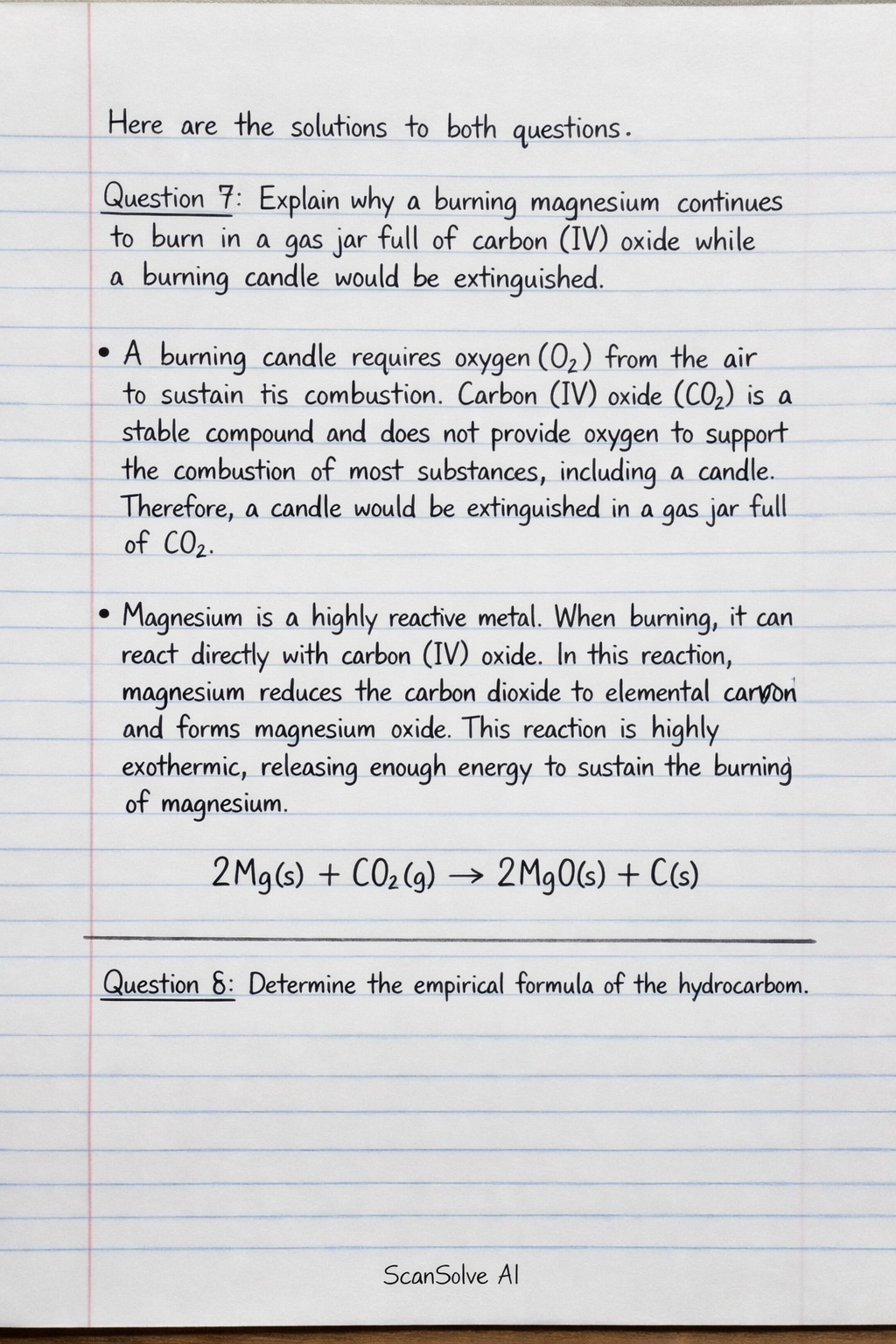
4 stepsHere are the solutions to both questions.
Part 7
Explain why a burning magnesium continues to burn in a gas jar full of carbon (IV) oxide while a burning candle would be extinguished.
- A burning candle requires oxygen () from the air to sustain its combustion. Carbon (IV) oxide () is a stable compound and does not provide oxygen to support the combustion of most substances, including a candle. Therefore, a candle would be extinguished in a gas jar full of .
- Magnesium is a highly reactive metal. When burning, it can react directly with carbon (IV) oxide. In this reaction, magnesium reduces the carbon dioxide to elemental carbon and forms magnesium oxide. This reaction is highly exothermic, releasing enough energy to sustain the burning of magnesium.
Part 8
Determine the empirical formula of the hydrocarbon.
Given:
Mass of
Mass of
Atomic mass of
Atomic mass of
Atomic mass of
Calculate the molar masses of and .
Calculate the moles of and produced.
Determine the moles of carbon and hydrogen atoms in the hydrocarbon.
Since all carbon in the hydrocarbon forms , the moles of carbon atoms are equal to the moles of .
Since all hydrogen in the hydrocarbon forms , and each molecule of contains two hydrogen atoms, the moles of hydrogen atoms are twice the moles of .
Determine the simplest whole-number ratio of C to H atoms.
Divide the moles of each element by the smallest number of moles (0.1909 mol).
For Carbon:For Hydrogen:
The ratio of C:H is approximately 1:2.
The empirical formula of the hydrocarbon is .
Try one yourself
A new problem that tests the same skill.
Still stuck on this one?
Ask a follow-up, and the answer starts from this question.
More Chemistry Questions
Handwritten Step-by-Step Solution
Get this as a handwritten image on WhatsApp — like a tutor wrote it for you.
Try on WhatsApp