
We read your photo as:
A) Calculate the mass concentration of iron (II). b) Explain why the solution was acidified with H2SO4 instead of HCl.
ScanSolve AI Answer
Step-by-step solution
2 stepsHere are the solutions to the questions:
Part a· 2 steps
**Calculate the mass concentration of the iron (II).
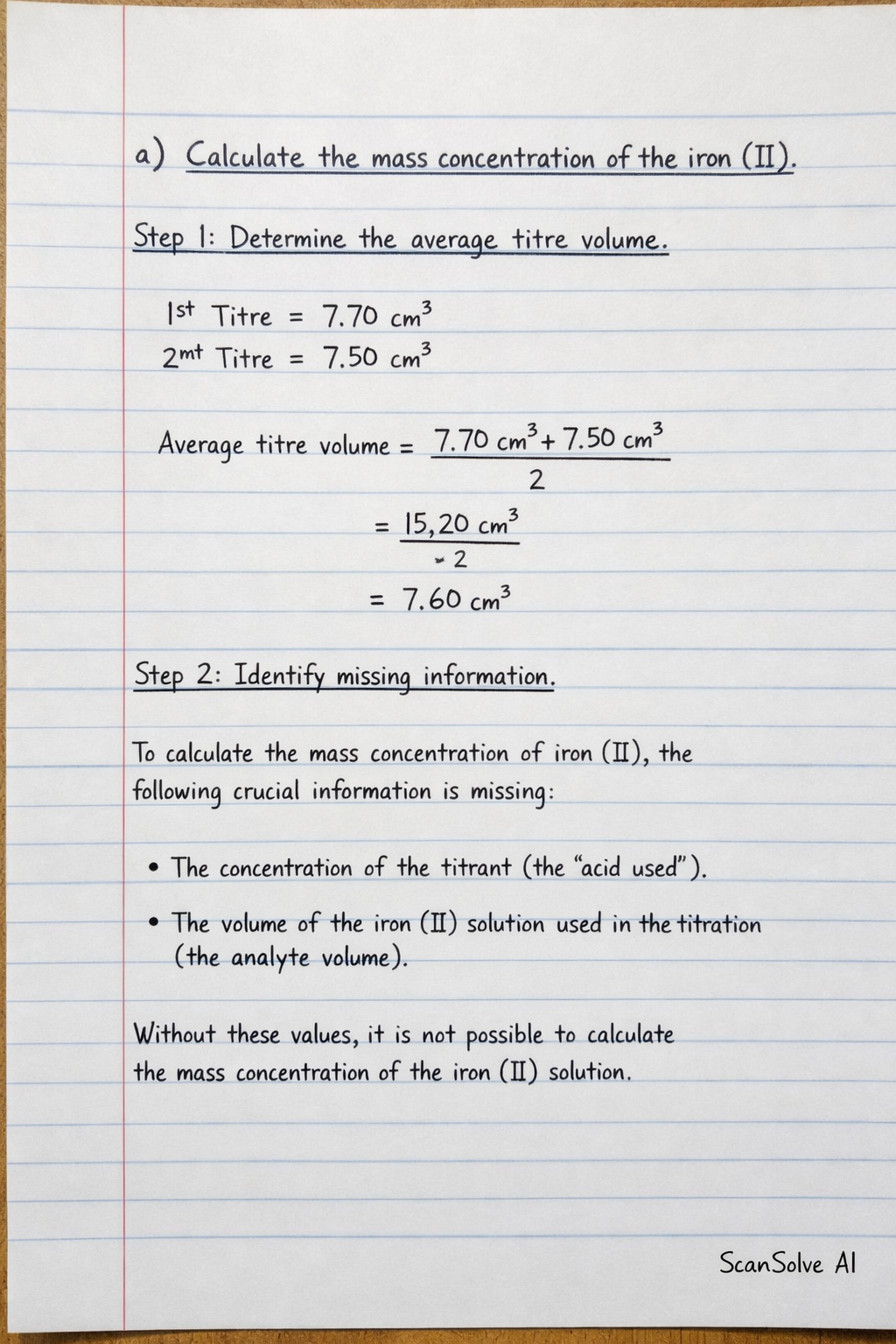
Determine the average titre volume.
The rough titre is usually discarded. The concordant titres are the 1st and 2nd titres.
1st Titre =
2nd Titre =
Average titre volume = .Identify missing information.
To calculate the mass concentration of iron (II), the following crucial information is missing from the provided image:
- The concentration of the titrant (the "acid used").
- The volume of the iron (II) solution used in the titration (the analyte volume).
Without these values, it is not possible to calculate the mass concentration of the iron (II) solution.
Part b
**Briefly explain why the solution was acidified with instead of .
In redox titrations, especially those involving strong oxidizing agents (like potassium permanganate, which is commonly used to titrate iron(II)), sulfuric acid () is preferred over hydrochloric acid () for acidification.
- Hydrochloric acid (): Contains chloride ions () which can be oxidized by strong oxidizing agents to chlorine gas (). This side reaction would interfere with the main titration, leading to inaccurate results.
- Sulfuric acid (): Its sulfate ions () are not easily oxidized and therefore do not interfere with the redox reaction, making it a suitable acid for such titrations.
Still stuck on this one?
Ask a follow-up, and the answer starts from this question.
More Chemistry Questions
Handwritten Step-by-Step Solution
Get this as a handwritten image on WhatsApp — like a tutor wrote it for you.
Try on WhatsApp