
We read your photo as:
Explain why: a) charcoal burners are dangerous in poorly ventilated rooms. b) reaction between calcium carbonate and dilute sulphuric acid stops. c) concentrated sulphuric acid is not used to dry ammo
ScanSolve AI Answer
Step-by-step solution
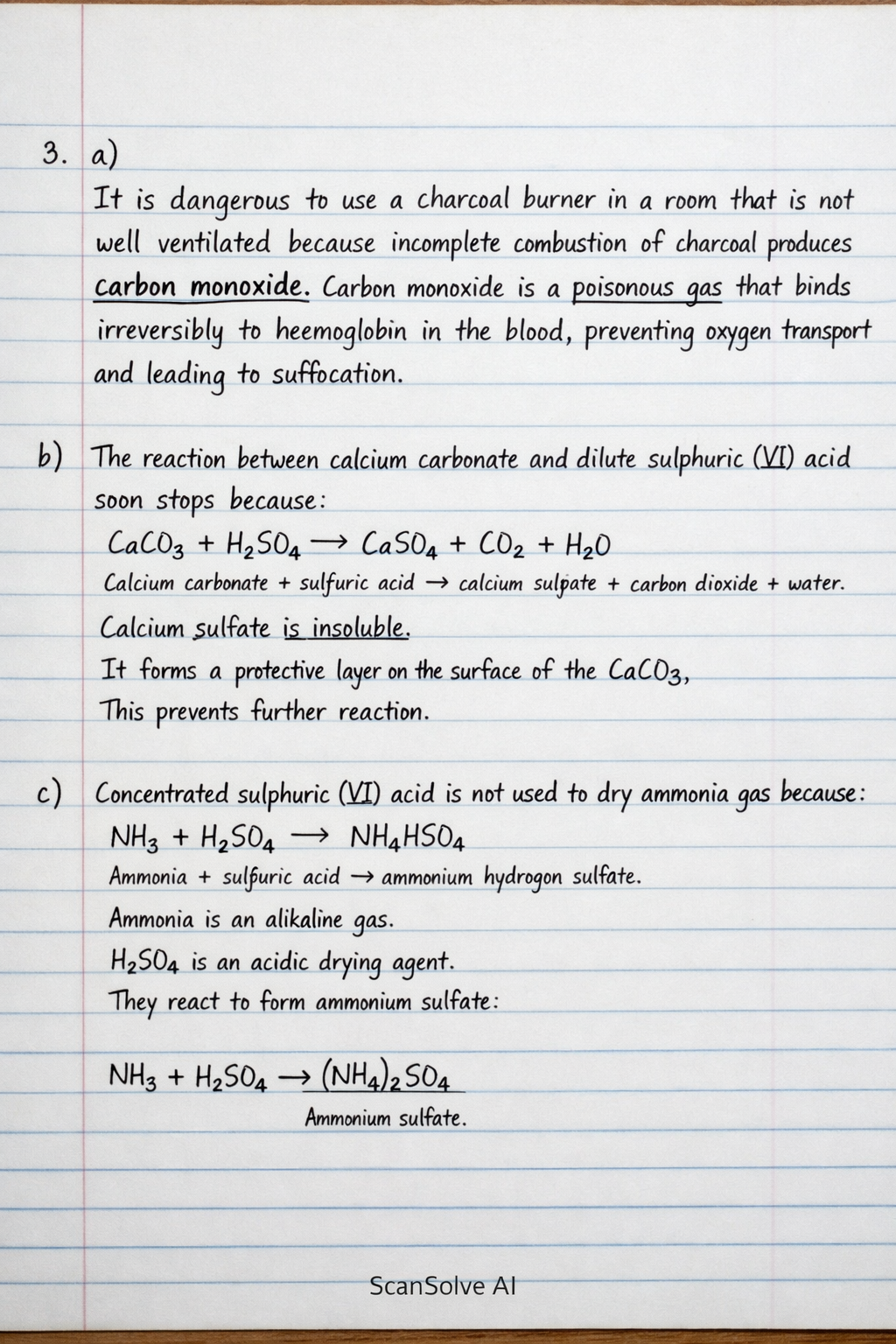
4 steps- a) It is dangerous to use a charcoal burner in a room that is not well ventilated because incomplete combustion of charcoal produces carbon monoxide. Carbon monoxide is a poisonous gas that binds irreversibly to haemoglobin in the blood, preventing oxygen transport and leading to suffocation.
b) The reaction between calcium carbonate and dilute sulphuric (VI) acid soon stops because the product, calcium sulphate, is insoluble. It forms a protective layer on the surface of the calcium carbonate, preventing further contact between the acid and the reactant.
c) Concentrated sulphuric (VI) acid is not used to dry ammonia gas because ammonia is an alkaline gas and concentrated sulphuric (VI) acid is an acidic drying agent. They would react chemically to form ammonium sulphate, thus removing the ammonia.
-
To prepare copper (II) sulphate crystals using dilute sulphuric (VI) acid and copper (II) oxide:
-
Add excess copper (II) oxide to a beaker containing warm dilute sulphuric (VI) acid and stir.
-
Filter the mixture to remove the unreacted copper (II) oxide. The filtrate is copper (II) sulphate solution.
-
Heat the copper (II) sulphate solution to evaporate some water until it is saturated (a crystal forms on a glass rod dipped into the solution and cooled).
-
Allow the saturated solution to cool slowly to form copper (II) sulphate crystals.
-
Wash the crystals with a small amount of cold distilled water and dry them between filter papers.
-
a) Oiling prevents rusting by forming a protective barrier on the surface of the metal. This barrier prevents oxygen and water (which are necessary for rusting) from coming into contact with the metal.
b) Two other methods of preventing rusting are:
- Painting: A layer of paint acts as a barrier, preventing oxygen and water from reaching the metal surface.
- Galvanising: Coating the iron with a layer of zinc. Zinc is more reactive than iron and corrodes preferentially (sacrificial protection), or it forms a protective oxide layer.
- a) (Assuming of 0.5 M hydrochloric acid was used to neutralize sodium hydroxide.)
Write the balanced chemical equation.
Calculate the moles of HCl used.
Determine the moles of NaOH reacted.
From the balanced equation, the mole ratio of is .
Calculate the molarity of sodium hydroxide.
The molarity of sodium hydroxide is .
Still stuck on this one?
Ask a follow-up, and the answer starts from this question.
More Chemistry Questions
Handwritten Step-by-Step Solution
Get this as a handwritten image on WhatsApp — like a tutor wrote it for you.
Try on WhatsApp