
We read your photo as:
A compound XY has the NaCl structure. The radius of the cation X+ is 100 pm. What is the possible range for the radius of the anion Y-?
ScanSolve AI Answer
Answer
Step-by-step solution
4 stepsIdentify the given information and the crystal structure.
The compound XY has an NaCl structure.
The radius of the cation X () is .
We need to find the radius of the anion Y ().Recall the radius ratio rule for the NaCl structure.
The NaCl structure is characterized by a coordination number of 6 for both the cation and the anion. This means the cation occupies octahedral voids. For stable octahedral coordination, the radius ratio must be in the range .
Calculate the possible range for using the radius ratio limits.
Using the lower limit of the radius ratio (0.414):
Using the upper limit of the radius ratio (0.732):
Thus, for the NaCl structure to be stable, the radius of the anion must be in the range .
Evaluate the given options.
- (a) : This value is greater than , so it is outside the valid range.
- (b) : This value is greater than , so it is outside the valid range.
- (c) : This value is within the valid range (). This corresponds to the maximum possible anion radius for which the cation can still maintain stable octahedral coordination (i.e., the cation just touches all six anions).
- (d) : This value is within the valid range ().
When multiple options fall within the valid range, the question often refers to a limiting condition. In this case, the value represents the upper limit for the anion radius to maintain the NaCl structure (octahedral coordination) with a cation radius of . If the anion were larger than this, the radius ratio would fall below 0.414, and the coordination number would likely decrease, leading to a different crystal structure.
The value is obtained directly from the lower limit of the radius ratio:
Rounding to one decimal place gives .
The final answer is .
Try one yourself
A new problem that tests the same skill.
Still stuck on this one?
Ask a follow-up, and the answer starts from this question.
More Chemistry Questions
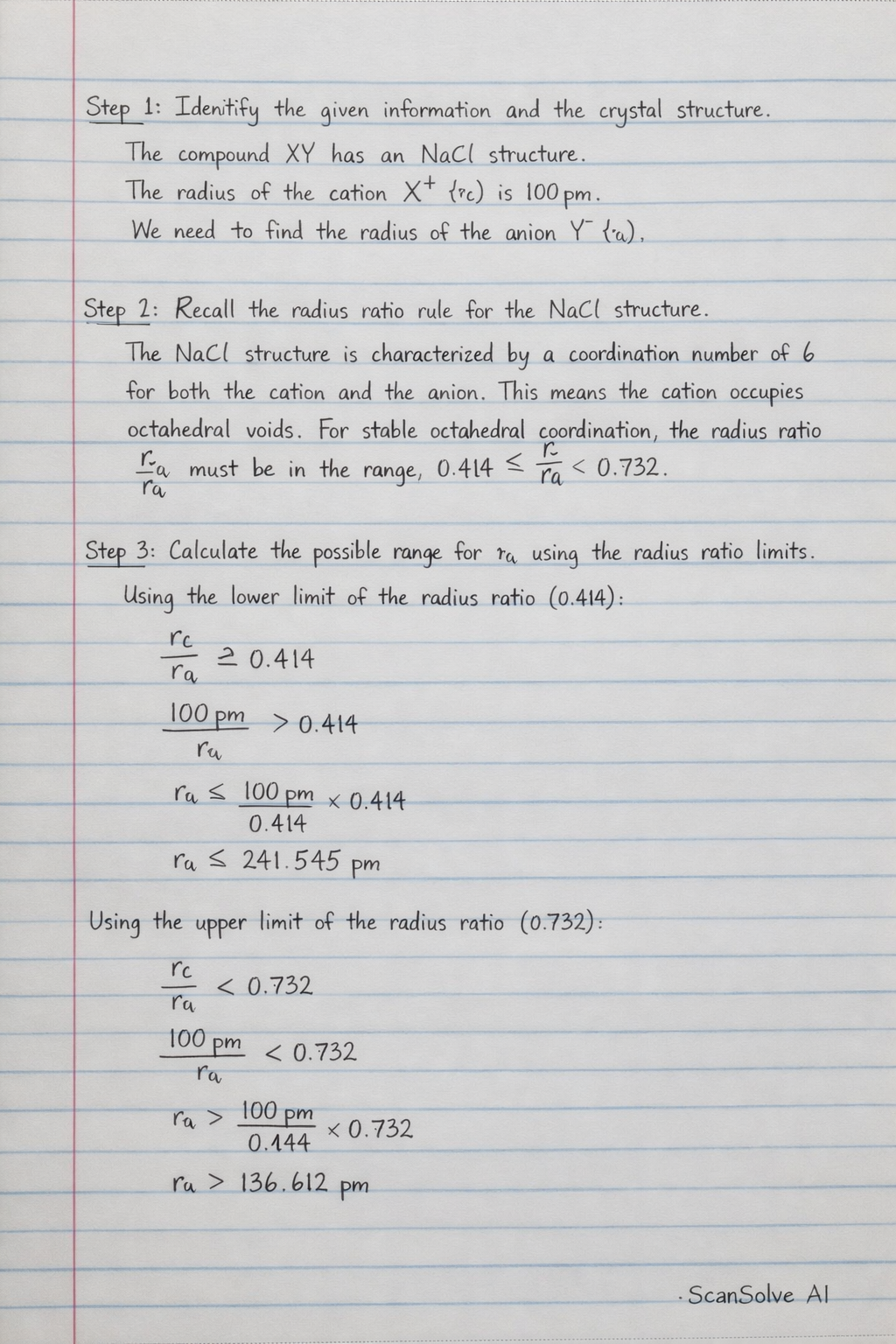
Handwritten Step-by-Step Solution
Get this as a handwritten image on WhatsApp — like a tutor wrote it for you.
Try on WhatsApp