
We read your photo as:
A) Define: i) Atomic number ii) Mass number. b) Calculate the relative atomic mass of element X. c) Define the term isotopes.
ScanSolve AI Answer
Answer
Step-by-step solution
3 steps6. a) Define:
Part i
Atomic number
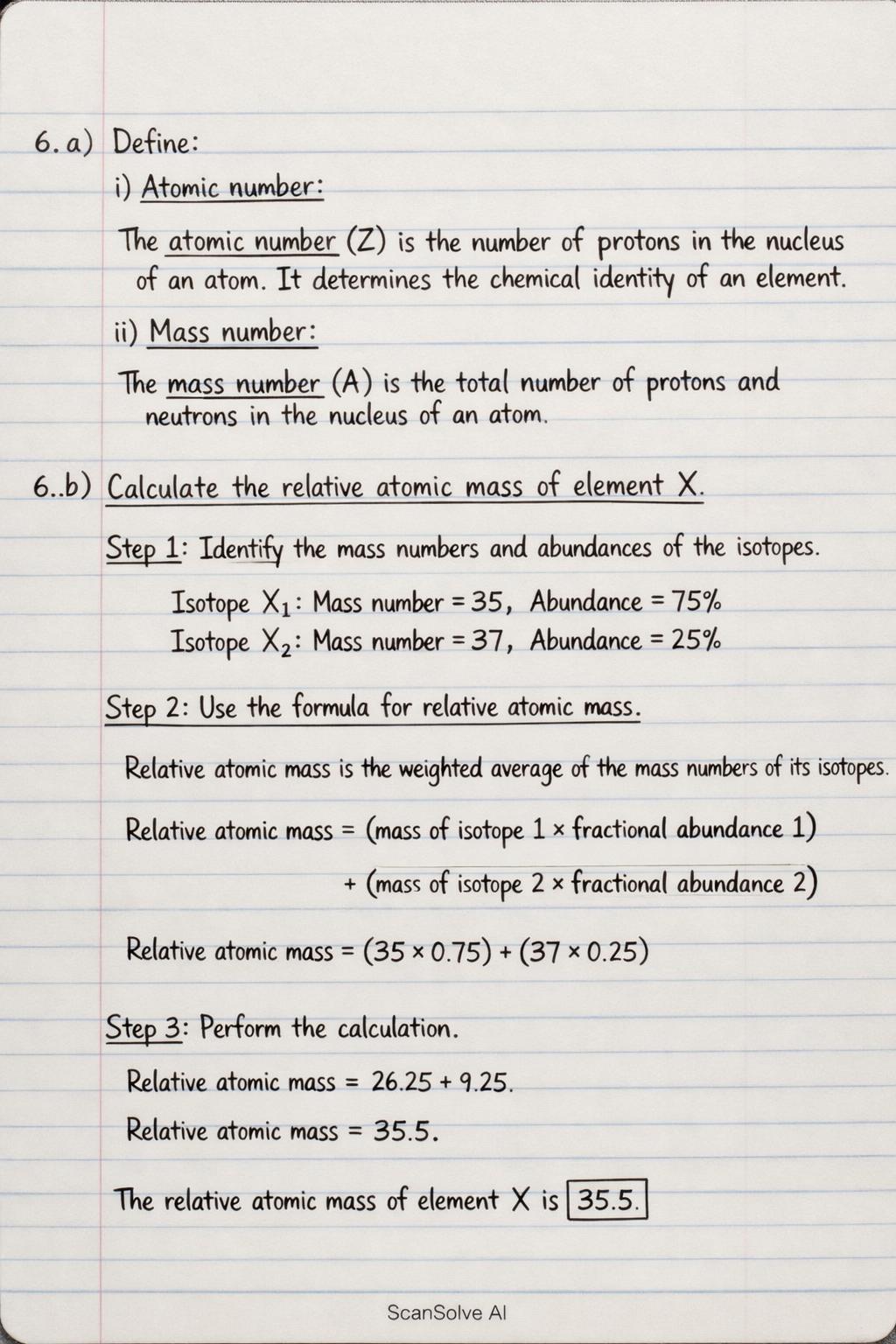
The atomic number (Z) is the number of protons in the nucleus of an atom. It determines the chemical identity of an element.
Part ii
Mass number
The mass number (A) is the total number of protons and neutrons in the nucleus of an atom.
6. b) Calculate the relative atomic mass of element X.
Identify the mass numbers and abundances of the isotopes.
Isotope X1: Mass number = 35, Abundance = 75%
Isotope X2: Mass number = 37, Abundance = 25%Use the formula for relative atomic mass.
Relative atomic mass is the weighted average of the mass numbers of its isotopes.
Perform the calculation.
The relative atomic mass of element X is .
6. c) Define the term isotopes.
Isotopes are atoms of the same element that have the same number of protons (atomic number) but different numbers of neutrons, resulting in different mass numbers.
Try one yourself
A new problem that tests the same skill.
Still stuck on this one?
Ask a follow-up, and the answer starts from this question.
More Chemistry Questions
Handwritten Step-by-Step Solution
Get this as a handwritten image on WhatsApp — like a tutor wrote it for you.
Try on WhatsApp