
We read your photo as:
A hydrocarbon diffuses twice as fast as sulphur dioxide. Calculate the molar mass of the hydrocarbon. (Given: Molar mass of S = 32.06 g/mol, O = 16.00 g/mol)
ScanSolve AI Answer
Answer
Step-by-step solution
4 stepsState Graham's Law of Diffusion and calculate the molar mass of sulphur dioxide.
Graham's Law of Diffusion states that the rate of diffusion of a gas is inversely proportional to the square root of its molar mass.
Where and are the rates of diffusion of gas 1 and gas 2, and and are their respective molar masses.
The molar mass of sulphur dioxide ():
Set up the equation using the given diffusion rates.
Let the hydrocarbon be gas 1 and sulphur dioxide be gas 2.
Given that the hydrocarbon diffuses twice as quickly as sulphur dioxide:So,
Using Graham's Law:
Solve for the molar mass of the hydrocarbon.
Square both sides of the equation:
Rearrange to solve for :
Determine the molecular formula of the hydrocarbon.
The general formula for the hydrocarbon is .
The molar mass of carbon () is .
The molar mass of hydrogen () is .
So, the molar mass of is:Since 'n' must be an integer, .
Substitute into the formula :
The molecular formula of the hydrocarbon is .
Try one yourself
A new problem that tests the same skill.
Still stuck on this one?
Ask a follow-up, and the answer starts from this question.
More Chemistry Questions
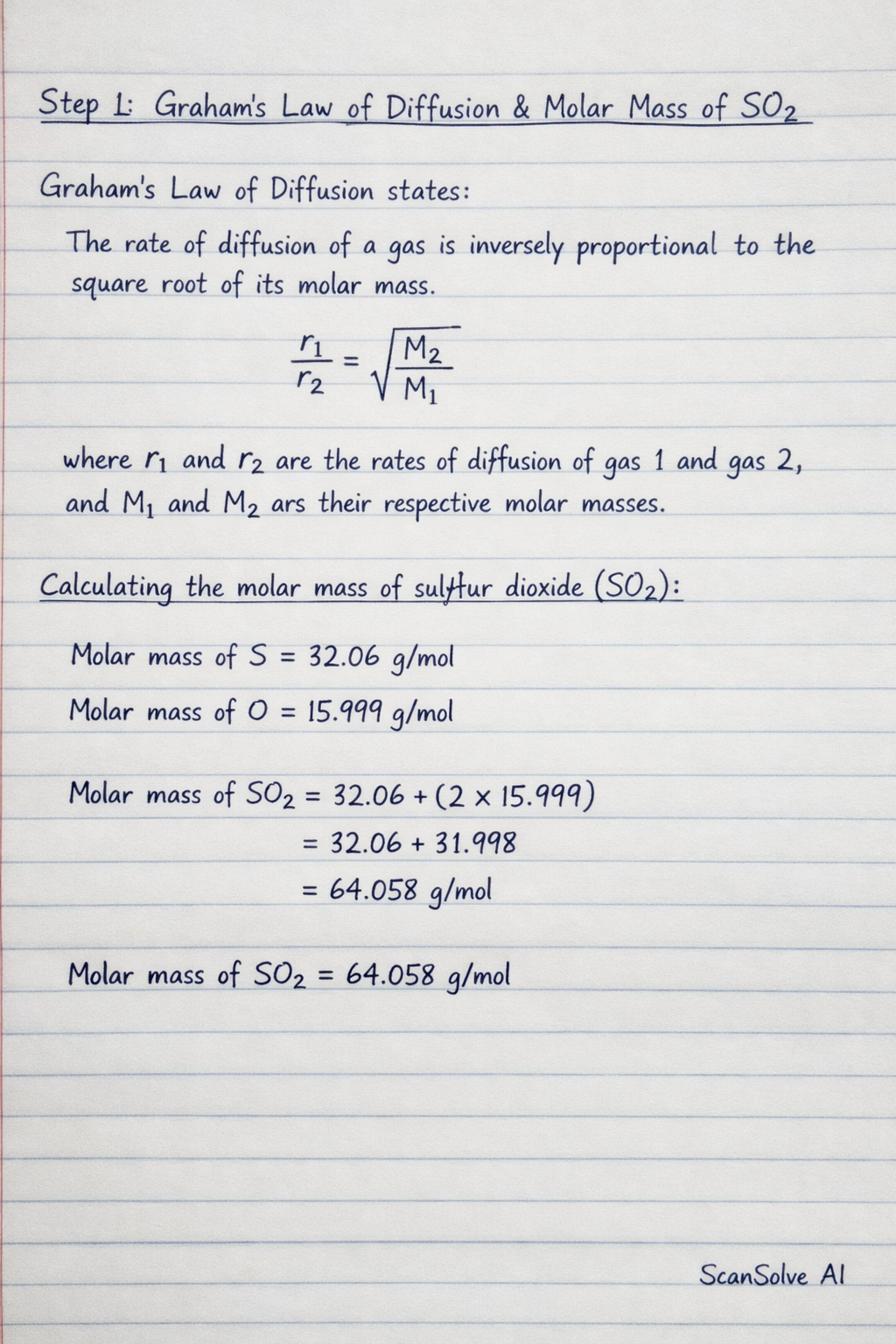
Handwritten Step-by-Step Solution
Get this as a handwritten image on WhatsApp — like a tutor wrote it for you.
Try on WhatsApp