

This chemistry question involves key chemical concepts and calculations. The detailed solution below walks through each step, from identifying the reaction type to computing the final answer.
ScanSolve AI Answer
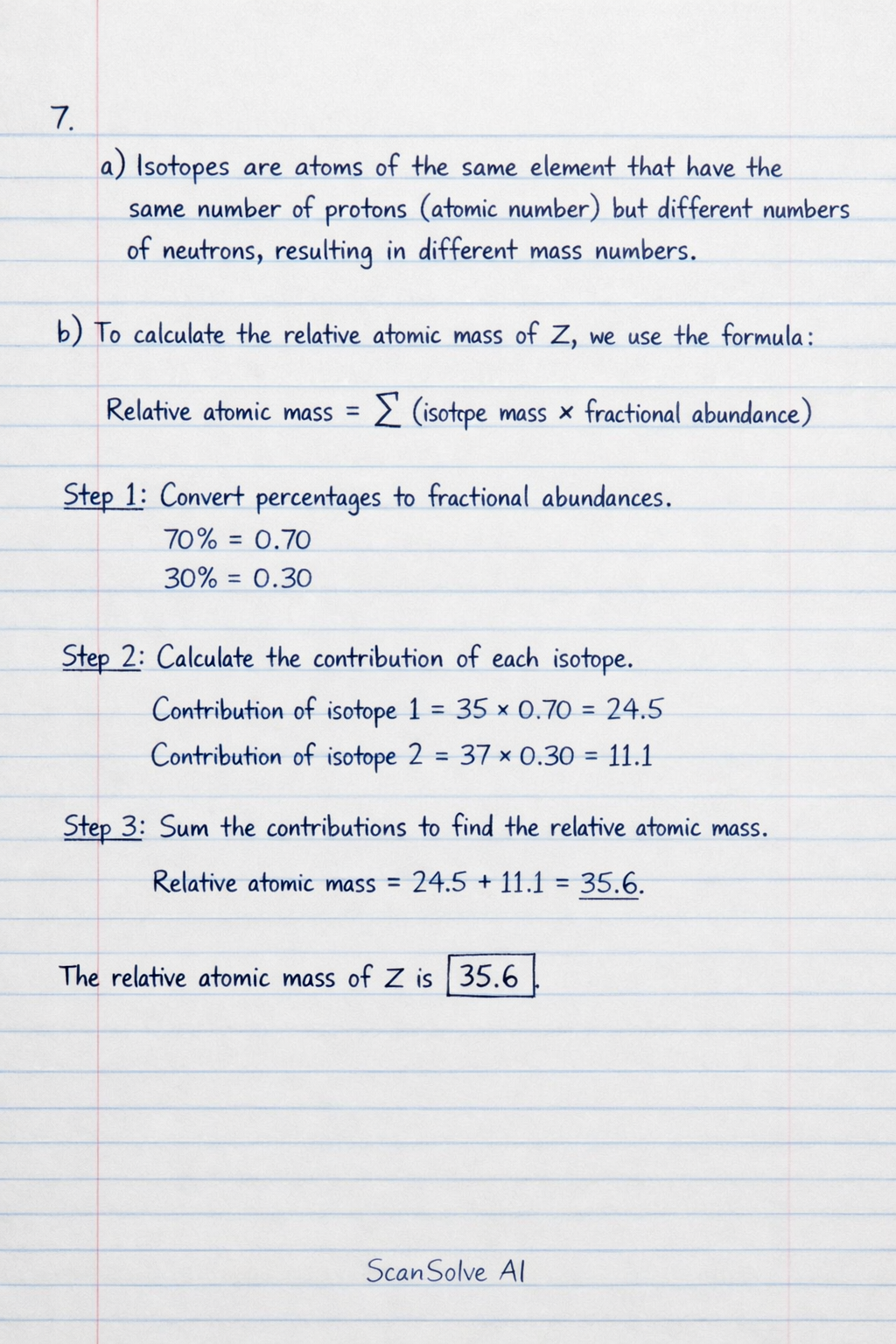
7. a) Isotopes are atoms of the same element that have the same number of protons (atomic number) but different numbers of neutrons, resulting in different mass numbers. b) To calculate the relative atomic mass of Z, we use the formula: Relative atomic mass = (isotope mass × fractional abundance) Step 1: Convert percentages to fractional abundances. 70\% = 0.70 30\% = 0.30 Step 2: Calculate the contribution of each isotope. Contribution of isotope 1 = 35 × 0.70 = 24.5 Contribution of isotope 2 = 37 × 0.30 = 11.1 Step 3: Sum the contributions to find the relative atomic mass. Relative atomic mass = 24.5 + 11.1 = 35.6 The relative atomic mass of Z is 35.6. 8. An element Y has electron configuration 2.8.7. a) Identify the: i) Period: The number of electron shells is 3 (2, 8, 7). Period: 3 ii) Group: The number of valence electrons is 7. Group: 17 b) State the chemical family of Y. Based on Group 17, the chemical family is Halogens. c) Predict the type of ion Y forms and explain why. Y will form a negative ion (anion) with a charge of -1. It has 7 valence electrons and will gain 1 electron to achieve a stable octet electron configuration (2.8.8). d) State TWO reasons why noble gases are chemically stable. i. Noble gases have a full outermost electron shell (octet rule, or duet for helium), which makes them energetically stable. ii. Their electron configuration is already stable, meaning they do not readily gain, lose, or share electrons to form chemical bonds. e) Give ONE example each of: i) Alkali metal: Sodium (Na) ii) Halogen: Chlorine (Cl) iii) Noble gas: Neon (Ne) 9. a) Write the electron arrangement (s and p notation) for: i) Na^+: Sodium (Na) has 11 electrons. Na^+ has lost one electron, so it has 10 electrons. 1s^2 2s^2 2p^6 ii) O^2-: Oxygen (O) has 8 electrons. O^2- has gained two electrons, so it has 10 electrons. 1s^2 2s^2 2p^6 b) Using valency, write the formula for: i) Magnesium chloride: Magnesium (Mg) has a valency of 2. Chlorine (Cl) has a valency of 1. MgCl_2 ii) Aluminium oxide: Aluminium (Al) has a valency of 3. Oxygen (O) has a valency of 2. Al_2O_3 Last free one today — make it count tomorrow, or type /upgrade for unlimited.