

This chemistry question involves key chemical concepts and calculations. The detailed solution below walks through each step, from identifying the reaction type to computing the final answer.
ScanSolve AI Answer
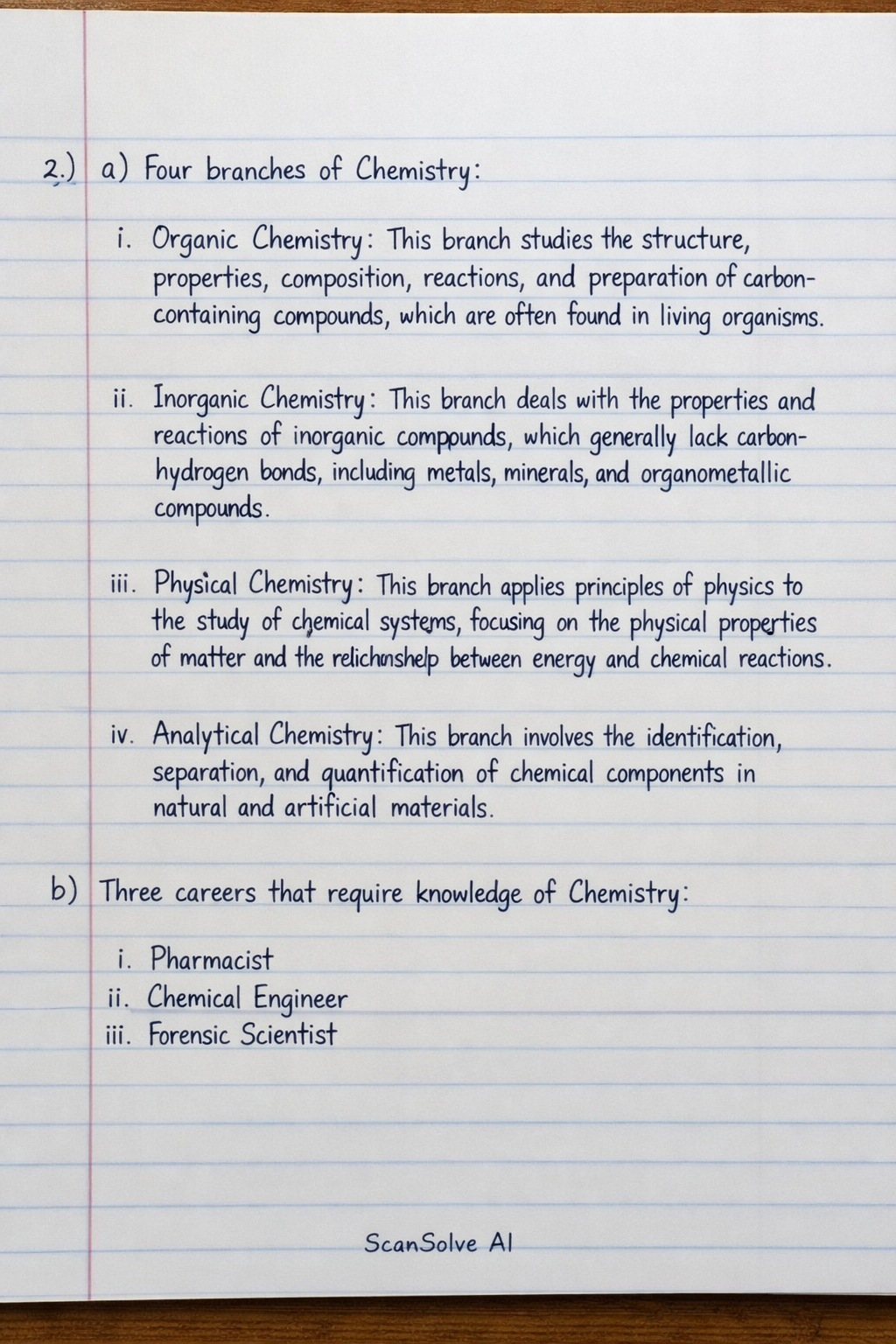
2. a) Four branches of Chemistry: i. Organic Chemistry: This branch studies the structure, properties, composition, reactions, and preparation of carbon-containing compounds, which are often found in living organisms. ii. Inorganic Chemistry: This branch deals with the properties and reactions of inorganic compounds, which generally lack carbon-hydrogen bonds, including metals, minerals, and organometallic compounds. iii. Physical Chemistry: This branch applies principles of physics to the study of chemical systems, focusing on the physical properties of matter and the relationship between energy and chemical reactions. iv. Analytical Chemistry: This branch involves the identification, separation, and quantification of chemical components in natural and artificial materials. b) Three careers that require knowledge of Chemistry: i. Pharmacist ii. Chemical Engineer iii. Forensic Scientist 3. a) Four applications of Chemistry in industry: i. Agriculture: Chemistry is used to develop pesticides, herbicides, and fertilisers that protect crops from pests and diseases, and enhance soil fertility, leading to increased food production. ii. Food Processing: Chemistry helps in understanding food composition, preservation methods, and the development of food additives to improve taste, texture, and shelf life, ensuring food safety and quality. iii. Pharmaceuticals: Chemistry is fundamental in the synthesis and development of new drugs and medicines, from identifying active compounds to formulating them for effective delivery and treatment of diseases. iv. Energy Production: Chemistry plays a crucial role in developing alternative energy sources like biofuels and solar cells, improving the efficiency of fossil fuel combustion, and designing materials for energy storage. b) Two economic benefits of Chemistry: i. It drives innovation and job creation in various industries, including manufacturing, pharmaceuticals, and technology, contributing to economic growth. ii. It leads to the development of cost-effective materials and processes, reducing production costs and increasing the affordability of goods and services. 4. a) Define the following terms: i) Drug: A substance that, when ingested, injected, inhaled, or applied to the body, produces a physiological or psychological effect. ii) Prescription: A written order from a qualified medical practitioner authorizing a patient to be provided with a specific medicine or treatment. iii) Dosage: The specific amount of a drug or medicine to be taken at one time or over a period, often determined by a medical professional. b) Three effects of drug abuse on a learner: i. Academic Decline: Drug abuse can impair cognitive functions such as memory, concentration, and problem-solving skills, leading to poor academic performance and potential school dropout. ii. Health Problems: Learners may experience various physical and mental health issues, including organ damage, addiction, depression, and anxiety, which can have long-term consequences. iii. Social and Behavioral Issues: Drug abuse can lead to strained relationships with family and friends, increased aggression, criminal behavior, and isolation, affecting the learner's overall social development. That's 2 down. 3 left today — send the next one.