
We read your photo as:
A pink solid V yields a colourless liquid and a pale blue residue Y on strong heating. Addition of the liquid to Y regenerates V. Identify V and Y and explain the changes and applications.
ScanSolve AI Answer
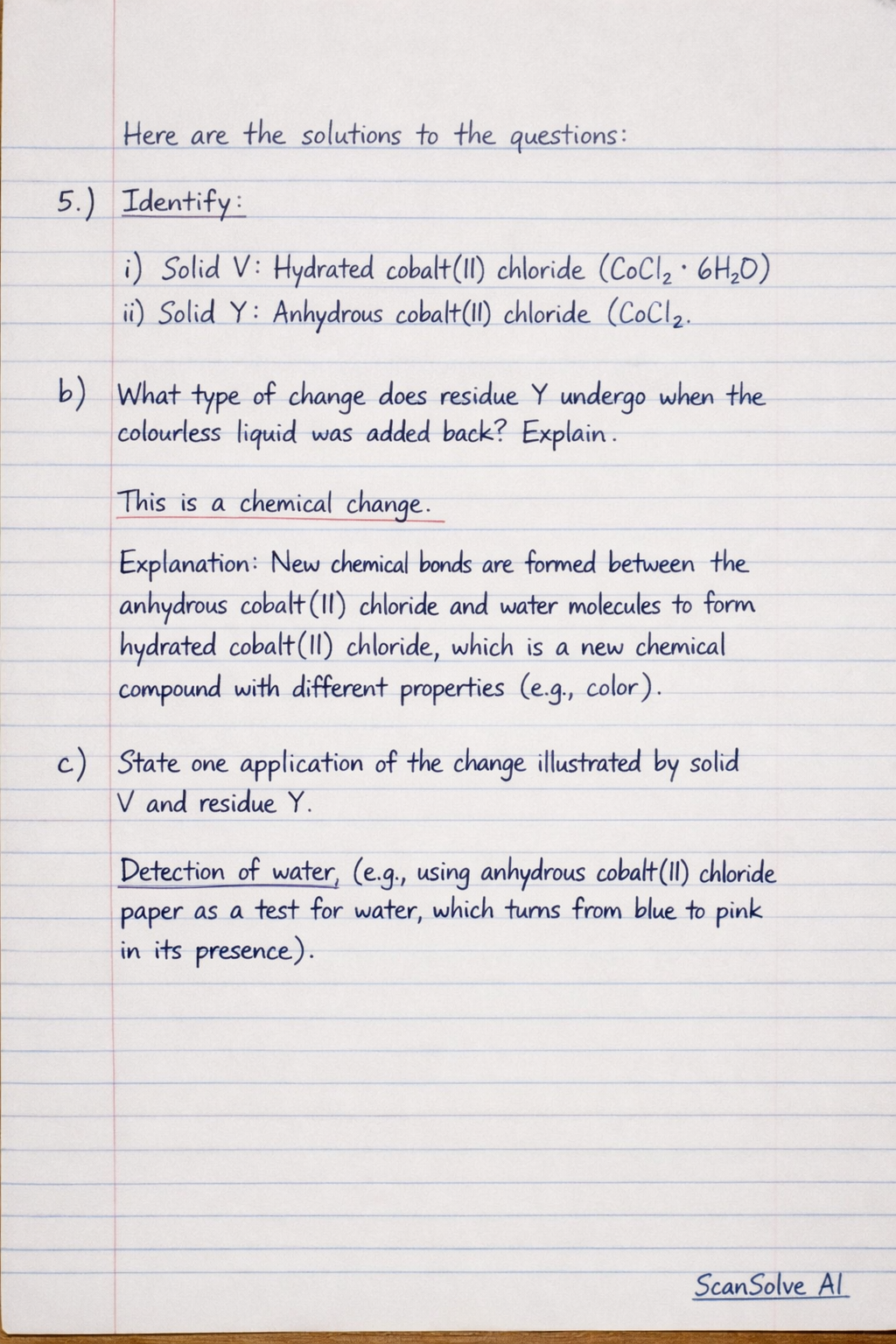
Here are the solutions to the questions:
5. When a pink solid V is heated strongly it breaks down to form droplets of a colourless liquid, and a pale blue residue Y. When the liquid droplets were added back to residue Y, the pink colour of V was regained.
a) Identify:
i) Solid V: Hydrated cobalt(II) chloride ()
ii) Solid Y: Anhydrous cobalt(II) chloride ()
b) What type of change does residue Y undergo when the colourless liquid was added back? Explain.
This is a chemical change.
Explanation: New chemical bonds are formed between the anhydrous cobalt(II) chloride and water molecules to form hydrated cobalt(II) chloride, which is a new chemical compound with different properties (e.g., color).
c) State one application of the change illustrated by solid V and residue Y.
Detection of water (e.g., using anhydrous cobalt(II) chloride paper as a test for water, which turns from blue to pink in its presence).
6. A sample of water at sea level was found to boil at temperatures between and . Explain this observation.
The water sample is impure. The presence of dissolved impurities (solutes) elevates the boiling point of water above (boiling point elevation). Additionally, an impure substance boils over a range of temperatures, rather than at a single fixed temperature, which further confirms its impurity.
Still stuck on this one?
Ask a follow-up, and the answer starts from this question.
More Chemistry Questions
Handwritten Step-by-Step Solution
Get this as a handwritten image on WhatsApp — like a tutor wrote it for you.
Try on WhatsApp