
We read your photo as:
A sample of calcium carbide of mass 2.5g reacts with water to produce acetylene gas and calcium hydroxide. i) State the formula of acetylene. ii) Write the balanced chemical equation for the reaction.
ScanSolve AI Answer
This answer stops before the end.
It was cut off when it was first written. Ask ScanSolve this question again for the full working.
Here are the solutions to your homework questions:
5.
a)
-
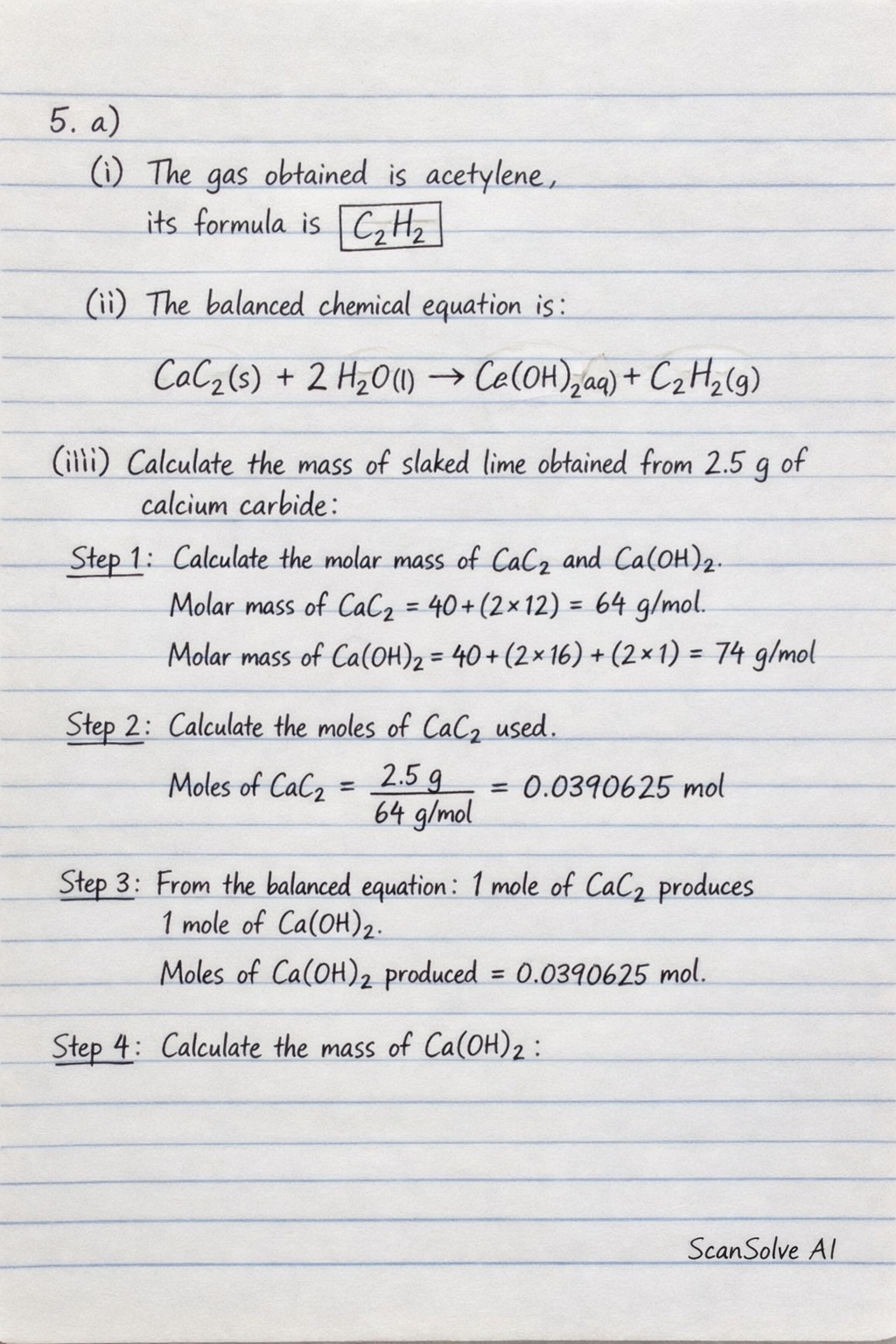
(i) The gas obtained is acetylene, and its formula is .
-
(ii) The balanced chemical equation is:
-
(iii) Calculate the mass of slaked lime obtained from 2.5g of calcium carbide.
Step 1: Calculate the molar mass of and .
Molar mass of .
Molar mass of .Step 2: Calculate the moles of used.
Step 3: From the balanced equation, 1 mole of produces 1 mole of . So, moles of produced = .
Step 4: Calculate the mass of .
The mass of slaked lime obtained is .
b)
-
(i) The number of Faradays used in this experiment.
Step 1: Calculate the total charge passed.
Step 2: Calculate the number of Faradays. (Using Faraday's constant )
Still stuck on this one?
Ask a follow-up, and the answer starts from this question.
More Chemistry Questions
Handwritten Step-by-Step Solution
Get this as a handwritten image on WhatsApp — like a tutor wrote it for you.
Try on WhatsApp