
We read your photo as:
A solid E was put in a boiling tube and 10cm³ of distilled water was added. The mixture was shaken thoroughly and the solid dissolved. The resulting solution was divided into five portions. a) Place a
ScanSolve AI Answer
Answer
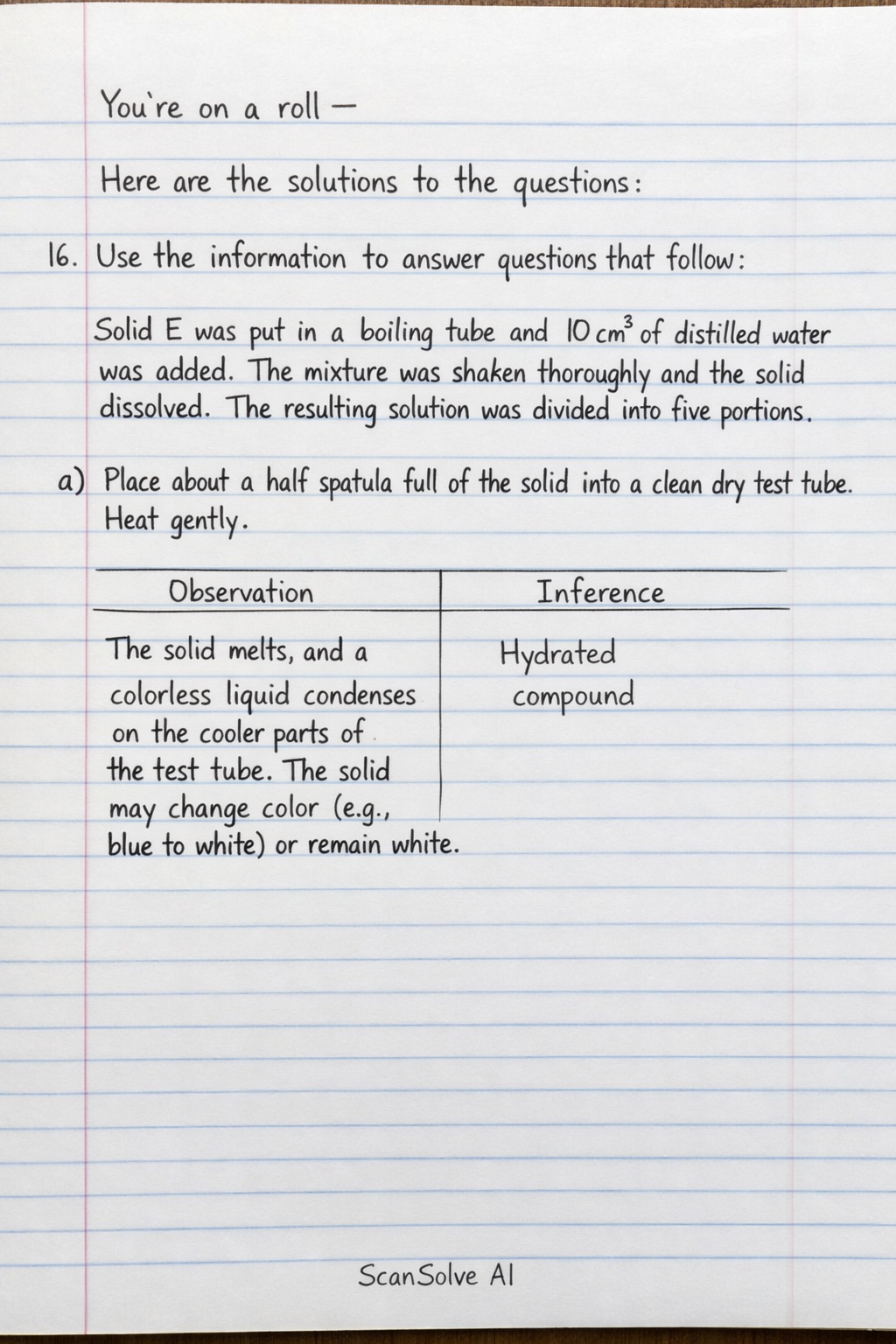
Here are the solutions to the questions:
-
Use the information to answer questions that follow: Solid E was put in a boiling tube and of distilled water was added. The mixture was shaken thoroughly and the solid dissolved. The resulting solution was divided into five portions. a) Place about a half spatula full of the solid into a clean dry test tube. Heat gently.
Observation Inference The solid melts, and a colorless liquid condenses on the cooler parts of the test tube. The solid may change color (e.g., blue to white) or remain white. Hydrated compound b) Place all the remaining portion of the solid in the test tube. Add about of distilled water, shake thoroughly. Divide the mixture into five portions.
Observation Inference The solid dissolves to form a colorless solution. Soluble compound c) To the first portion, add three drops of sodium hydroxide then add excess.
Observation Inference A white precipitate is formed, which dissolves in excess sodium hydroxide. , , present d) To the second portion, add three drops of aqueous ammonia then add excess.
Observation Inference A white precipitate is formed, which is insoluble in excess aqueous ammonia. , present e) To the third portion, add three drops of sodium sulphate solution.
Observation Inference No precipitate is formed. present f) To the fourth portion, add three drops of lead (II) nitrate solution and preserve the product to be used in (g) below.
Observation Inference White precipitate , present g) To the portion in (iv) above, add five drops of dilute hydrochloric acid.
Observation Inference The white precipitate remains insoluble. , present h) To the fifth portion, add three drops of barium nitrate solution.
Observation Inference White precipitate present i) Identify the cation and anion present:
Cation:
Anion:j) Identify Compound E:
Compound E:
Try one yourself
A new problem that tests the same skill.
Still stuck on this one?
Ask a follow-up, and the answer starts from this question.
More Chemistry Questions
Handwritten Step-by-Step Solution
Get this as a handwritten image on WhatsApp — like a tutor wrote it for you.
Try on WhatsApp