
We read your photo as:
A solution has a volume of 95 cm³ and a density of 1 g/cm³. The temperature of the solution increases from 43.7°C to 49.6°C when a reaction occurs. If the specific heat capacity of the solution is 4.2
ScanSolve AI Answer
Answer
Step-by-step solution
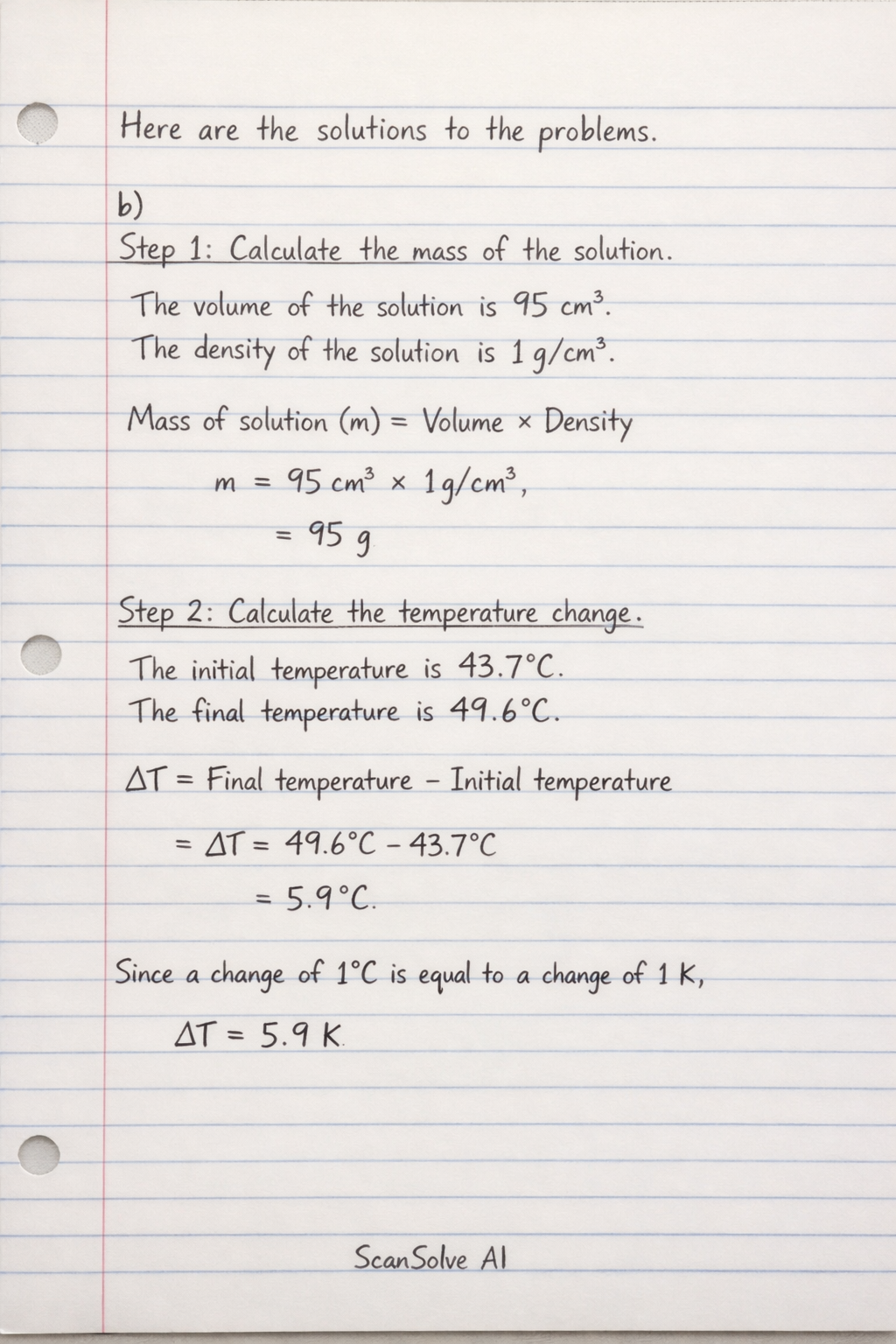
5 stepsHere are the solutions to the problems.
Part b· 5 steps
Calculate the mass of the solution.
The volume of the solution is .
The density of the solution is .Calculate the temperature change.
The initial temperature is .
The final temperature is .Since a change of is equal to a change of , .
Calculate the heat absorbed by the solution.
The specific heat capacity of the solution () is .
Since the temperature increased, the reaction is exothermic, meaning the reaction released this heat. So, .
Convert to kilojoules:Calculate the moles of copper deposited.
The mass of copper deposited is .
The molar mass of copper () is .Calculate the molar enthalpy change.
Rounding to three significant figures:
- The atomic numbers of nitrogen and fluorine are 7 and 9 respectively.
Part a
Draw electron dot (+) and Cross (x) diagrams to illustrate bonding in the molecules of
(I) Nitrogen
Nitrogen (N) has an atomic number of 7, so it has 5 valence electrons. In a nitrogen molecule (), two nitrogen atoms share three pairs of electrons to form a triple covalent bond, and each nitrogen atom has one lone pair of electrons.
(II) Fluorine
Fluorine (F) has an atomic number of 9, so it has 7 valence electrons. In a fluorine molecule (), two fluorine atoms share one pair of electrons to form a single covalent bond, and each fluorine atom has three lone pairs of
Try one yourself
A new problem that tests the same skill.
Still stuck on this one?
Ask a follow-up, and the answer starts from this question.
More Chemistry Questions
Handwritten Step-by-Step Solution
Get this as a handwritten image on WhatsApp — like a tutor wrote it for you.
Try on WhatsApp