
We read your photo as:
A student is performing a calorimetry experiment to determine the enthalpy of dissolution of Na2S2O3. The student recorded the following data. Calculate the change in temperature and the molarity of s
ScanSolve AI Answer
This answer stops before the end.
It was cut off when it was first written. Ask ScanSolve this question again for the full working.
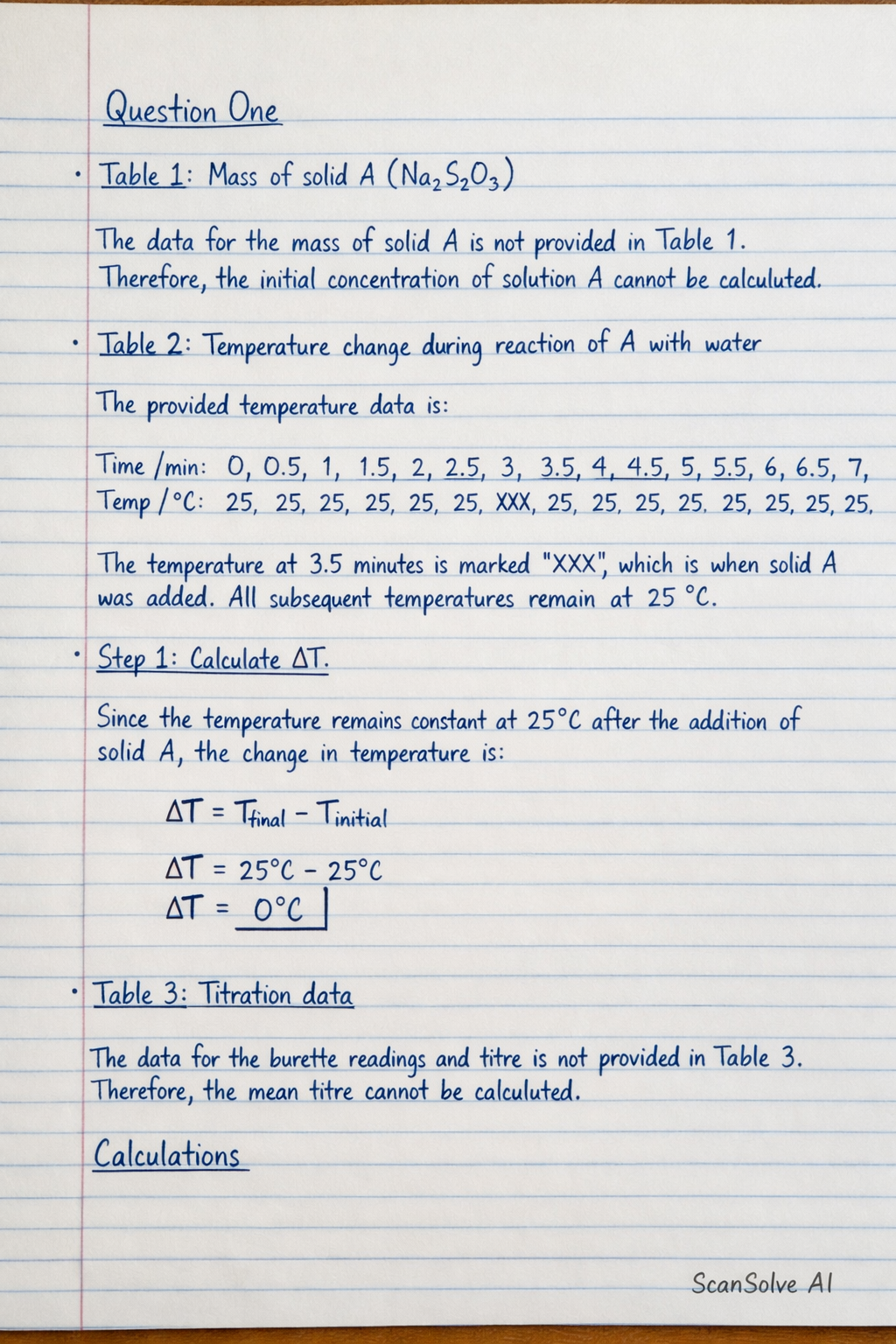
Question One
-
Table 1: Mass of solid A (Na₂S₂O₃) The data for the mass of solid A is not provided in Table 1. Therefore, the initial concentration of solution A cannot be calculated.
-
Table 2: Temperature change during reaction of A with water The provided temperature data is: Time/min: 0, 0.5, 1, 1.5, 2, 2.5, 3, 3.5, 4, 4.5, 5, 5.5, 6, 6.5, 7 Temp/°C: 25, 25, 25, 25, 25, 25, 25, XXX, 25, 25, 25, 25, 25, 25, 25
The temperature at 3.5 minutes is marked "XXX", which is when solid A was added. All subsequent temperatures remain at 25 °C.
Step 1: Calculate .
Since the temperature remains constant at after the addition of solid A, the change in temperature is:\Delta T = T_{\text{final}} - T_{\text{initial}} = 25 \,^{\circ}\text{C} - 25 \,^{\circ}\text{C} = \boxed{\text{0 \,^{\circ}\text{C}}} -
Table 3: Titration data The data for the burette readings and titre is not provided in Table 3. Therefore, the mean titre cannot be calculated.
Calculations
-
Calculate the molarity of solution A and solution B. The question asks to determine the concentration of solution B using solution A, and then asks to calculate the molarity of solution A using the titre. This implies a standardisation of solution B using solution A, where solution A's concentration is either known or determined first. Given the procedure, solution A (Na₂S₂O₃) is prepared from a weighed mass, so its concentration can be calculated. Then, solution B (K₂Cr₂O₇) is titrated with solution A.
- Step 1: Calculate the molarity of solution A (Na₂S₂O₃). This requires the mass of solid A from Table 1. Molar mass of Na₂S₂O₃ = . If the mass of solid A (Na₂S₂O₃) was grams, and it was dissolved in () of water:
Still stuck on this one?
Ask a follow-up, and the answer starts from this question.
More Chemistry Questions
Handwritten Step-by-Step Solution
Get this as a handwritten image on WhatsApp — like a tutor wrote it for you.
Try on WhatsApp