
We read your photo as:
Explain why alkali earth metals conduct electricity in solid state but their compounds do not. (12) When ammonium chloride is heated in a test tube, its moist red litmus paper turns blue then red. Exp
ScanSolve AI Answer
Here are the solutions to the questions:
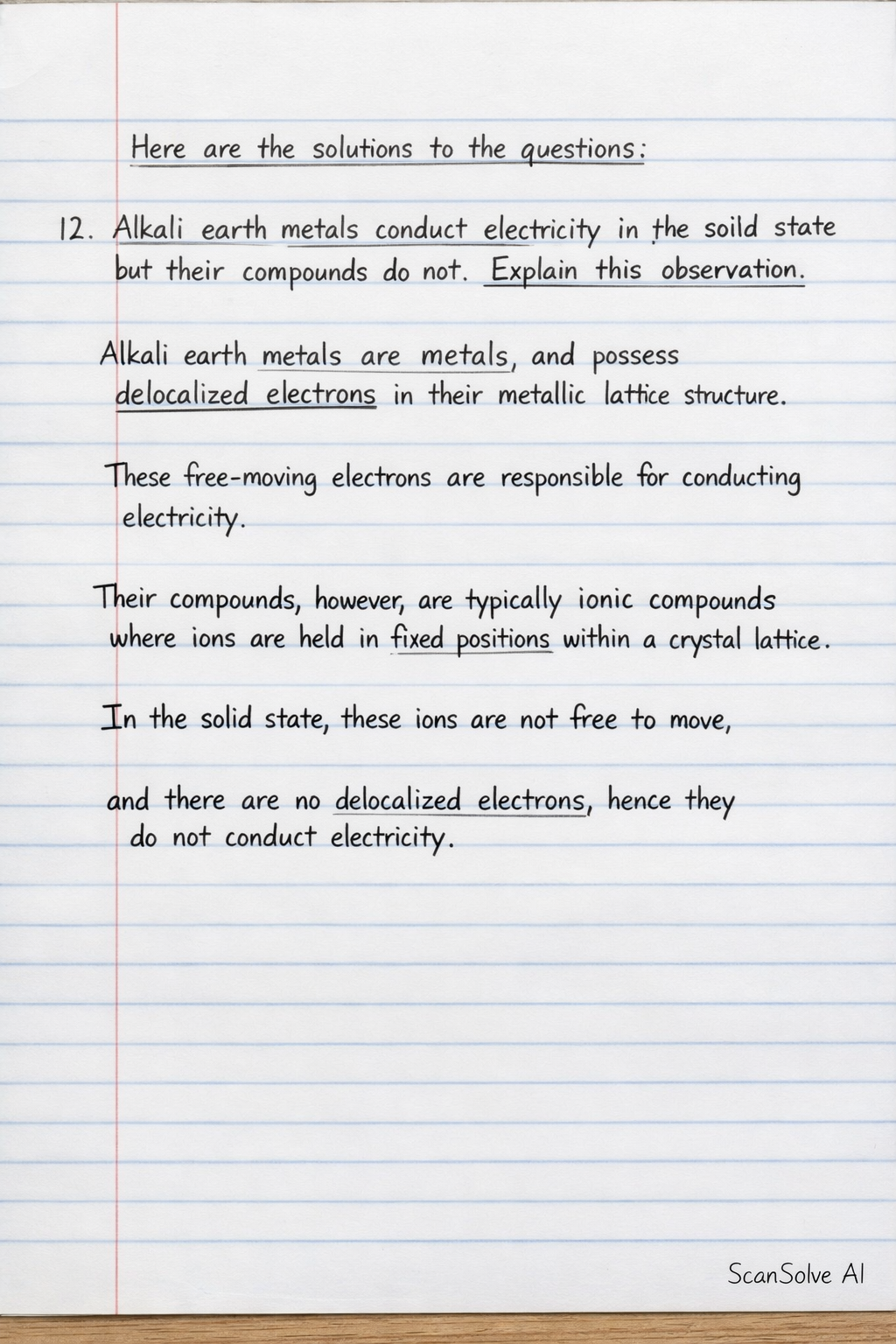
12. Alkali earth metals conduct electricity in the solid state but their compounds do not. Explain this observation.
Alkali earth metals are metals and possess delocalized electrons in their metallic lattice structure. These free-moving electrons are responsible for conducting electricity. Their compounds, however, are typically ionic compounds where ions are held in fixed positions within a crystal lattice. In the solid state, these ions are not free to move, and there are no delocalized electrons, hence they do not conduct electricity.
13. In an experiment, ammonium chloride was heated in a test tube. When a moist red litmus paper was placed in the rim of the test tube, the paper first changed blue then changed back to red. Explain this observation.
When ammonium chloride () is heated, it undergoes thermal decomposition to produce ammonia gas () and hydrogen chloride gas ():
Ammonia gas is alkaline and has a lower molar mass (17 g/mol) than hydrogen chloride (36.5 g/mol). Therefore, ammonia diffuses faster and reaches the moist red litmus paper first, turning it blue. As heating continues, the heavier and slower-diffusing hydrogen chloride gas, which is acidic, eventually reaches the litmus paper, overriding the effect of ammonia and turning the paper back to red.
14. The electron arrangement for elements represented by letters W, X, Y and Z are as shown below.
- W: 2.8.6
- X: 2.8.2
- Y: 2.8.1
- Z: 2.8.8
a) Select the element which forms:
i) A divalent anion? * An anion is formed by gaining electrons. Divalent means gaining two electrons. An element with 6 valence electrons (like W) will gain 2 electrons to achieve a stable octet. * W
ii) A partially soluble hydroxide? * Elements in Group 2 (like X, with 2 valence electrons) form hydroxides that are generally partially soluble (e.g., , ). Group 1 elements (like Y) form highly soluble hydroxides. * X
b) Which element has the largest atomic radius? Explain
- All elements (W, X, Y, Z) have three electron shells, placing them in Period 3 of the periodic table.
- Across a period, atomic radius generally decreases from left to right due to an increasing nuclear charge (more protons) pulling the electrons closer to the nucleus, despite the electrons being in the same main energy level.
- Y (Group 1) is the furthest to the left in Period 3, followed by X (Group 2), W (Group 16), and Z (Group 18).
- Therefore, Y has the largest atomic radius.
- Explanation: Element Y has the fewest protons among the Period 3 elements listed, resulting in the weakest effective nuclear charge pulling on its valence electrons, thus leading to the largest atomic radius.
15. White crystals of sugar change to a black solid when mixed with excess concentrated sulphuric (VI) acid. Explain this observation.
Concentrated sulphuric (VI) acid () is a powerful dehydrating agent. Sugar (sucrose, ) is a carbohydrate. When mixed with concentrated sulphuric acid, the acid removes hydrogen and oxygen atoms from the sugar in the form of water, leaving behind a black residue of carbon. This process is known as dehydration.
16. Nitrogen gas can be obtained through fractional distillation of liquefied air or by heating ammonium nitrate. The nitrogen obtained from fractional distillation of liquefied air is heavier than that extracted from ammonium nitrate. Explain.
Nitrogen obtained from the fractional distillation of liquefied air is not entirely pure. Air contains approximately 1% noble gases, primarily argon (Ar), which has a molar mass of approximately 40 g/mol. Nitrogen () has a molar mass of 28 g/mol. Due to the similar boiling points of nitrogen () and argon (), it is difficult to completely separate them during fractional distillation. Therefore, the nitrogen obtained from air will contain traces of argon, making its average molar mass slightly higher, and thus it will be heavier.
Nitrogen obtained from the thermal decomposition of ammonium nitrate () is produced by the reaction:
This method yields pure nitrogen gas () with no significant impurities like argon. Consequently, this pure nitrogen is lighter than the nitrogen obtained from air.
Still stuck on this one?
Ask a follow-up, and the answer starts from this question.
More Chemistry Questions
Handwritten Step-by-Step Solution
Get this as a handwritten image on WhatsApp — like a tutor wrote it for you.
Try on WhatsApp