
We read your photo as:
Ammonia reacts with copper(II) oxide. (i) Identify gas H. [1] (ii) Write a balanced chemical equation for the reaction in the combustion tube. [1] (iii) State two observations you would make in the co
ScanSolve AI Answer
Answer
Step-by-step solution
2 stepsPart i
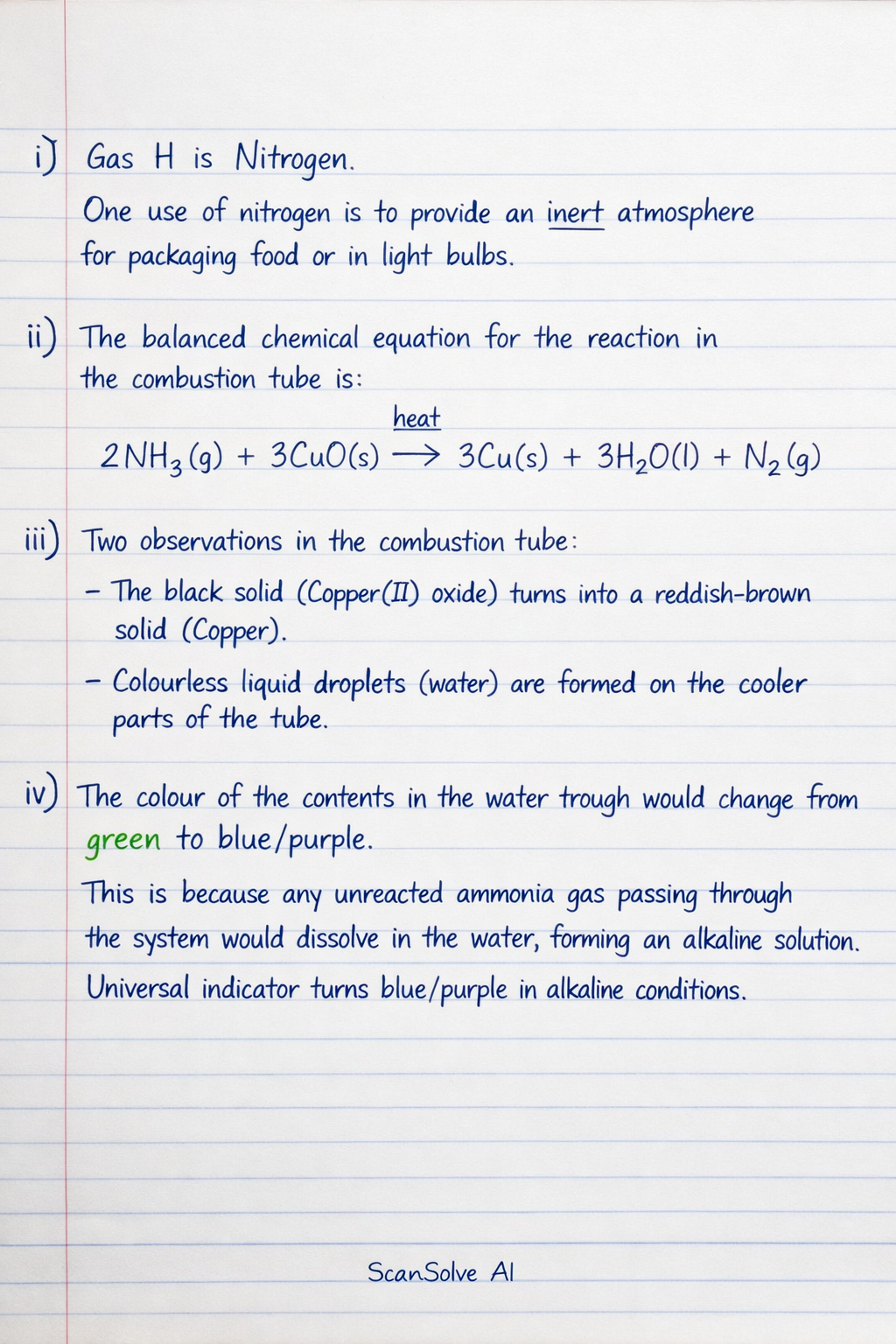
Gas H is *Nitrogen
One use of nitrogen is to provide an inert atmosphere for packaging food or in light bulbs.
Part ii
The balanced chemical equation for the reaction in the combustion tube is
Part iii
Two observations in the combustion tube
- The black solid (Copper(II) oxide) turns into a reddish-brown solid (Copper).
- Colourless liquid droplets (water) are formed on the cooler parts of the tube.
Part iv
The colour of the contents in the water trough would change from *green to blue/purple
This is because any unreacted ammonia gas passing through the system would dissolve in the water, forming an alkaline solution. Universal indicator turns blue/purple in alkaline conditions.
Part v
Step 1: Calculate the moles of ammonia.
Assuming molar volume of gas at room temperature and pressure (RTP) is .
Use the mole ratio from the balanced equation to find moles of water (liquid Z).
From the equation , the mole ratio of is .
Calculate the mass of water (liquid Z).
Molar mass of .
The mass of liquid Z formed is .
Try one yourself
A new problem that tests the same skill.
Still stuck on this one?
Ask a follow-up, and the answer starts from this question.
More Chemistry Questions
Handwritten Step-by-Step Solution
Get this as a handwritten image on WhatsApp — like a tutor wrote it for you.
Try on WhatsApp