
We read your photo as:
An organic compound is composed of 62.17% Carbon, 27.8% Hydrogen, and x oxygen. Determine the empirical formula of the compound.
ScanSolve AI Answer
Answer
Step-by-step solution
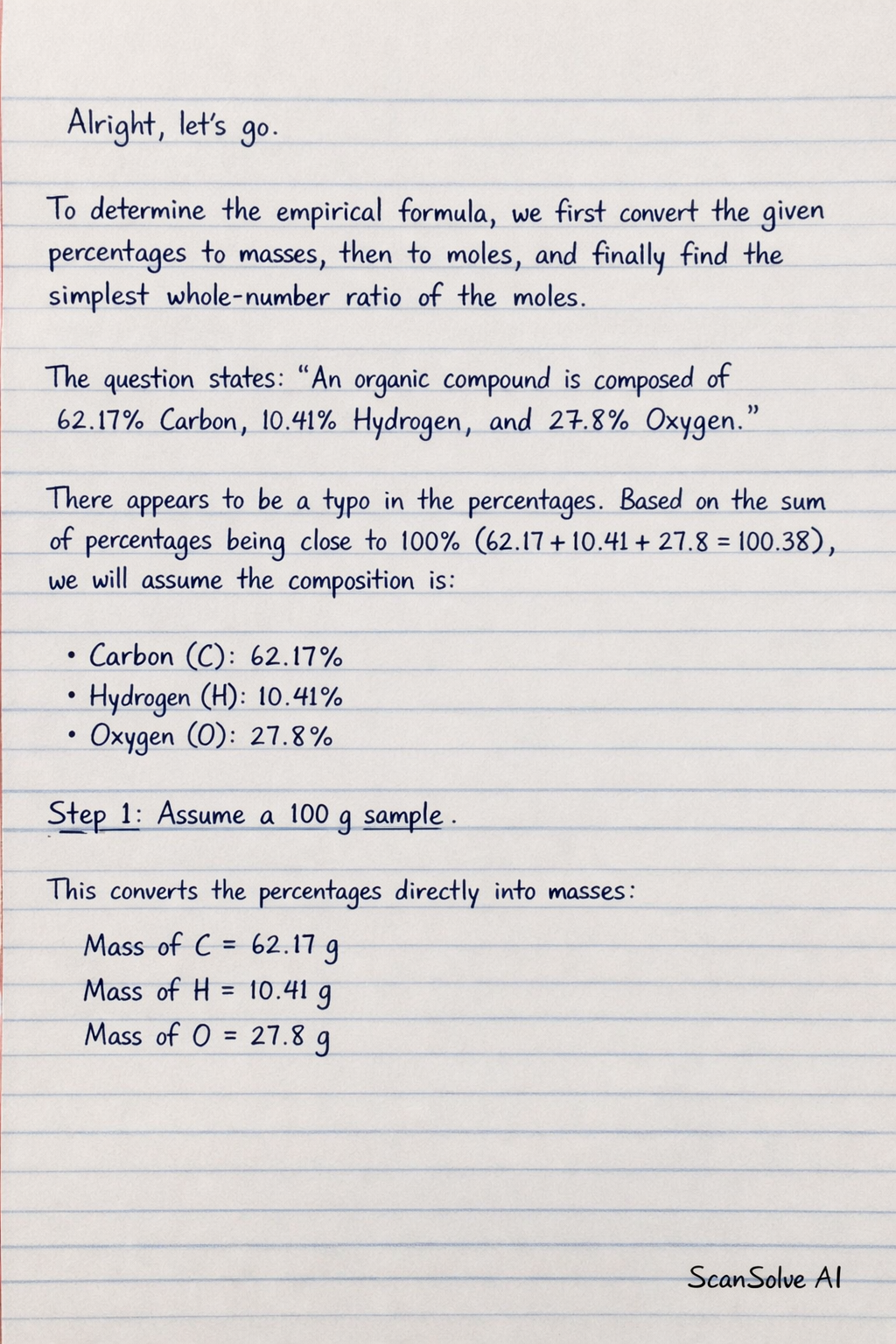
4 stepsTo determine the empirical formula, we first convert the given percentages to masses, then to moles, and finally find the simplest whole-number ratio of the moles.
The question states: "An organic compound is composed of 62.17 Carbon, 10.41% hydrogen, and 27.8% Carbon, x oxygen."
There appears to be a typo in the percentages. Based on the sum of percentages being close to 100% (), we will assume the composition is:
- Carbon (C): 62.17%
- Hydrogen (H): 10.41%
- Oxygen (O): 27.8%
Assume a 100 g sample.
This converts the percentages directly into masses:
Mass of C =
Mass of H =
Mass of O =Convert the mass of each element to moles using their atomic masses (C = 12.01 g/mol, H = 1.008 g/mol, O = 16.00 g/mol).
Moles of C:
Moles of H:
Moles of O:
Divide each mole value by the smallest number of moles to find the simplest mole ratio.
The smallest number of moles is (for Oxygen).
Ratio for C:Ratio for H:
Ratio for O:
Write the empirical formula using these whole-number ratios.
The empirical formula is .
Try one yourself
A new problem that tests the same skill.
Still stuck on this one?
Ask a follow-up, and the answer starts from this question.
More Chemistry Questions
Handwritten Step-by-Step Solution
Get this as a handwritten image on WhatsApp — like a tutor wrote it for you.
Try on WhatsApp