
Avogadro's law; chemical symbols, formula, equations and uses. Relative atomic mass based on C=12, the mole concept and Avogadro's number
ScanSolve AI Answer
Answer
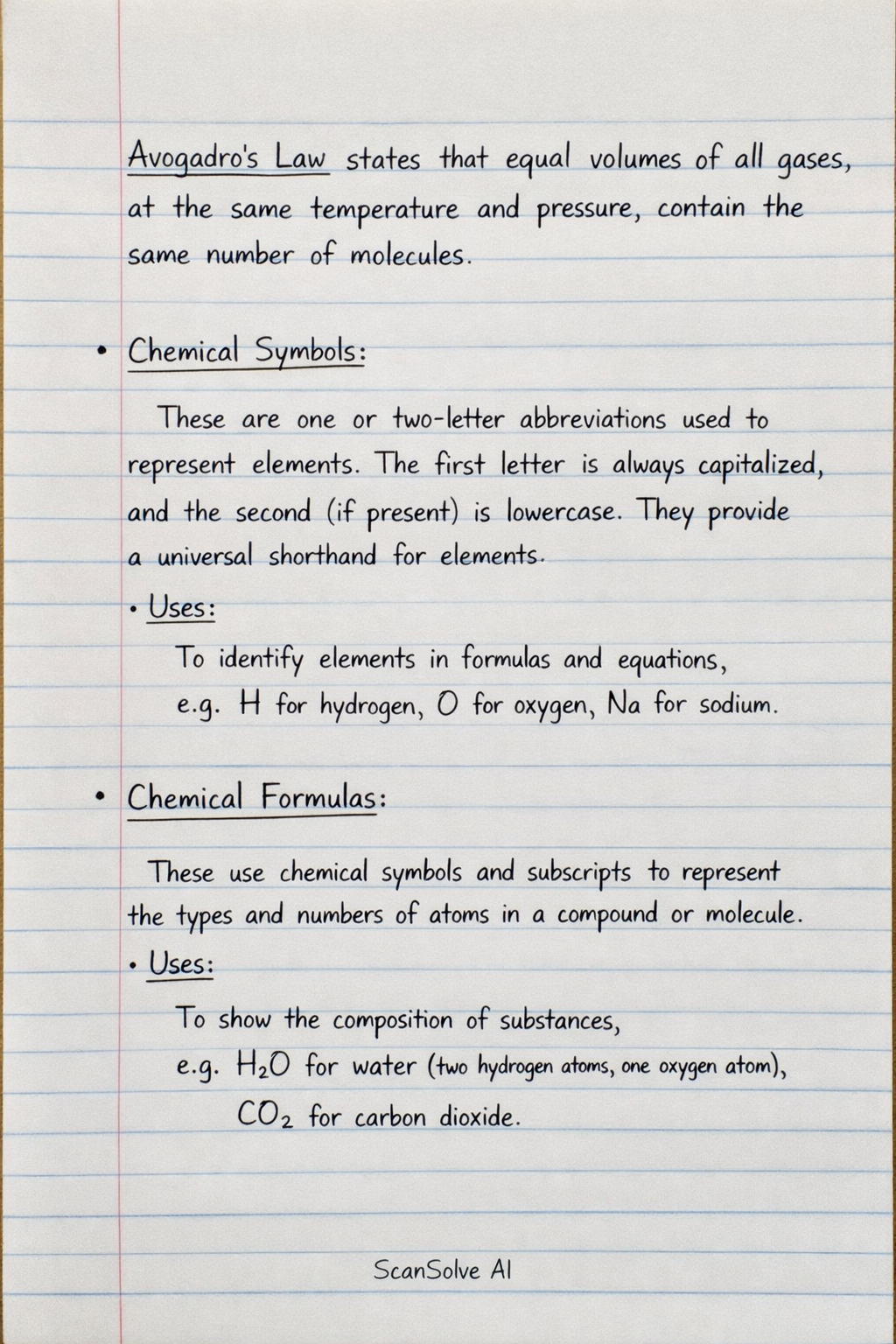
Avogadro's Law states that equal volumes of all gases, at the same temperature and pressure, contain the same number of molecules.
-
Chemical Symbols: These are one or two-letter abbreviations used to represent elements. The first letter is always capitalized, and the second (if present) is lowercase. They provide a universal shorthand for elements.
- Uses: To identify elements in formulas and equations, e.g., for hydrogen, for oxygen, for sodium.
-
Chemical Formulas: These use chemical symbols and subscripts to represent the types and numbers of atoms in a compound or molecule.
- Uses: To show the composition of substances, e.g., for water (two hydrogen atoms, one oxygen atom), for carbon dioxide.
-
Chemical Equations: These represent chemical reactions using chemical formulas for reactants (starting materials) and products (substances formed), separated by an arrow (). They must be balanced to obey the law of conservation of matter.
- Uses: To describe chemical changes, show the substances involved, and indicate stoichiometric relationships, e.g., .
-
Relative Atomic Mass (based on C=12): This is the average mass of an atom of an element compared to the mass of an atom of carbon-12. Carbon-12 is assigned a mass of exactly 12 atomic mass units ().
- Uses: Provides a standard for comparing the masses of atoms of different elements.
-
The Mole Concept: A mole is a unit of amount of substance. It is defined as the amount of substance that contains as many elementary entities (atoms, molecules, ions, etc.) as there are atoms in exactly 12 grams of carbon-12.
- Uses: Provides a convenient way to count large numbers of atoms or molecules and to relate macroscopic masses to microscopic quantities in chemical reactions.
-
Avogadro's Number: This is the number of elementary entities (atoms, molecules, ions, etc.) in one mole of a substance. Its approximate value is .
- Uses: To convert between the number of moles and the number of particles, and to relate molar mass to the mass of individual atoms/molecules.
Still stuck on this one?
Ask a follow-up, and the answer starts from this question.
More Chemistry Questions
Handwritten Step-by-Step Solution
Get this as a handwritten image on WhatsApp — like a tutor wrote it for you.
Try on WhatsApp