

This chemistry question involves key chemical concepts and calculations. The detailed solution below walks through each step, from identifying the reaction type to computing the final answer.
ScanSolve AI Answer
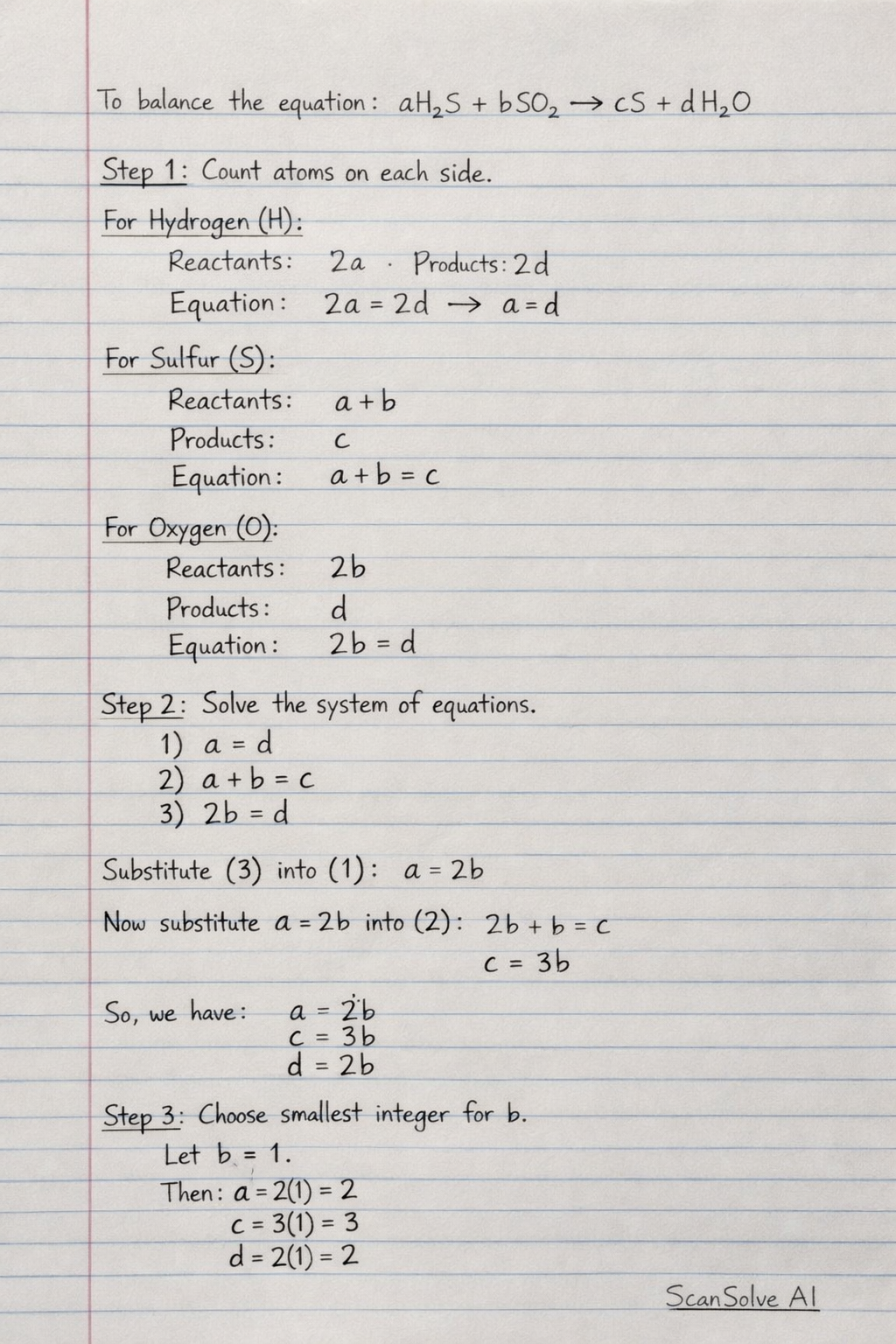
To balance the equation aH_2S + bSO_2 → cS + dH_2O, we need to ensure the number of atoms for each element is the same on both sides of the reaction. Step 1: Write down the number of atoms for each element on both sides of the equation using the coefficients a, b, c, d. For Hydrogen (H): Reactants: 2a Products: 2d Equation: 2a = 2d a = d For Sulfur (S): Reactants: a (from H_2S) + b (from SO_2) Products: c (from S) Equation: a + b = c For Oxygen (O): Reactants: 2b (from SO_2) Products: d (from H_2O) Equation: 2b = d Step 2: Solve the system of equations. We have: 1) a = d 2) a + b = c 3) 2b = d Substitute equation (3) into equation (1): a = 2b Now substitute a = 2b into equation (2): 2b + b = c c = 3b So, we have the relationships: a = 2b c = 3b d = 2b Step 3: Choose the smallest integer value for b to find the coefficients. Let b = 1. Then: a = 2(1) = 2 c = 3(1) = 3 d = 2(1) = 2 Step 4: Check the balanced equation with these coefficients. The balanced equation is 2H_2S + 1SO_2 → 3S + 2H_2O. Reactants: H: 2 × 2 = 4 S: 2 × 1 + 1 × 1 = 3 O: 1 × 2 = 2 Products: H: 2 × 2 = 4 S: 3 × 1 = 3 O: 2 × 1 = 2 All atoms are balanced. Step 5: Compare with the given options. The calculated coefficients are a=2, b=1, c=3, d=2. This matches option A. The final answer is A. a=2, b=1, c=3, d=2. That's 2 down. 3 left today — send the next one.