
We read your photo as:
Balance the chemical equation: Fe + Cl2 -> FeCl3
ScanSolve AI Answer
Answer
Step-by-step solution
6 stepsAssign variables to the stoichiometric coefficients for each reactant and product.
Let , , and be the coefficients for , , and respectively.
Write down the balance equations for each element present in the reaction.
For Iron (Fe): The number of Fe atoms on the reactant side must equal the number of Fe atoms on the product side.
For Chlorine (Cl): The number of Cl atoms on the reactant side must equal the number of Cl atoms on the product side.
Assign a value to one of the variables to solve the system of equations.
Let's assume .
Solve for the other variables using the equations.
From equation (1):
If , then .Substitute into equation (2):
Convert fractional coefficients to whole numbers.
The coefficients are , , . To get whole numbers, multiply all coefficients by the smallest integer that eliminates the fraction, which is 2.
Write the balanced chemical equation using the whole number coefficients.
Try one yourself
A new problem that tests the same skill.
Still stuck on this one?
Ask a follow-up, and the answer starts from this question.
More Chemistry Questions
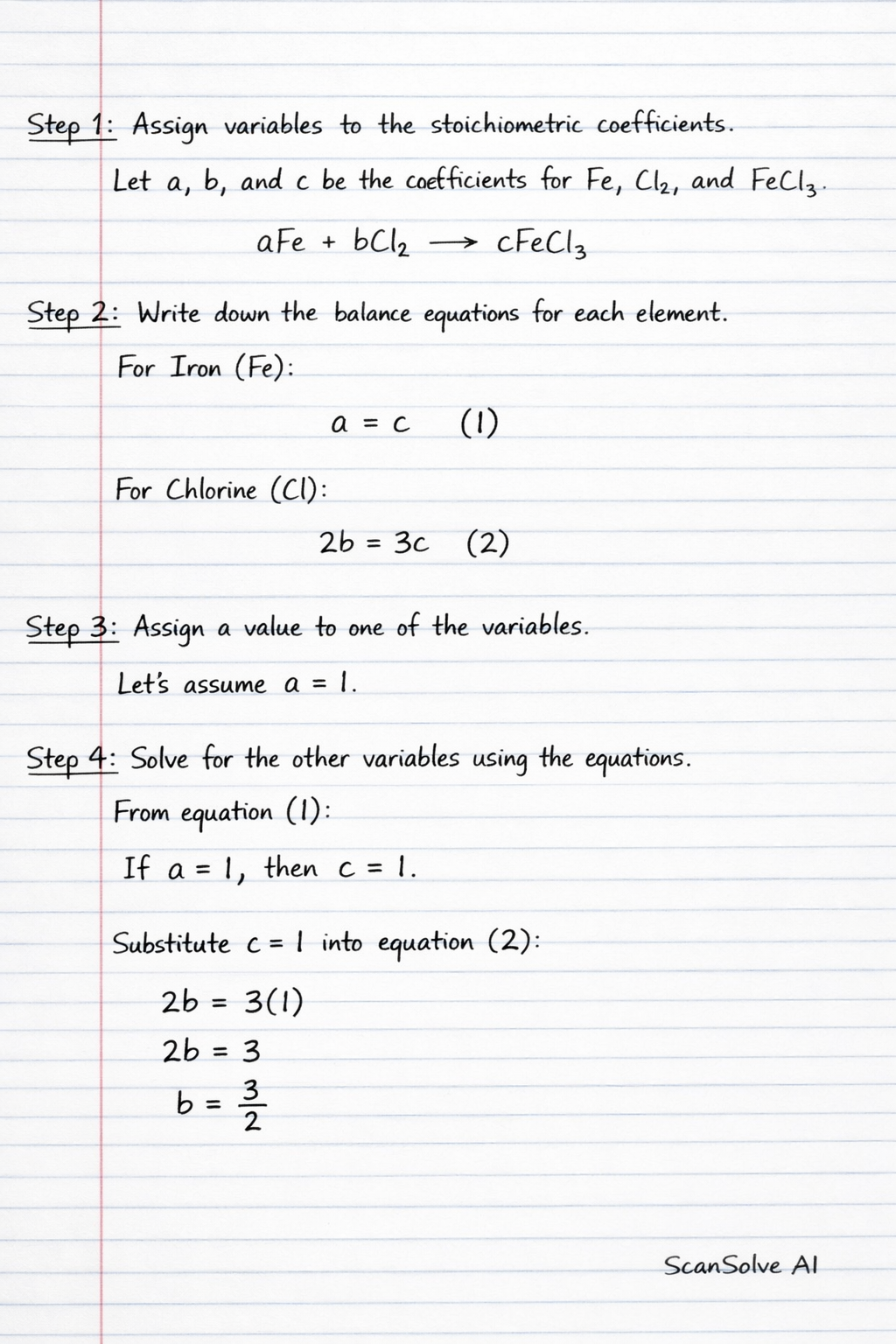
Handwritten Step-by-Step Solution
Get this as a handwritten image on WhatsApp — like a tutor wrote it for you.
Try on WhatsApp