We read your photo as:

Balance the chemical equation for the reaction between copper (II) oxide and sulfuric acid and determine the limiting reactant.

Chemistry

ScanSolve AI Answer

Step-by-step solution

10 steps

Part a· 2 steps

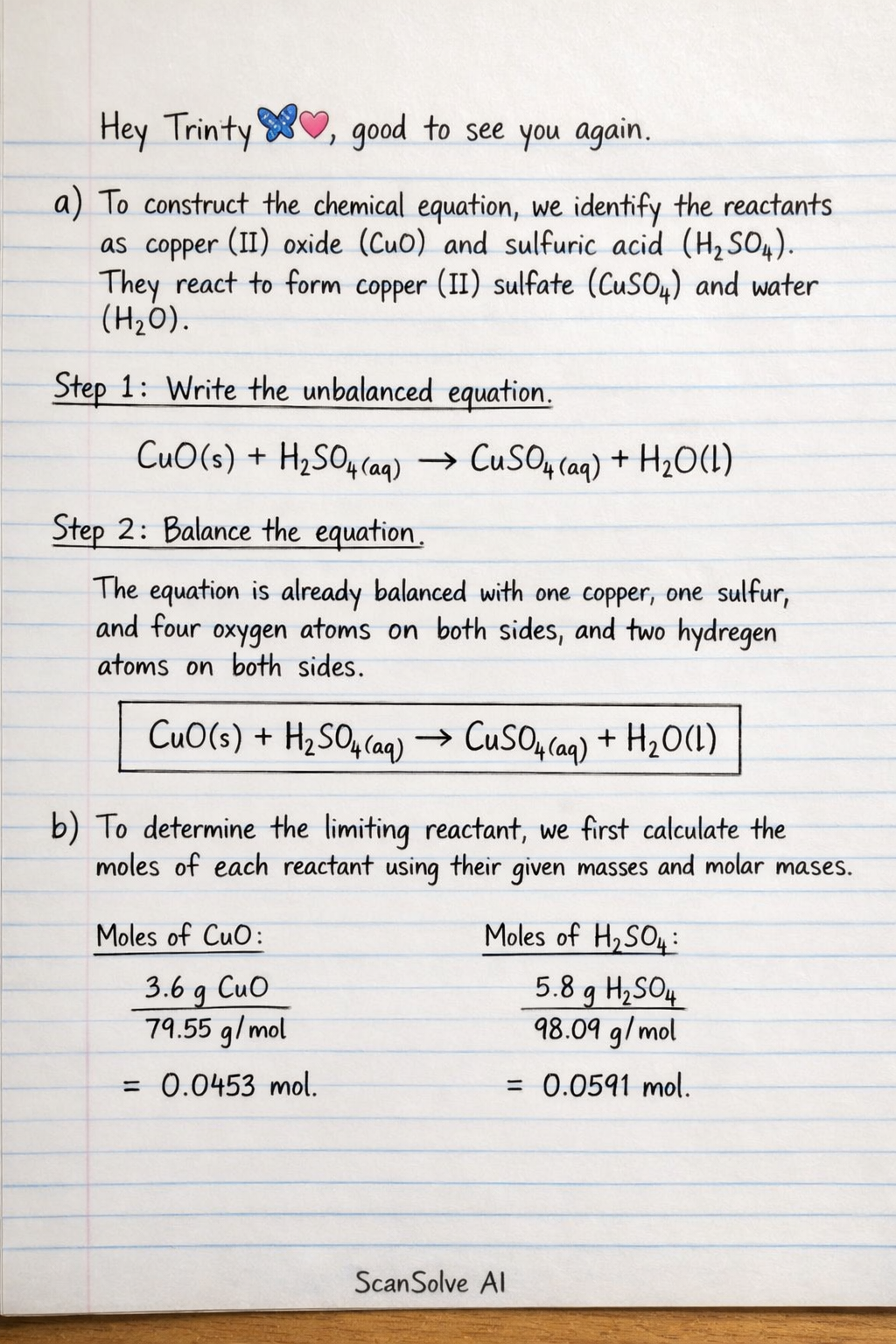
To construct the chemical equation, we identify the reactants as copper (II) oxide (CuO) and sulfuric acid (H₂SO₄). They react to form copper (II) sulfate (CuSO₄) and water (H₂O).

  1. Write the unbalanced equation.

    CuO(s)+H2SO4(aq)⟶CuSO4(aq)+H2O(l)\text{CuO(s)} + \text{H}_{2}\text{SO}_{4}\text{(aq)} \longrightarrow \text{CuSO}_{4}\text{(aq)} + \text{H}_{2}\text{O(l)}
  2. Balance the equation.

    The equation is already balanced with one copper, one sulfur, and four oxygen atoms (excluding the oxygen in water) on both sides, and two hydrogen atoms on both sides.

    CuO(s)+H2SO4(aq)⟶CuSO4(aq)+H2O(l)\boxed{\text{CuO(s)} + \text{H}_{2}\text{SO}_{4}\text{(aq)} \longrightarrow \text{CuSO}_{4}\text{(aq)} + \text{H}_{2}\text{O(l)}}

Part b· 3 steps

To determine the limiting reactant, we first calculate the moles of each reactant using their given masses and molar masses.

  1. Calculate the molar masses of the reactants.

    Molar mass of CuO:

    Cu=63.55 g/mol\text{Cu} = 63.55 \text{ g/mol} O=16.00 g/mol\text{O} = 16.00 \text{ g/mol} Molar mass of CuO=63.55+16.00=79.55 g/mol\text{Molar mass of CuO} = 63.55 + 16.00 = 79.55 \text{ g/mol}

    Molar mass of H₂SO₄:

    H=1.01 g/mol\text{H} = 1.01 \text{ g/mol} S=32.07 g/mol\text{S} = 32.07 \text{ g/mol} O=16.00 g/mol\text{O} = 16.00 \text{ g/mol} Molar mass of H2SO4=(2×1.01)+32.07+(4×16.00)=2.02+32.07+64.00=98.09 g/mol\text{Molar mass of H}_{2}\text{SO}_{4} = (2 \times 1.01) + 32.07 + (4 \times 16.00) = 2.02 + 32.07 + 64.00 = 98.09 \text{ g/mol}
  2. Calculate the moles of each reactant.

    Moles of CuO:

    Moles of CuO=7.95 g79.55 g/mol=0.1000 mol\text{Moles of CuO} = \frac{7.95 \text{ g}}{79.55 \text{ g/mol}} = 0.1000 \text{ mol}

    Moles of H₂SO₄:

    Moles of H2SO4=7.35 g98.09 g/mol=0.07493 mol\text{Moles of H}_{2}\text{SO}_{4} = \frac{7.35 \text{ g}}{98.09 \text{ g/mol}} = 0.07493 \text{ mol}
  3. Identify the limiting reactant.

    From the balanced equation, 1 mole of CuO reacts with 1 mole of H₂SO₄. Since we have fewer moles of H₂SO₄ (0.07493 mol) than CuO (0.1000 mol), sulfuric acid is the limiting reactant.

    The limiting reactant is H2SO4 (sulfuric acid).\boxed{\text{The limiting reactant is H}_{2}\text{SO}_{4} \text{ (sulfuric acid).}}

Part c· 3 steps

To calculate the mass of copper (II) sulfate crystals (CuSO₄·5H₂O) expected, we use the moles of the limiting reactant.

  1. Determine the moles of CuSO₄ produced.

    Based on the stoichiometry of the balanced equation, 1 mole of H₂SO₄ produces 1 mole of CuSO₄.

    Moles of CuSO4=Moles of H2SO4=0.07493 mol\text{Moles of CuSO}_{4} = \text{Moles of H}_{2}\text{SO}_{4} = 0.07493 \text{ mol}
  2. Calculate the molar mass of copper (II) sulfate pentahydrate (CuSO₄·5H₂O).

    Molar mass of CuSO₄:

    Cu=63.55 g/mol\text{Cu} = 63.55 \text{ g/mol} S=32.07 g/mol\text{S} = 32.07 \text{ g/mol} O=16.00 g/mol\text{O} = 16.00 \text{ g/mol} Molar mass of CuSO4=63.55+32.07+(4×16.00)=159.62 g/mol\text{Molar mass of CuSO}_{4} = 63.55 + 32.07 + (4 \times 16.00) = 159.62 \text{ g/mol}

    Molar mass of 5H₂O:

    H2O=(2×1.01)+16.00=18.02 g/mol\text{H}_{2}\text{O} = (2 \times 1.01) + 16.00 = 18.02 \text{ g/mol} Molar mass of 5H2O=5×18.02=90.10 g/mol\text{Molar mass of 5H}_{2}\text{O} = 5 \times 18.02 = 90.10 \text{ g/mol}

    Molar mass of CuSO₄·5H₂O:

    Molar mass of CuSO4⋅5H2O=159.62+90.10=249.72 g/mol\text{Molar mass of CuSO}_{4}\cdot5\text{H}_{2}\text{O} = 159.62 + 90.10 = 249.72 \text{ g/mol}
  3. Calculate the theoretical mass of CuSO₄·5H₂O.

    Theoretical mass=Moles of CuSO4×Molar mass of CuSO4⋅5H2O\text{Theoretical mass} = \text{Moles of CuSO}_{4} \times \text{Molar mass of CuSO}_{4}\cdot5\text{H}_{2}\text{O} Theoretical mass=0.07493 mol×249.72 g/mol=18.71 g\text{Theoretical mass} = 0.07493 \text{ mol} \times 249.72 \text{ g/mol} = 18.71 \text{ g} The theoretical mass of copper (II) sulfate crystals is 18.7 g.\boxed{\text{The theoretical mass of copper (II) sulfate crystals is } 18.7 \text{ g.}}

Part d· 2 steps

To calculate the percentage yield, we use the actual yield obtained and the theoretical yield calculated in part (c).

  1. State the actual and theoretical yields.

    Actual yield = 16.3 g
    Theoretical yield = 18.71 g

  2. Calculate the percentage yield.

    Percentage yield=Actual yieldTheoretical yield×100%\text{Percentage yield} = \frac{\text{Actual yield}}{\text{Theoretical yield}} \times 100\% Percentage yield=16.3 g18.71 g×100%=87.1%\text{Percentage yield} = \frac{16.3 \text{ g}}{18.71 \text{ g}} \times 100\% = 87.1\% The percentage yield is 87.1%.\boxed{\text{The percentage yield is } 87.1\%.}
Was this helpful?

Still stuck on this one?

Ask a follow-up, and the answer starts from this question.

Got a different question?Ask your own question
Handwritten step-by-step solution preview

Handwritten Step-by-Step Solution

Get this as a handwritten image on WhatsApp — like a tutor wrote it for you.

Try on WhatsApp