
Brife notes under The mole concept and stochiometry
Chemistry
ScanSolve AI Answer
Here are brief notes on The Mole Concept and Stoichiometry:
-
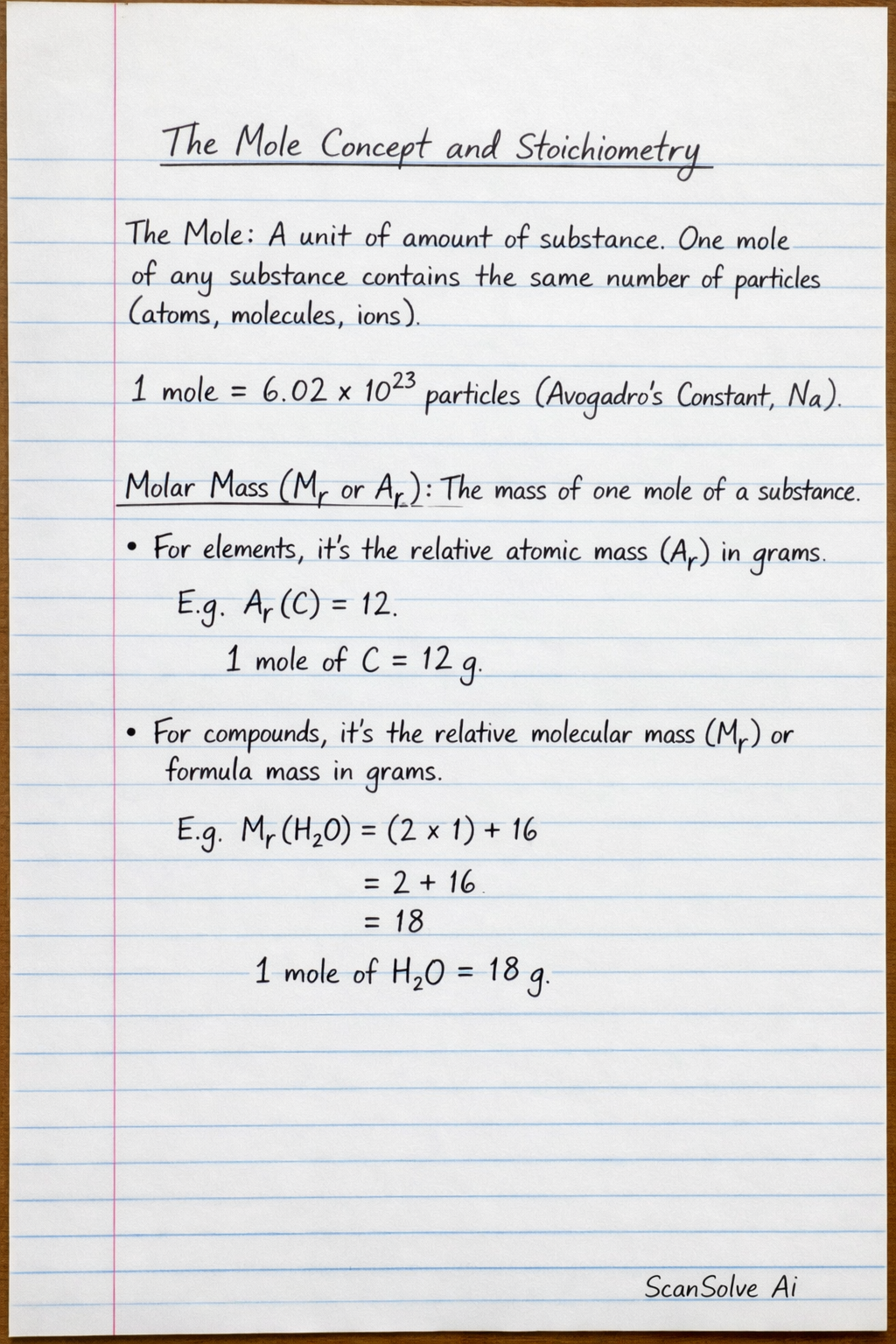
The Mole: A unit of amount of substance. One mole of any substance contains the same number of particles (atoms, molecules, ions).
-
Molar Mass ( or ): The mass of one mole of a substance.
- For elements, it's the relative atomic mass () in grams. E.g., , so .
- For compounds, it's the relative molecular mass () or formula mass in grams. E.g., , so .
-
Calculating Moles:
- From mass:
- From number of particles:
- For gases at room temperature and pressure (r.t.p., , ): . (Note: At standard temperature and pressure (s.t.p., , ), .)
-
Stoichiometry: The study of the quantitative relationships between reactants and products in a chemical reaction.
- Mole Ratio: Derived from the balanced chemical equation, it shows the ratio of moles of reactants consumed and products formed. Example: The mole ratio of is .
-
Calculations using Stoichiometry:
- Write a balanced chemical equation.
- Convert known quantities (mass, volume, particles) to moles.
- Use the mole ratio from the balanced equation to find moles of the unknown substance.
- Convert moles of the unknown substance back to the required quantity (mass, volume, particles).
-
Empirical Formula: The simplest whole-number ratio of atoms in a compound.
- To find: Convert mass/percentage of each element to moles, divide by the smallest number of moles, and simplify to the simplest whole-number ratio.
-
Molecular Formula: The actual number of atoms of each element in a molecule.
- It is a whole-number multiple of the empirical formula.
Was this helpful?
Still stuck on this one?
Ask a follow-up, and the answer starts from this question.
Got a different question?Ask your own question
More Chemistry Questions
Handwritten Step-by-Step Solution
Get this as a handwritten image on WhatsApp — like a tutor wrote it for you.
Try on WhatsApp