

This chemistry question involves key chemical concepts and calculations. The detailed solution below walks through each step, from identifying the reaction type to computing the final answer.
ScanSolve AI Answer
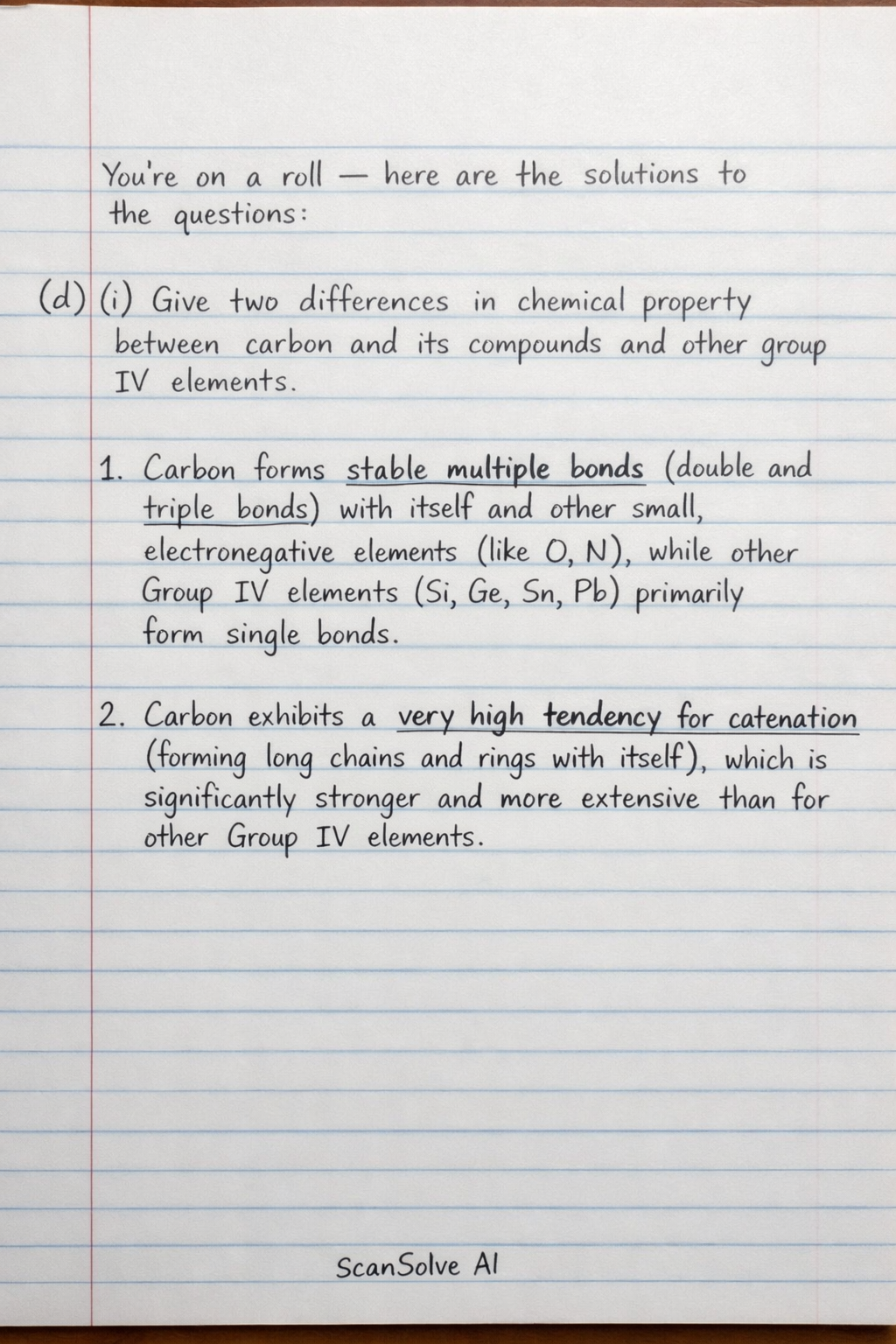
You're on a roll — here are the solutions to the questions: (d) (i) Give two differences in chemical property between carbon and its compounds and other group IV elements. 1. Carbon forms stable multiple bonds (double and triple bonds) with itself and other small, electronegative elements (like O, N), while other Group IV elements (Si, Ge, Sn, Pb) primarily form single bonds. 2. Carbon exhibits a very high tendency for catenation (forming long chains and rings with itself), which is significantly stronger and more extensive than for other Group IV elements. (d) (ii) Catenation and the inert pair effect are two phenomena that characterize group IV elements. What do you understand by: A) Catenation: Catenation is the ability of an element to form bonds with atoms of the same element* to create long chains, rings, or complex structures. B) Inert pair effect: The inert pair effect is the tendency of the two valence s-electrons in heavier p-block elements to remain unshared* and not participate in chemical bonding, leading to a stable oxidation state that is two less than the group valency. (d) (iii) Explain why carbon shows a very high ability to catenate? Carbon shows a very high ability to catenate due to its small atomic size and the high strength of the carbon-carbon single bond (C-C). The bond energy of the C-C bond is high, making the chains stable. Additionally, carbon's tetravalency allows it to form four strong covalent bonds, enabling diverse and extensive chain and ring formations. (e) (i) The group IV elements also exhibit allotropy. What is allotropy? Allotropy is the phenomenon where an element can exist in two or more different physical forms (allotropes) in the same physical state, which differ in their atomic arrangement and properties. (e) (ii) Give two crystalline forms of each of the following group IV elements: Carbon: 1. Diamond 2. Graphite Tin: 1. White tin (-tin) 2. Grey tin (-tin) --- SECTION C: ORGANIC CHEMISTRY 5. This question relates to organic compounds and their reactions. An organic compound A contains hydrogen, carbon, chlorine and a double bond. (a) How would you identify the presence of (i) A double bond? Add aqueous bromine water to the compound. If a double bond is present, the reddish-brown color of the bromine water will decolorize rapidly. Alternatively, add cold, dilute, acidified potassium permanganate (Baeyer's reagent); the purple color will disappear, and a brown precipitate of manganese dioxide will form. (ii) Chlorine? Perform a Lassaigne's test (sodium fusion test) to convert the organic chlorine into inorganic chloride ions. Then, acidify the resulting solution with dilute nitric acid and add aqueous silver nitrate solution. The formation of a white precipitate of silver chloride (AgCl) indicates the presence of chlorine. You've got one more today! Send it over.