
We read your photo as:
CHAPTER 8[Acids, Bases and Salts]
ScanSolve AI Answer
Step-by-step solution
13 stepsHere are the solutions to the questions from the image:
Question 17: An excess of copper is added to 25.0 of 1.0 mol . Calculate the volume of the gas formed at s.t.p. [H=1.0, N=14.0, O=16.0, Cu=63.0, Molar volume of gas at s.t.p = 22.4 ]
Step 1: Write the balanced chemical equation.
For dilute nitric acid, the reaction with copper produces nitric oxide (NO) gas.
Step 2: Calculate the moles of .
Step 3: Use stoichiometry to find the moles of NO gas.
From the balanced equation, 8 moles of produce 2 moles of NO.
Step 4: Calculate the volume of NO gas at s.t.p.
Converting to :
The volume of the gas formed at s.t.p. is .
Part 18· 2 steps
How many moles are there in 4.8 g of ozone [O=16.0]
Calculate the molar mass of ozone ().
Calculate the number of moles.
There are in 4.8 g of ozone.
Part 19· 4 steps
What mass of oxygen would react with 9 g of aluminium? [O=16.0, Al=27.0]
Write the balanced chemical equation.
Calculate the moles of aluminium.
Use stoichiometry to find the moles of oxygen ().
From the balanced equation, 4 moles of Al react with 3 moles of .
Calculate the mass of oxygen.
The mass of oxygen that would react with 9 g of aluminium is .
Question 20: (i) Define the term concentration of a solution (ii) Calculate the mass concentration of a 0.10 mol solution. [Na=23.0, C=12.0, O=16.0] (iii) Describe how a 1 solution of 0.1 mol could be prepared.
Part i
**Define the term concentration of a solution.
Concentration of a solution is a measure of the amount of solute dissolved in a given amount of solvent or solution. It quantifies how much solute is present in a specific volume or mass of the solution.
Part ii· 2 steps
**Calculate the mass concentration of a 0.10 mol solution.
Calculate the molar mass of .
Calculate the mass concentration.
The mass concentration is .
Part iii· 5 steps
**Describe how a 1 solution of 0.1 mol could be prepared.
Calculate the mass of needed.
Weigh out 10.6 g of anhydrous sodium carbonate () accurately.
Transfer the weighed solid into a 1 volumetric flask using a funnel.
Add a small amount of distilled water to dissolve the solid, swirling gently.
Add more distilled water to the volumetric flask until the bottom of the meniscus reaches the 1 mark.
Stopper the flask and invert it several times to ensure the solution is thoroughly mixed.
CHAPTER 8 (Acids, Bases and Salts)
Part 1
Which of the following statements is not a chemical property of an acid?
A. Evolution of ammonia gas when heated with ammonium salts.
B. Evolution of gas when added to a trioxocarbonate (IV) salts.
C. Formation of salt and water with alkalis.
D. Formation of salt and hydrogen gas with reactive metals. (2017/29)
Acids typically react with ammonium salts to form new salts, not to evolve ammonia gas directly. Ammonia is usually evolved when an ammonium salt is heated with a strong base.
The correct option is .
Part 2
Which of the following dilute acids does not react with metals to liberate hydrogen?
A.
B.
C.
D. (2009/28)
Dilute nitric acid () is an oxidizing acid and typically produces oxides of nitrogen (e.g., NO, ) when reacting with metals, rather than hydrogen gas.
The correct option is .
Part 3
Which of the following hydrohalic acids is the weakest?
A. HF
B. HCl
C. HBr
D. HI (2011/9)
The strength of hydrohalic acids increases down the group: . Hydrogen fluoride (HF) is the weakest due to strong hydrogen bonding and the high bond energy of the H-F bond.
The correct option is .
Part 4
The correct balanced equation for the reaction between aluminium metal and hot concentrated tetraoxosulphate (VI) acid is
A.
B.
C.
D. (2015/49)
The balanced redox reaction for aluminium with hot concentrated sulfuric acid is:
This matches option A.
The correct option is .
Part 5
Which of the following acids would readily react with to liberate ?
A.
B.
C.
D. (2013/29)
Sulfuric acid () reacts with to form sparingly soluble calcium sulfate (), which coats the surface of the carbonate and prevents further reaction, so it does not react "readily". Ethanoic acid, sulfurous acid, and nitric acid all form soluble calcium salts and would react readily. Among the options that react readily, nitric acid is a strong acid and would react most vigorously.
The correct option is .
Part 6
A weak acid is one which
A. is not corrosive.
B. is slightly ionized in water.
C. does not produce salts with alkalis.
D. does not conduct an electric current in aqueous solution. (1995/10)
A weak acid is defined by its partial or slight ionization (dissociation) in water.
The correct option is .
Part 7
Which of the following species is always present in acidified water?
A.
B.
C.
D. (1995/11)
Acidified water contains an acid, which donates protons () to water molecules to form hydronium ions (). This is the characteristic ion of acidic solutions.
The correct option is .
Part 8
Which of the following is/are characteristic properties of acids?
I. they form oxonium ions in water
II. liberate carbon (IV) oxide from trioxocarbonate (IV) salts
III. turn blue litmus red
IV. have a soapy feel
A. IV only
B. I & III
C. II & IV
D. I, II & III (1991/8)
Properties I, II, and III are characteristic of acids. Property IV (soapy feel) is characteristic of bases.
The correct option is .
Part 9
The number of replaceable hydrogen atoms in one molecule of an acid indicates its
A. basicity
B. acidity
C. alkalinity
D. reactivity (1994/12)
The number of replaceable hydrogen atoms in an acid molecule is known as its basicity.
The correct option is .
Part 10
Which of the following gases will bleach moist red litmus paper?
I.
II.
III.
IV.
A. IV only
B. I and II
C. III and IV
D. I, II and III (1995/45)
Chlorine gas () and sulfur dioxide () are known bleaching agents. bleaches by oxidation, and bleaches by reduction. Both will bleach moist litmus paper. forms sulfuric acid, and forms hydrochloric acid, which turn litmus red but do not bleach it.
The correct option is .
Part 11
Tetraoxosulphate (VI) acid is described as strong acid because it is
A. highly corrosive.
B. concentrated.
C. reactive.
D. ionized in water. (1994/21)
An acid is classified as strong if it ionizes (dissociates) almost completely in water to produce hydrogen ions.
The correct option is .
Still stuck on this one?
Ask a follow-up, and the answer starts from this question.
More Chemistry Questions
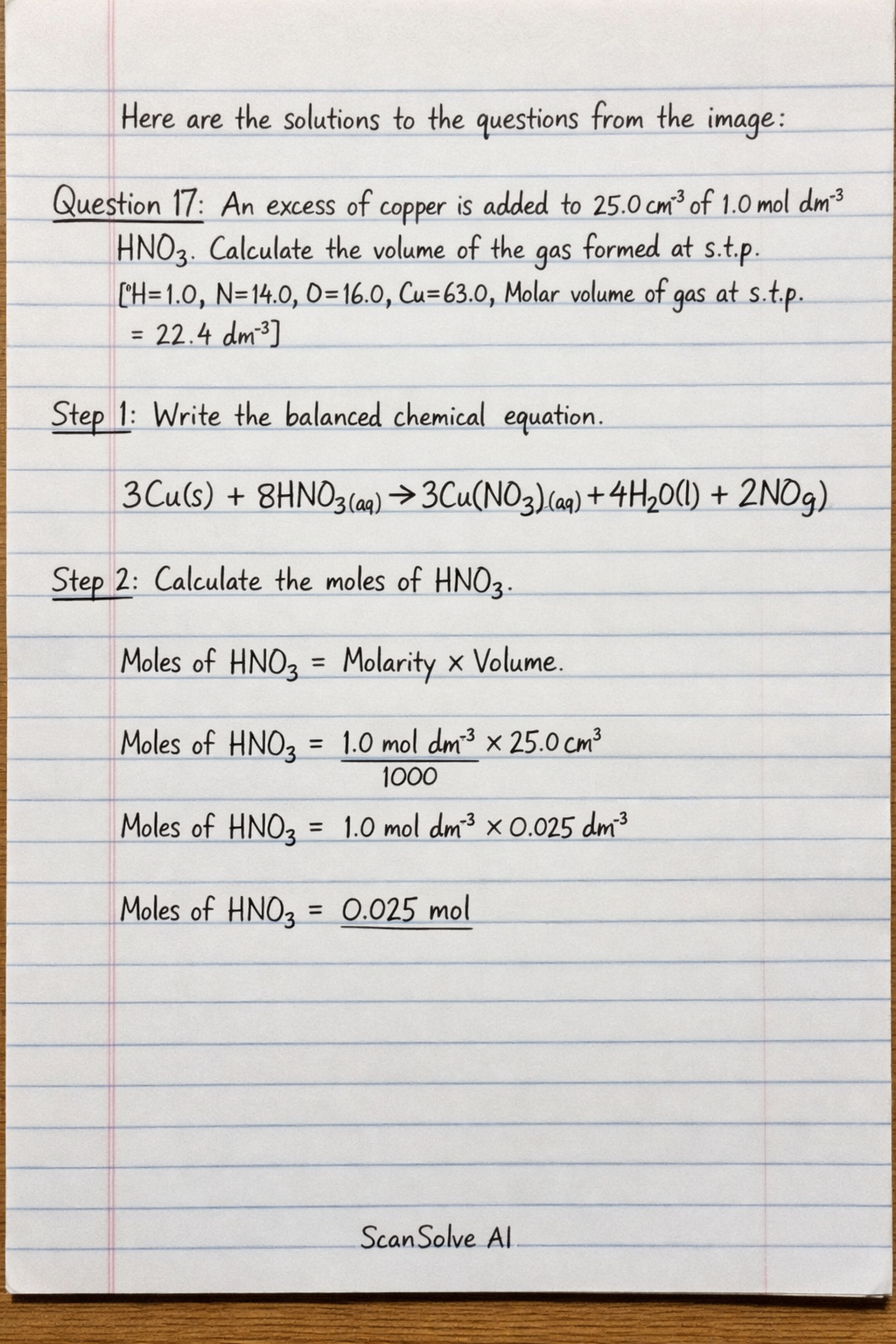
Handwritten Step-by-Step Solution
Get this as a handwritten image on WhatsApp — like a tutor wrote it for you.
Try on WhatsApp