
We read your photo as:
Explain chemical equilibrium and determine the heat of reaction for a given scenario using Le Chatelier's principle.
ScanSolve AI Answer
Answer
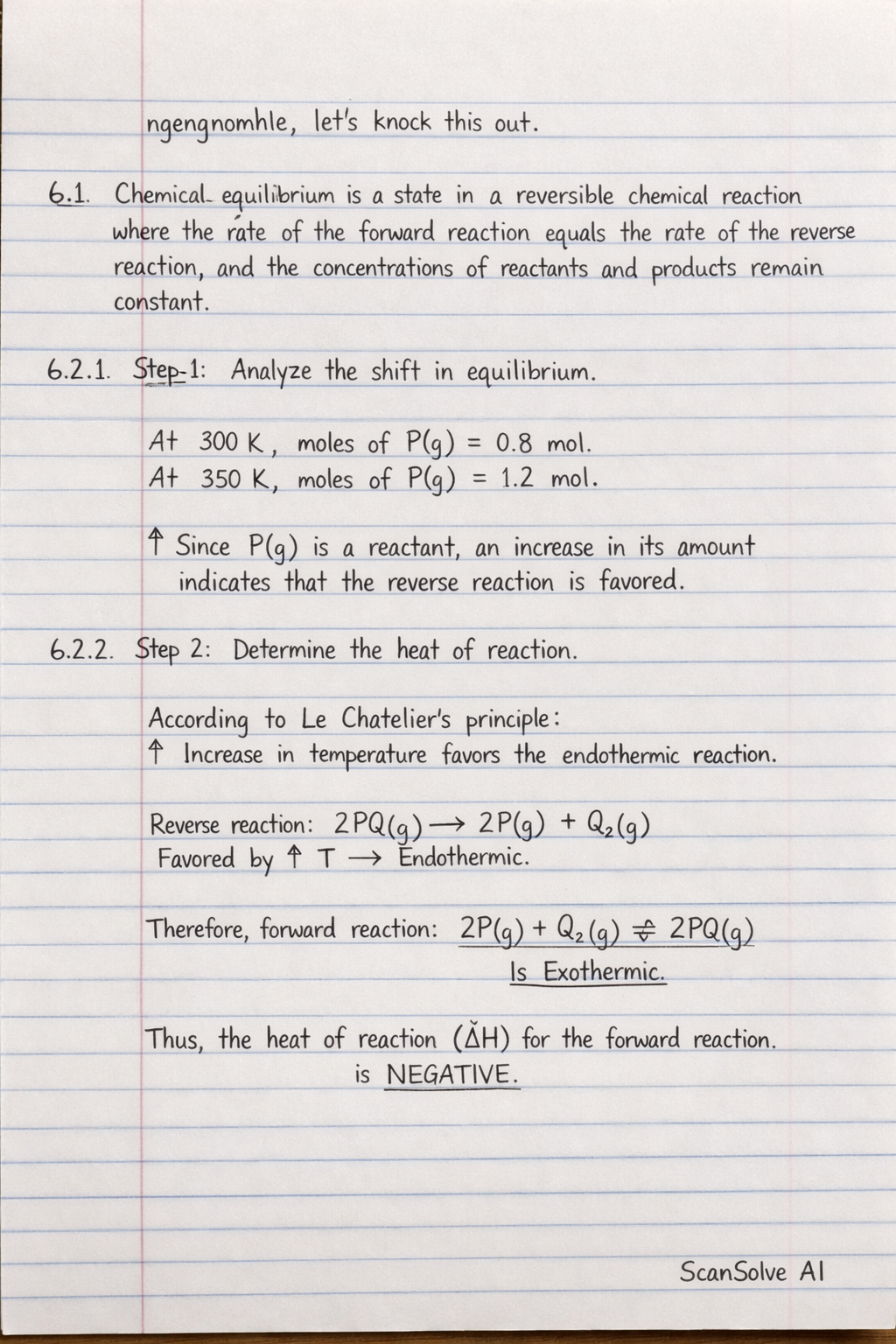
6.1 Chemical equilibrium is a state in a reversible chemical reaction where the rate of the forward reaction equals the rate of the reverse reaction, and the concentrations of reactants and products remain constant.
Step-by-step solution
4 steps6.2.1
Analyze the shift in equilibrium.
At , the moles of are . When the temperature is increased to , the moles of increase to . Since is a reactant, an increase in its amount indicates that the reverse reaction is favored.
Determine the heat of reaction.
According to Le Chatelier's principle, an increase in temperature favors the endothermic reaction. Since the reverse reaction () is favored by an increase in temperature, the reverse reaction is endothermic. Therefore, the forward reaction () is exothermic.
The heat of the reaction () for the forward reaction is NEGATIVE.6.2.2
Le Chatelier's principle states that if a change of condition is applied to a system in equilibrium, the system will shift in a direction that relieves the stress. In this case, increasing the temperature is a stress. The system relieves this stress by favoring the reaction that absorbs heat, which is the endothermic reaction. Since the amount of reactant increased, the equilibrium shifted to the left (reverse reaction). This means the reverse reaction is endothermic, and consequently, the forward reaction is exothermic.6.2.3
Calculate the moles of each substance at the new equilibrium at .
The initial moles at are:
At , the new equilibrium has .
The change in moles of is .
Since the reaction is , and increased by , the reverse reaction occurred.
Based on the stoichiometry of the reverse reaction ():- If increased by , then increased by .
- decreased by . The moles at equilibrium are:
Calculate the concentrations of each substance at .
The volume of the container is .
$[Q_2] = \
Still stuck on this one?
Ask a follow-up, and the answer starts from this question.
More Chemistry Questions
Handwritten Step-by-Step Solution
Get this as a handwritten image on WhatsApp — like a tutor wrote it for you.
Try on WhatsApp