
This chemistry question involves key chemical concepts and calculations. The detailed solution below walks through each step, from identifying the reaction type to computing the final answer.
ScanSolve AI Answer
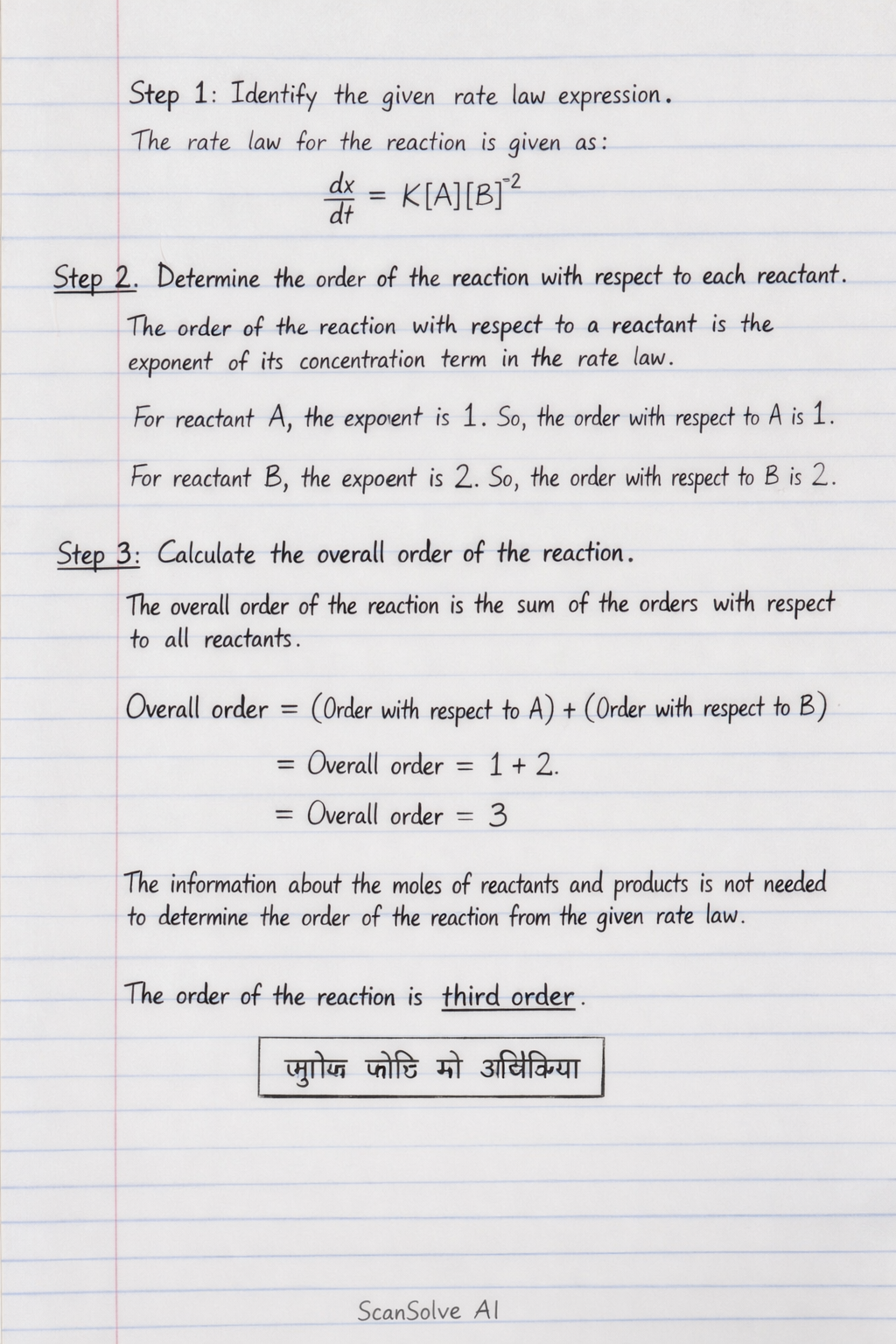
Step 1: Identify the given rate law expression. The rate law for the reaction is given as: (dx)/(dt) = K[A][B]^2 Step 2: Determine the order of the reaction with respect to each reactant. The order of the reaction with respect to a reactant is the exponent of its concentration term in the rate law. For reactant A, the exponent is 1. So, the order with respect to A is 1. For reactant B, the exponent is 2. So, the order with respect to B is 2. Step 3: Calculate the overall order of the reaction. The overall order of the reaction is the sum of the orders with respect to all reactants. Overall order = (Order with respect to A) + (Order with respect to B) Overall order = 1 + 2 Overall order = 3 The information about the moles of reactants and products is not needed to determine the order of the reaction from the given rate law. The order of the reaction is third order. तृतीय कोटि की अभिक्रिया