
We read your photo as:
Given: altitude (h) = 6 cm, base edge (s) = 4 cm.
ScanSolve AI Answer
Step-by-step solution
14 steps8:
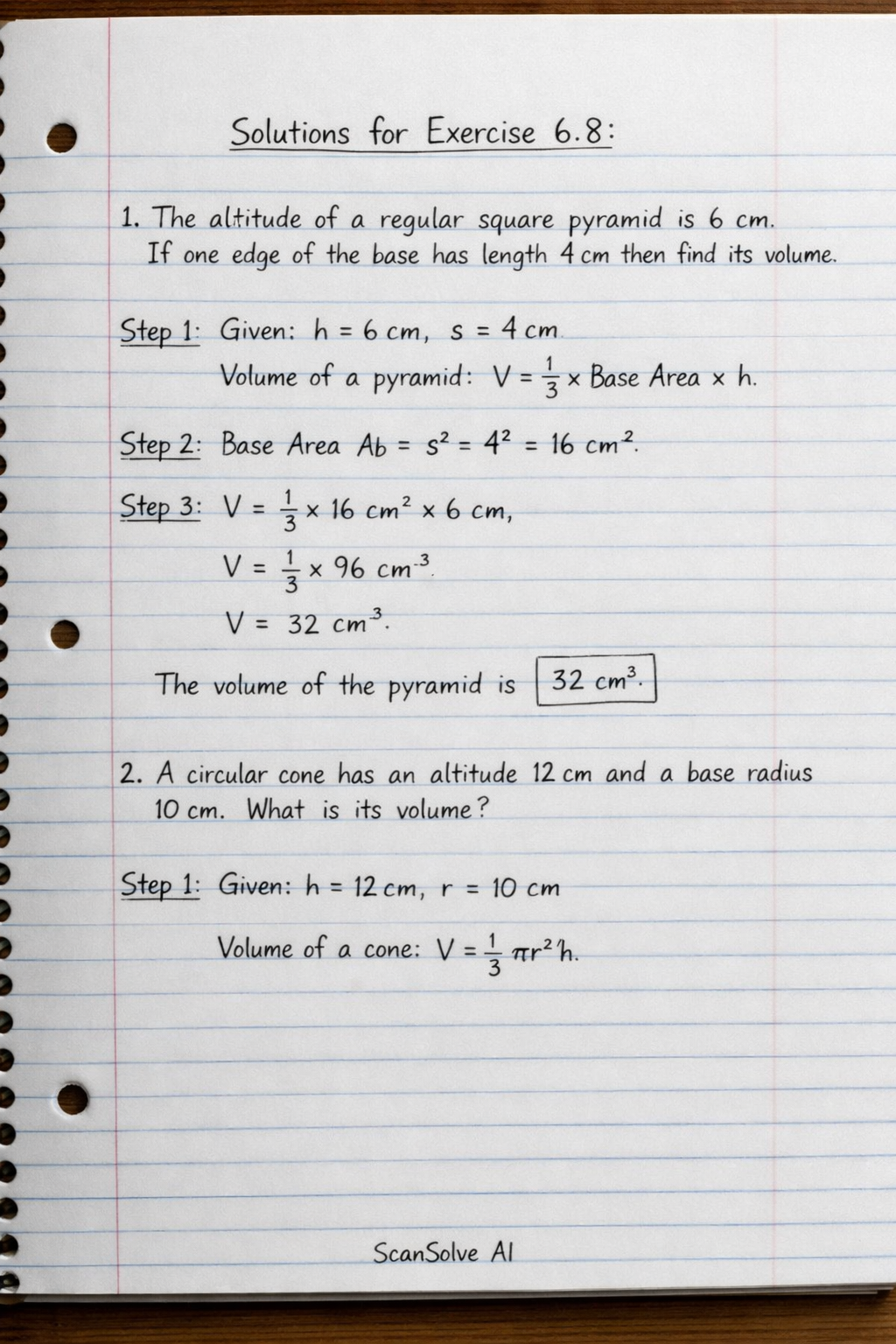
1. The altitude of a regular square pyramid is 6 cm. If one edge of the base has length 4 cm then find its volume.
Identify the given values and the formula for the volume of a pyramid.
Given: altitude () = 6 cm, base edge () = 4 cm.
The volume of a pyramid is .Calculate the area of the square base.
Base Area () = .
Calculate the volume of the pyramid.
The volume of the pyramid is .
2. A circular cone has an altitude 12 cm and a base radius 10 cm. What is its volume?
Identify the given values and the formula for the volume of a cone.
Given: altitude () = 12 cm, base radius () = 10 cm.
The volume of a cone is .Substitute the values into the formula and calculate the volume.
Using :
The volume of the cone is .
3. A right circular cone has height 10 cm and circumference of the base is cm. Find its volume.
Identify the given values and use the circumference to find the radius.
Given: height () = 10 cm, circumference () = cm.
The formula for circumference is .Divide both sides by :
Calculate the volume of the cone using the found radius and given height.
The volume of a cone is .
Using :
The volume of the cone is .
4. The lateral edge of a regular tetrahedron is 6 cm. Find its total surface area and its volume.
Identify the given value and formulas for a regular tetrahedron.
Given: lateral edge () = 6 cm.
A regular tetrahedron has 4 equilateral triangular faces.
Area of one equilateral triangle with side : .
Total Surface Area () = .
Volume () of a regular tetrahedron with edge : .Calculate the total surface area.
Using :
Calculate the volume.
Using :
The total surface area is
\boxed{\text{36\sqrt{3} cm}^2 \text{ or approximately 62.35 cm}^2}and the volume is\boxed{\text{18\sqrt{2} cm}^3 \text{ or approximately 25.45 cm}^3}.5. A right circular conical vessel of altitude 20 cm and base radius 10 cm is kept with its vertex downwards. If one liter of water is poured into it, how high above the vertex will the level of the water be? Use .
Identify the given dimensions of the conical vessel and the volume of water.
Vessel altitude () = 20 cm, vessel base radius () = 10 cm.
Volume of water () = 1 liter = 1000 cm.
Use .Establish the relationship between the radius () and height () of the water using similar triangles.
Since the vessel is vertex downwards, the water forms a smaller cone similar to the vessel.
The ratio of radius to height is constant: .Write the volume of water in terms of its height ().
The volume of the water cone is .
Substitute :Solve for using the given volume of water.
Multiply both sides by 12:
Divide by 3.14:
Take the cube root:
The level of the water will be approximately .
Still stuck on this one?
Ask a follow-up, and the answer starts from this question.
More Chemistry Questions
Handwritten Step-by-Step Solution
Get this as a handwritten image on WhatsApp — like a tutor wrote it for you.
Try on WhatsApp