
We read your photo as:
Define the term rate of reaction.
ScanSolve AI Answer
Answer
Step-by-step solution
6 stepsDefine the term rate of reaction.
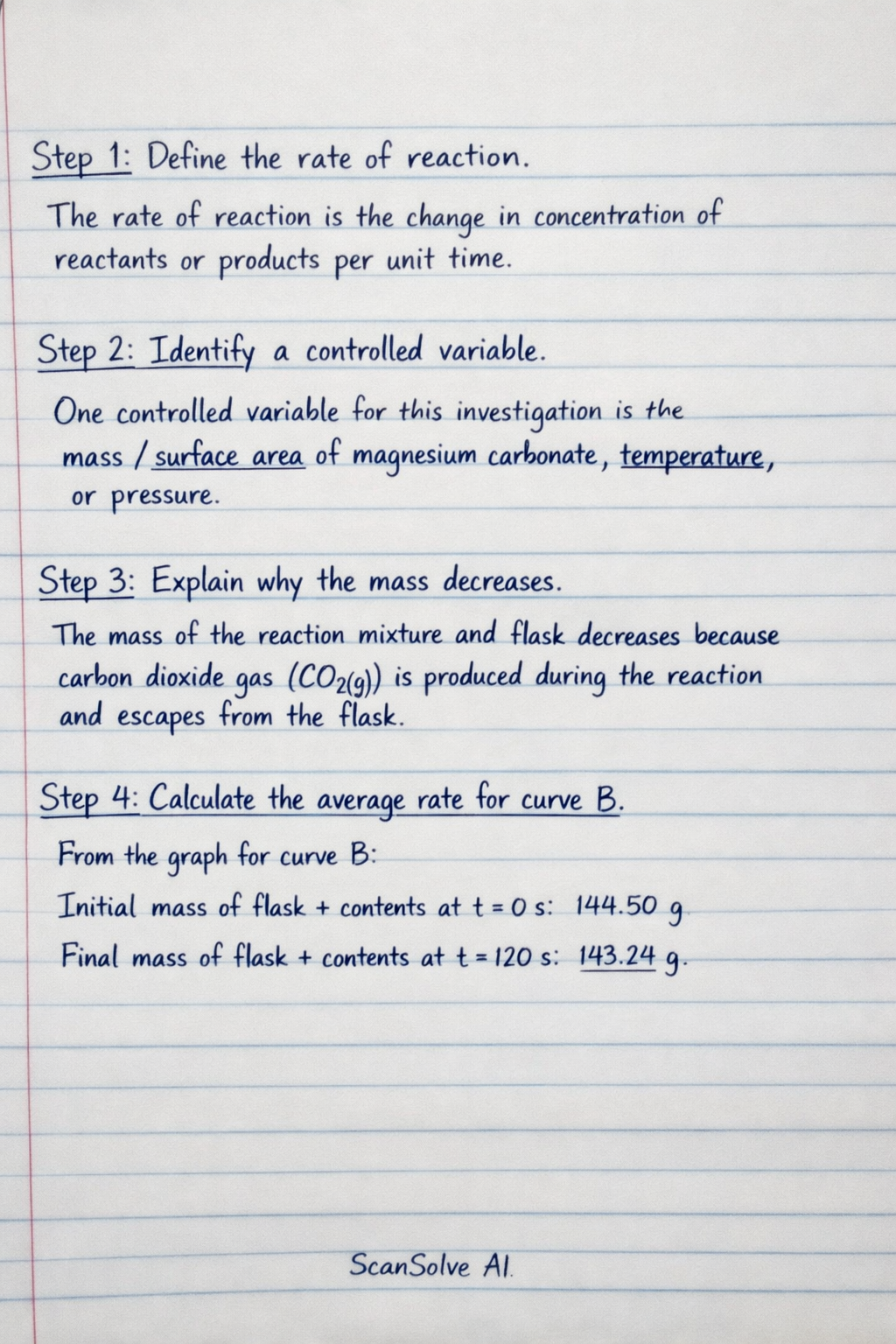
The rate of reaction is the change in concentration of reactants or products per unit time.
Identify a controlled variable.
One controlled variable for this investigation is the mass/surface area of magnesium carbonate, temperature, or pressure.
Explain why the mass decreases.
The mass of the reaction mixture and flask decreases because carbon dioxide gas () is produced during the reaction and escapes from the flask.
Calculate the average rate for curve B.
From the graph for curve B:
Initial mass of flask + contents at is .
Final mass of flask + contents at is .Mass of produced:
Molar mass of :
Moles of produced:
Volume of produced (molar gas volume is ):
Average rate of production:
Rounding to three significant figures:
The average rate is .Identify the curve for Experiment 1 and explain using collision theory.
Experiment 1 has the lowest concentration (). A lower concentration means a slower reaction rate, which corresponds to the curve with the least steep slope (slowest mass decrease).
Therefore, curve A represents Experiment 1.
According to collision theory, a lower concentration of means there are fewer particles per unit volume. This leads to a decrease in the frequency of effective collisions between and particles, resulting in a slower reaction rate.Compare the final mass of in Experiment 2 and Experiment 3.
The final mass of produced in Experiment 2 will be THE SAME as that in Experiment 3.
This is because the problem states that hydrochloric acid is in excess. This means that magnesium carbonate () is the limiting reactant in both experiments. Since the initial amount of the limiting reactant () is the same for all experiments, the total amount of product () formed will be the same, regardless of the concentration.
Try one yourself
A new problem that tests the same skill.
Still stuck on this one?
Ask a follow-up, and the answer starts from this question.
More Chemistry Questions
Handwritten Step-by-Step Solution
Get this as a handwritten image on WhatsApp — like a tutor wrote it for you.
Try on WhatsApp