
We read your photo as:
Complete the following reactions, showing the major products and reaction names:
ScanSolve AI Answer
Answers
7 partsStep-by-step solution
16 stepsHere are the completed equations and the names of the major products:
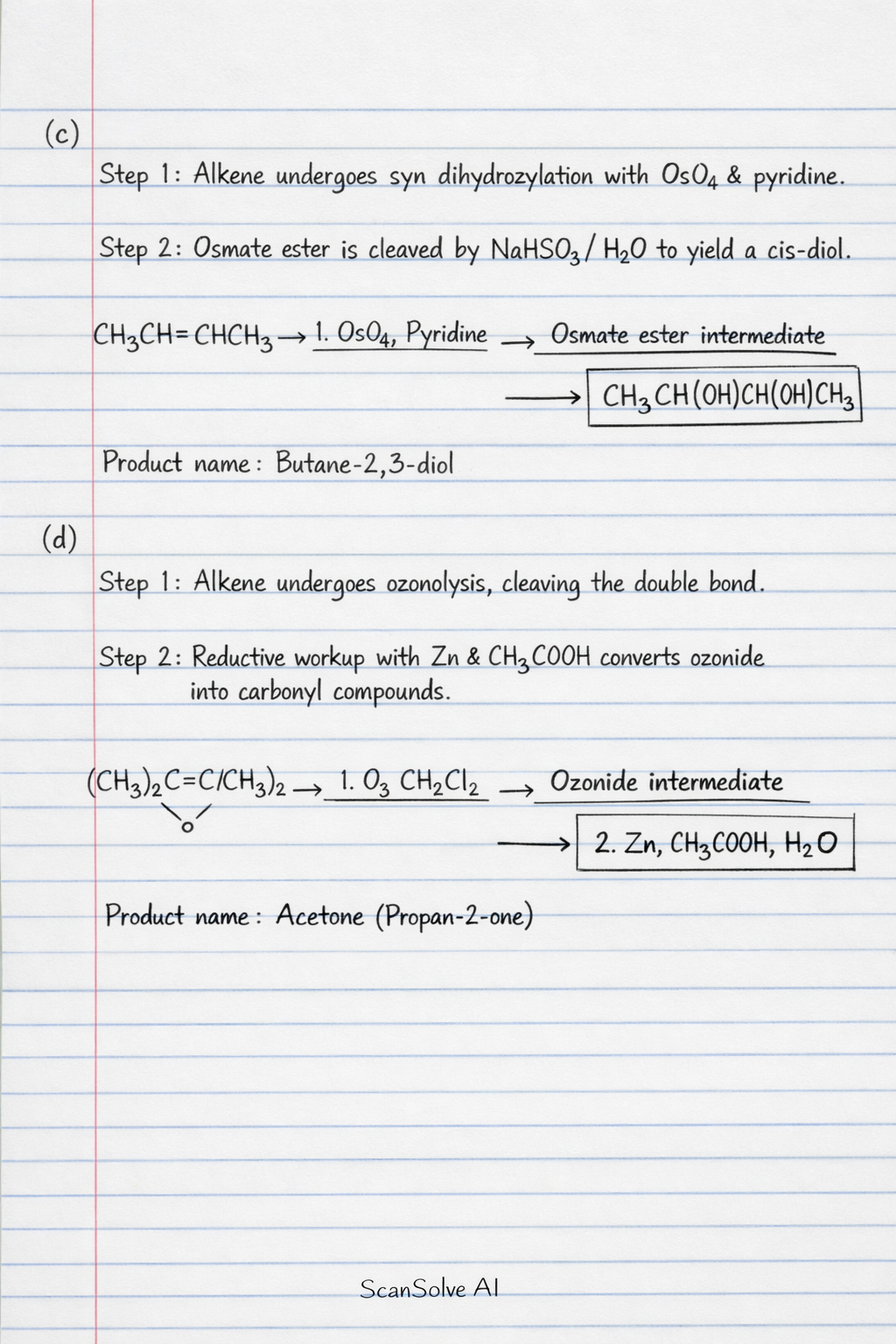
Part c· 2 steps
The alkene undergoes syn dihydroxylation using osmium tetroxide () and pyridine.
The osmate ester is then cleaved by to yield a cis-diol.
Product name: Butane-2,3-diol
Part d
The alkene undergoes ozonolysis, cleaving the double bond.
Reductive workup with zinc and acetic acid converts the intermediate ozonide into carbonyl compounds.
Since the alkene is tetrasubstituted, two molecules of ketone are formed.
Product name: Acetone (Propan-2-one)
Part e
The 1,2-diol undergoes oxidative cleavage with periodic acid ().
This reaction breaks the carbon-carbon bond between the two hydroxyl-bearing carbons, opening the ring and forming a dicarbonyl compound.
Product name: Octane-2,7-dione
Part f
Cyclohexene reacts with diiodomethane () in the presence of a zinc-copper couple () in ether.
This is a Simmons-Smith reaction, which adds a methylene group across the double bond to form a cyclopropane ring.
Product name: Bicyclo[4.1.0]heptane
Part g
The alkene undergoes hydroboration with diborane () in THF.
This adds boron to the less substituted carbon.
Subsequent oxidation with hydrogen peroxide () and sodium hydroxide () replaces the boron with a hydroxyl group, resulting in an anti-Markovnikov addition of water.
Product name: 2-methylpentan-1-ol
Part h
2,3-dimethylbuta-1,3-diene reacts with but-2-ene in a Diels-Alder cycloaddition.
This [4+2] cycloaddition forms a six-membered ring with a new double bond.
Product name: 1,2,4,5-tetramethylcyclohex-1-ene
Part h(i)
Acetone reacts with a phosphonium ylide, which is generated in situ from triphenylphosphine () and methyl bromide ().
This is a Wittig reaction, which converts a ketone into an alkene by replacing the carbonyl oxygen with the alkylidene group from the ylide.
Product name: 2-methylpropene
j)
Acetophenone reacts with phosphorus pentachloride ().
This reaction replaces the carbonyl oxygen with two chlorine atoms, forming a geminal dichloride.
Product name: 1,1-dichloro-1-phenylethane
Try one yourself
A new problem that tests the same skill.
Still stuck on this one?
Ask a follow-up, and the answer starts from this question.
More Chemistry Questions
Handwritten Step-by-Step Solution
Get this as a handwritten image on WhatsApp — like a tutor wrote it for you.
Try on WhatsApp