
We read your photo as:
Complete the following reactions with relevant structures: a) H3C−C(CH3)=CH2 --Oxymercuration-demercuration--> b) H3C−C(CH3)=CH2 --Hydroboration-oxidation--> c) Cold, dilute KMnO4/NaOH
ScanSolve AI Answer
Step-by-step solution
6 steps1. Complete the following reactions with relevant structures:
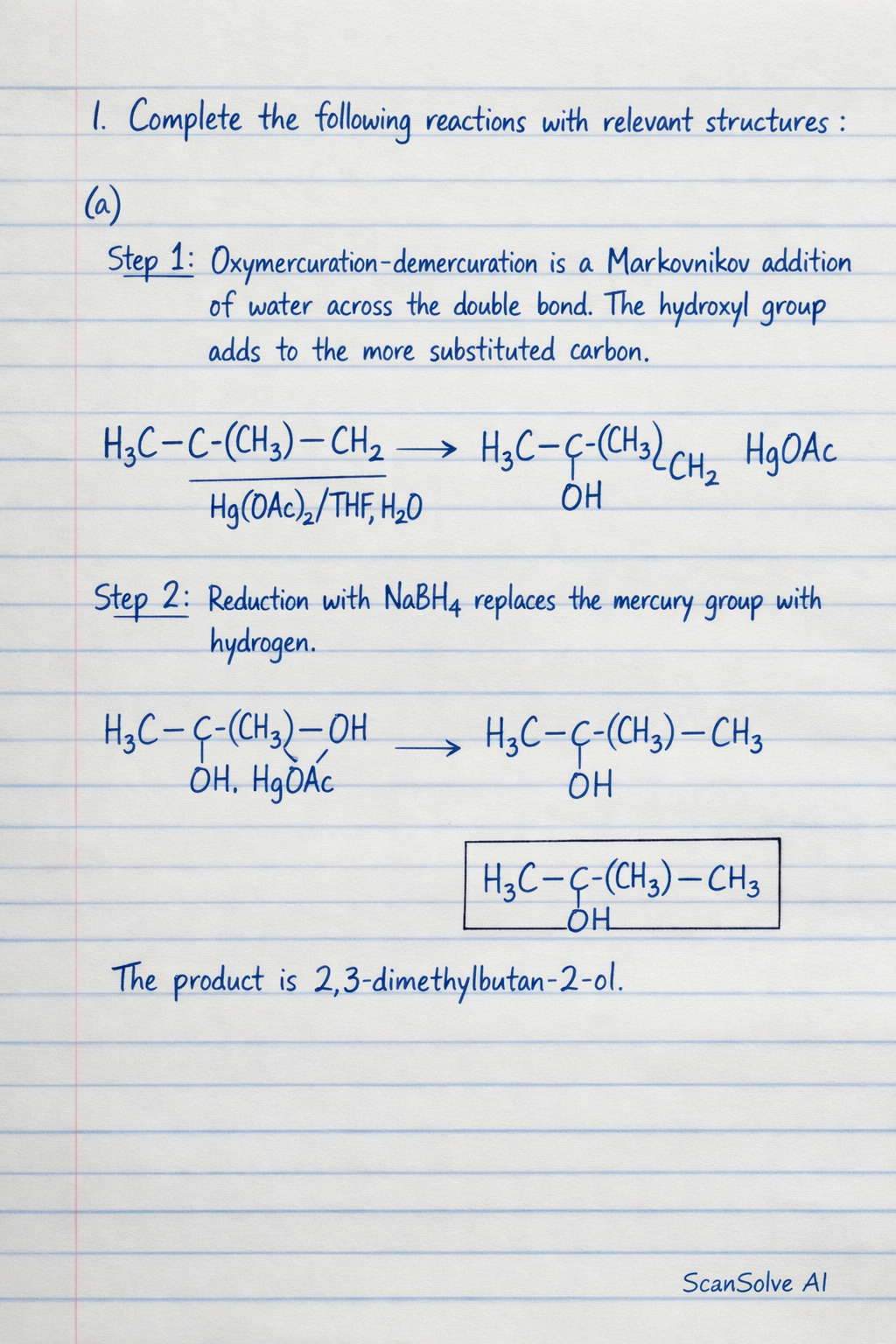
a)
Oxymercuration-demercuration is a Markovnikov addition of water across the double bond.
The hydroxyl group adds to the more substituted carbon.
Reduction with NaBH replaces the mercury group with hydrogen.
The product is 2,3-dimethylbutan-2-ol.
b)
Hydroboration-oxidation is an anti-Markovnikov addition of water across the double bond.
The hydroxyl group adds to the less substituted carbon.
Oxidation with HO/NaOH replaces the borane group with a hydroxyl group.
The product is 2,3-dimethylbutan-1-ol.
c)
Cold, dilute KMnO/NaOH causes syn dihydroxylation of the alkene, adding two hydroxyl groups to the same face of the double bond.The product is cis-cyclopentane-1,2-diol.
d)
Ethylmagnesium chloride (a Grignard reagent) acts as a nucleophile, attacking the carbonyl carbon of cyclohexanone.
Acidic workup (HO/H) protonates the alkoxide to form a tertiary alcohol.
The product is 1-ethylcyclohexanol.
2. a) Give the chemical structures of 3-methyl phenol and 2-methyl cyclohexanol.
a)
- 3-methyl phenol (m-cresol):
\begin{center} \begin{tikzpicture}[scale=0.8] \draw (0,0) -- (1,0) -- (1.5,0.866) -- (1,1.732) -- (0,1.732) -- (-0.5,0.866) -- cycle; \draw (0.5,1.732) node[above] {OH}; \draw (1.7,0.866) node[right] {CH$_3$}; \end{tikzpicture} \end{center} - 2-methyl cyclohexanol:
\begin{center} \begin{tikzpicture}[scale=0.8] \draw (0,0) -- (1,0) -- (1.5,0.866) -- (1,1.732) -- (0,1.732) -- (-0.5,0.866) -- cycle; \draw (0.5,1.732) node[above] {OH}; \draw (0.5,0) node[below] {CH$_3$}; \end{tikzpicture} \end{center}
b) Briefly compare the physical properties of these two compounds and give reasons for your observations.
- Acidity: 3-methyl phenol is acidic (pKa 10), while 2-methyl cyclohexanol is neutral (pKa 16-18). This is because the hydroxyl group in phenol is directly attached to an aromatic ring, allowing for resonance stabilization of the conjugate base (phenoxide ion). The hydroxyl group in 2-methyl cyclohexanol is attached to a saturated carbon, so no such resonance stabilization is possible.
- Boiling Point: Both compounds have hydroxyl groups and can form hydrogen bonds, leading to relatively high boiling points compared to hydrocarbons of similar molecular weight. However, 3-methyl phenol generally has a slightly higher boiling point (202 °C) than 2-methyl cyclohexanol (165 °C for cis, 166 °C for trans). This difference can be attributed to the planar aromatic ring in phenol, which allows for more efficient packing and stronger intermolecular forces, as well as the slightly more polar nature of the phenolic -OH due to the electron-withdrawing aromatic ring.
- Solubility in Water: Both compounds are moderately soluble in water due to their ability to form hydrogen bonds with water molecules. However, their solubility decreases as the nonpolar hydrocarbon portion increases. 3-methyl phenol is slightly more soluble than 2-methyl cyclohexanol due to its more polar nature and smaller non-polar alkyl chain compared to the cyclohexyl ring.
3. Give the structures and names of two in each case of pharmaceutically important alcohols and phenols.
-
Pharmaceutically Important Alcohols:
- Ethanol: Application: Used as a solvent in many drug formulations, an antiseptic, and a disinfectant.
- Menthol:
\begin{center} \begin{tikzpicture}[scale=0.7] \draw (0,0) -- (1,0) -- (1.5,0.866) -- (1,1.732) -- (0,1.732) -- (-0.5,0.866) -- cycle; \draw (0.5,1.732) node[above] {OH}; \draw (0.5,0) node[below] {CH$_3$}; \draw (1.7,0.866) node[right] {CH(CH$_3$)$_2$}; \end{tikzpicture} \end{center}Application: Used as a topical analgesic, a cooling agent in creams and ointments, and a decongestant.
-
Pharmaceutically Important Phenols:
- Paracetamol (Acetaminophen):
\begin{center} \begin{tikzpicture}[scale=0.8] \draw (0,0) -- (1,0) -- (1.5,0.866) -- (1,1.732) -- (0,1.732) -- (-0.5,0.866) -- cycle; \draw (0.5,1.732) node[above] {OH}; \draw (1.7,0.866) node[right] {NHCOCH$_3$}; \end{tikzpicture} \end{center}Application: Widely used as an analgesic (pain reliever) and antipyretic (fever reducer). - Salicylic Acid:
\begin{center} \begin{tikzpicture}[scale=0.8] \draw (0,0) -- (1,0) -- (1.5,0.866) -- (1,1.732) -- (0,1.732) -- (-0.5,0.866) -- cycle; \draw (0.5,1.732) node[above] {OH}; \draw (1.7,0.866) node[right] {COOH}; \end{tikzpicture} \end{center}Application: Used as a keratolytic agent for skin conditions (e.g., acne, warts) and as a precursor for aspirin.
- Paracetamol (Acetaminophen):
4. Give the IUPAC names of the following structures:
a)
The longest carbon chain containing the ketone is 5 carbons. The ketone is at position 3. There are methyl groups at positions 2 and 4.Name:
b)
This is a ketone with a phenyl group and an ethyl group attached to the carbonyl. The longest chain containing the carbonyl is 3 carbons (propan-1-one), with a phenyl group at position 1.\begin{center} \begin{tikzpicture}[scale=0.8] \draw (0,0) -- (1,0) -- (1.5,0.866) -- (1,1.732) -- (0,1.732) -- (-0.5,0.866) -- cycle; \draw (1.7,0.866) node[right] {C(=O)CH$_2$CH$_3$}; \end{tikzpicture} \end{center}Name:c)
The longest chain containing both the aldehyde and the double bond is 6 carbons. The aldehyde group is always carbon 1. The double bond is between carbons 2 and 3.Name:
d)
The longest chain containing both the aldehyde and the hydroxyl group is 5 carbons. The aldehyde group is always carbon 1. The hydroxyl group is at carbon 3.Name:
- 3-methyl phenol (m-cresol):
Still stuck on this one?
Ask a follow-up, and the answer starts from this question.
More Chemistry Questions
Handwritten Step-by-Step Solution
Get this as a handwritten image on WhatsApp — like a tutor wrote it for you.
Try on WhatsApp