
We read your photo as:
Create 10 multiple-choice questions about oxidation and reduction based on the provided text.
ScanSolve AI Answer
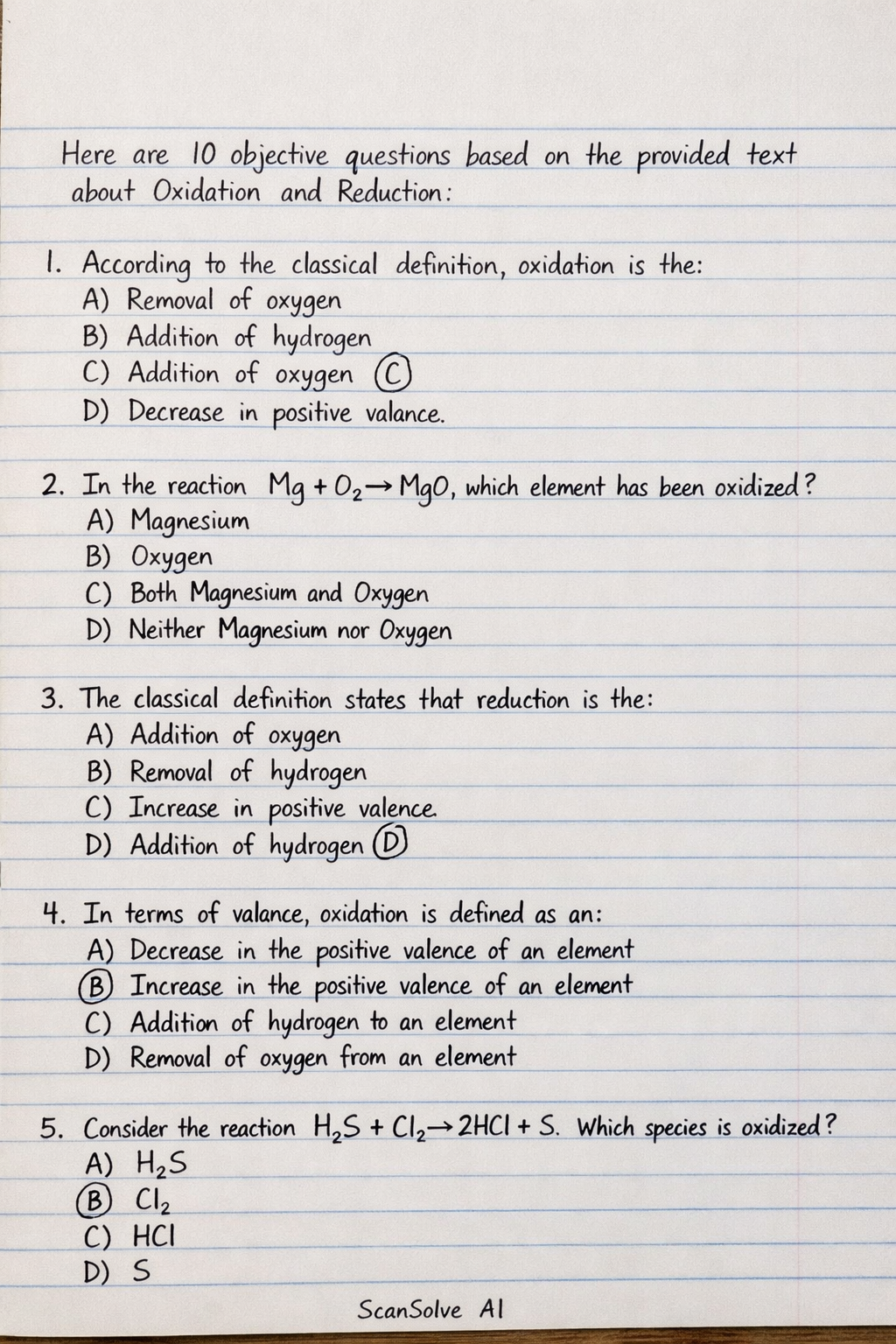
Here are 10 objective questions based on the provided text about Oxidation and Reduction:
-
According to the classical definition, oxidation is the: A) Removal of oxygen B) Addition of hydrogen C) Addition of oxygen D) Decrease in positive valence
-
In the reaction , which element has been oxidized? A) Magnesium B) Oxygen C) Both Magnesium and Oxygen D) Neither Magnesium nor Oxygen
-
The classical definition states that reduction is the: A) Addition of oxygen B) Removal of hydrogen C) Increase in positive valence D) Addition of hydrogen
-
In terms of valence, oxidation is defined as an: A) Decrease in the positive valence of an element B) Increase in the positive valence of an element C) Addition of hydrogen to an element D) Removal of oxygen from an element
-
Consider the reaction . Which species is oxidized? A) B) C) D)
-
Why is considered oxidized in the reaction ? A) It gained oxygen. B) It lost hydrogen. C) It gained chlorine. D) Its positive valence decreased.
-
According to the valence concept, reduction involves a: A) Gain of oxygen B) Loss of hydrogen C) Decrease in the positive valence D) Increase in the positive valence
-
If an element's positive valence changes from 0 to +2, this process is an example of: A) Reduction B) Oxidation C) Neutralization D) Hydrolysis
-
Which of the following is NOT a classical definition of reduction? A) Addition of hydrogen B) Removal of oxygen C) Increase in positive valence D) Decrease in positive valence
-
In the example , the valence of Magnesium changes from: A) +2 to 0 B) 0 to +2 C) -2 to 0 D) 0 to -2
Still stuck on this one?
Ask a follow-up, and the answer starts from this question.
More Chemistry Questions
Handwritten Step-by-Step Solution
Get this as a handwritten image on WhatsApp — like a tutor wrote it for you.
Try on WhatsApp