
We read your photo as:
Create two tables to record observations when a solid is mixed with a liquid and summarize findings.
ScanSolve AI Answer
The image shows two tables for recording observations from an experiment where a solid is mixed with a liquid. Since no experimental data is provided, I will explain what kind of information should be recorded in each section.
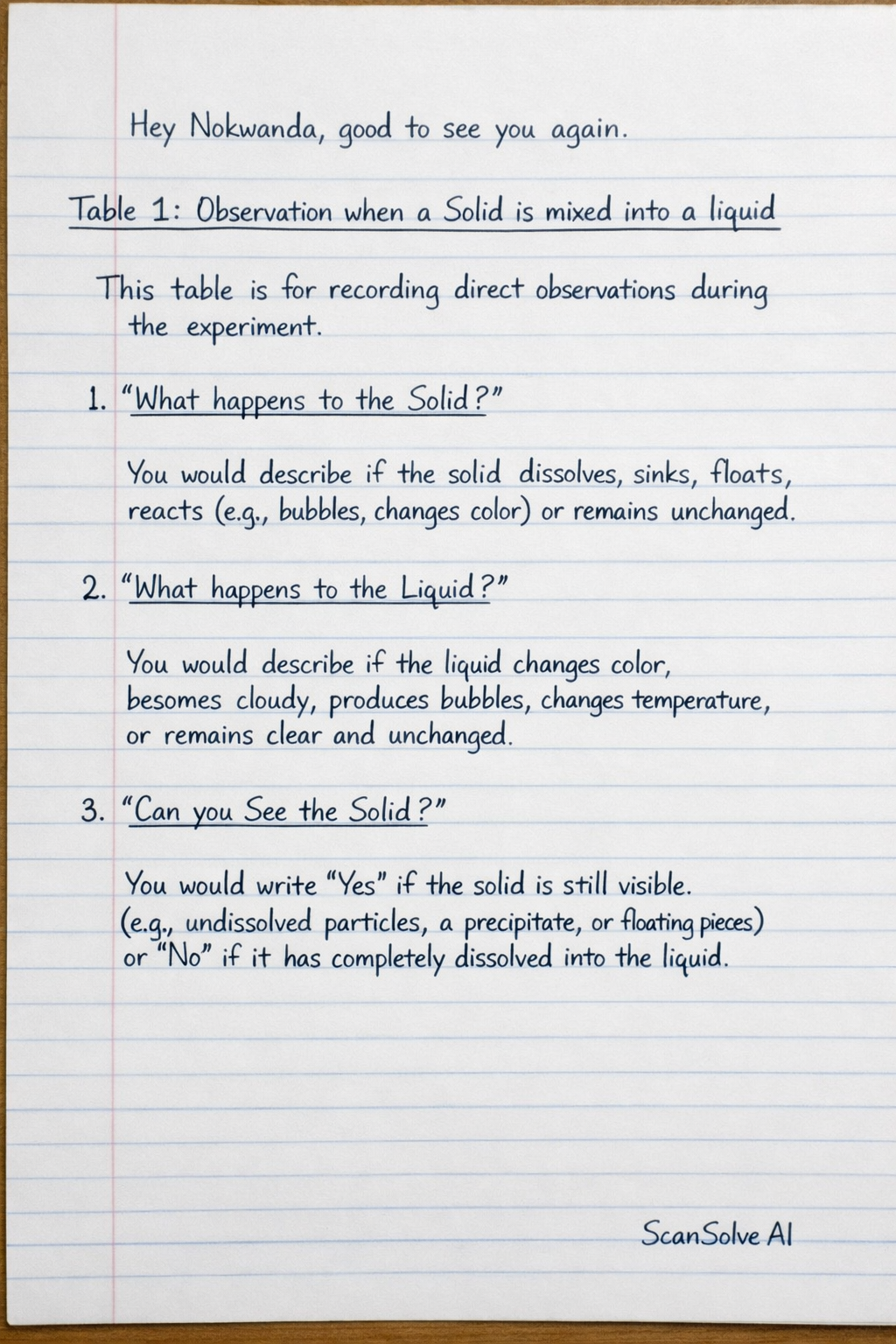
Table 1: Observation when a Solid is mixed into a liquid
This table is for recording direct observations during the experiment.
- "What happens to the Solid?": Here, you would describe if the solid dissolves, sinks, floats, reacts (e.g., bubbles, changes color), or remains unchanged.
- "What happens to the liquid?": Here, you would describe if the liquid changes color, becomes cloudy, produces bubbles, changes temperature, or remains clear and unchanged.
- "Can you See the Solid?": You would write "Yes" if the solid is still visible (e.g., as undissolved particles, a precipitate, or floating pieces) or "No" if it has completely dissolved into the liquid.
- "Can you See the Liquid?": You would write "Yes" if the liquid phase is still visible and distinct, or "No" if it has become completely opaque or transformed into another state.
Table 2: Summary of observation. Tick in the correct column
This table is for summarizing specific outcomes across different trials (Glass 1, 2, 3, 4). You would place a tick (or "X") in the column for each glass where the corresponding observation was made.
- "The Solid settle at the bottom": Tick this if the solid did not dissolve and sank to the bottom of the glass.
- "The liquid looks like before": Tick this if the liquid's appearance (e.g., color, clarity) did not change after the solid was added.
- "The liquid changed": Tick this if the liquid's appearance (e.g., color, clarity, presence of bubbles, formation of a new substance) visibly altered after the solid was added.
To fill these tables, you would need to perform the experiment for each "Glass" (trial) and record your specific observations.
Still stuck on this one?
Ask a follow-up, and the answer starts from this question.
More Chemistry Questions
Handwritten Step-by-Step Solution
Get this as a handwritten image on WhatsApp — like a tutor wrote it for you.
Try on WhatsApp