
We read your photo as:
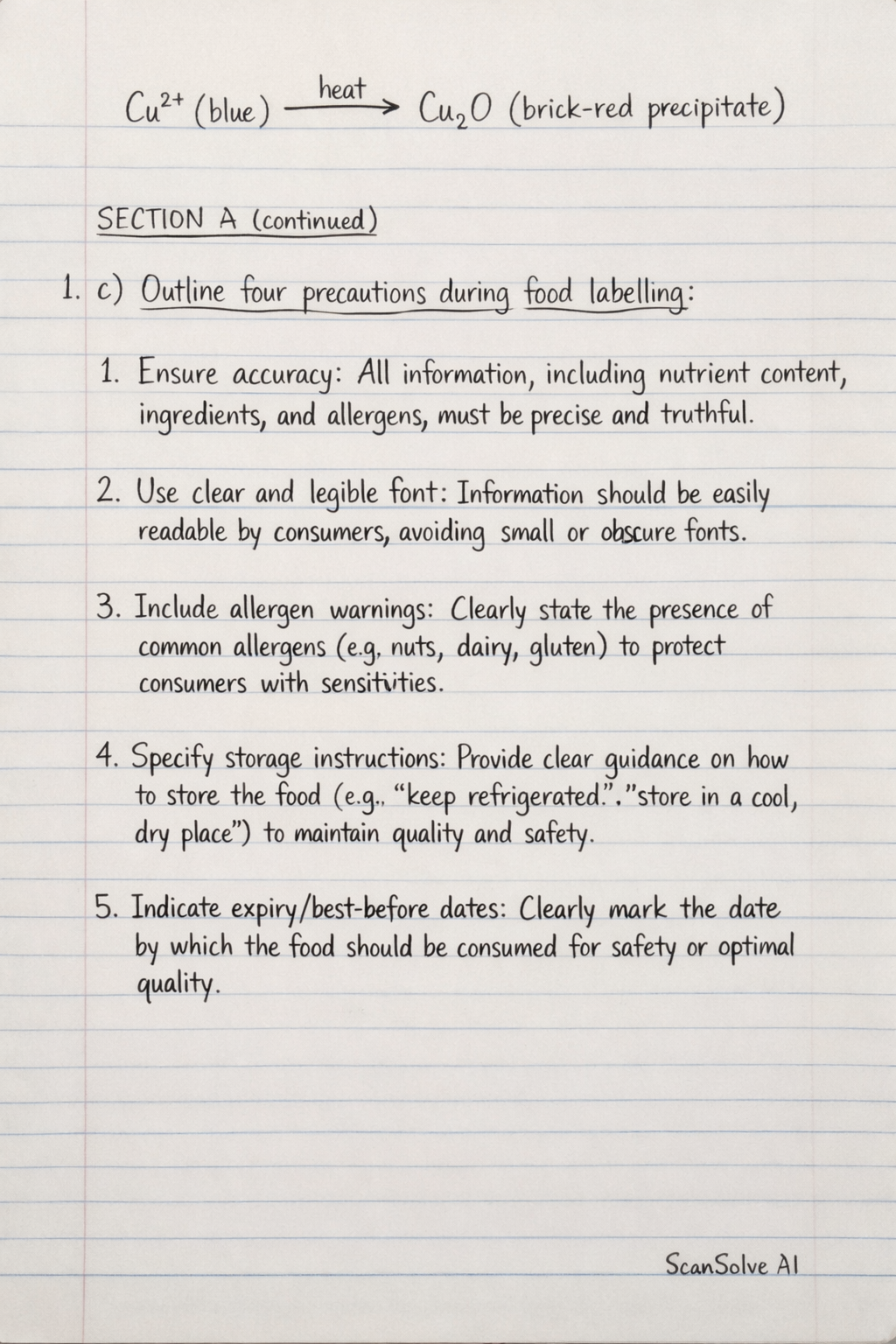
Cu²+ (blue) heat Cu₂O (brick-red precipitate)
ScanSolve AI Answer
SECTION A (continued)
1. c) Outline four precautions during food labelling.
- Ensure accuracy: All information, including nutrient content, ingredients, and allergens, must be precise and truthful.
- Use clear and legible font: Information should be easily readable by consumers, avoiding small or obscure fonts.
- Include allergen warnings: Clearly state the presence of common allergens (e.g., nuts, dairy, gluten) to protect consumers with sensitivities.
- Specify storage instructions: Provide clear guidance on how to store the food (e.g., "keep refrigerated," "store in a cool, dry place") to maintain quality and safety.
- Indicate expiry/best-before dates: Clearly mark the date by which the food should be consumed for safety or optimal quality.
1. d) What is the importance of quality control in food processing?
Quality control in food processing is crucial for several reasons:
- Ensures food safety: It identifies and eliminates potential hazards (e.g., pathogens, contaminants) to prevent foodborne illnesses.
- Maintains product consistency: It ensures that food products consistently meet specified standards for taste, texture, appearance, and nutritional content.
- Complies with regulations: It helps food manufacturers adhere to legal and industry standards, avoiding penalties and maintaining market access.
- Protects brand reputation: Consistent quality builds consumer trust and loyalty, safeguarding the brand's image and market share.
- Reduces waste and costs: By detecting defects early, it minimizes rework, spoilage, and recalls, leading to more efficient production.
SECTION C
5. a) Define an enzyme.
An enzyme is a biological catalyst, typically a protein, that speeds up the rate of specific biochemical reactions in living organisms without being consumed in the process.
5. b) Describe the selectivity of enzymes.
Enzymes exhibit high specificity or selectivity, meaning each enzyme typically catalyzes only one specific reaction or acts on a very limited range of structurally similar substrates. This is often explained by the "lock and key" or "induced fit" model, where the enzyme's active site has a unique shape that precisely fits its particular substrate, much like a specific key fits into a specific lock. This ensures that metabolic pathways are highly regulated and efficient.
5. c) Explain how enzymes are sensitive to:
i) Temperature
Enzymes have an optimal temperature at which they exhibit maximum activity.
- Below optimal temperature: Enzyme activity decreases because molecules move slower, leading to fewer collisions between the enzyme and its substrate. The enzyme is not denatured, and activity can be restored by increasing the temperature.
- Above optimal temperature: Enzyme activity rapidly decreases because the high kinetic energy causes the enzyme's three-dimensional structure, particularly the active site, to change shape permanently. This process is called denaturation, and it renders the enzyme inactive. Most human enzymes have an optimal temperature around .
ii) pH
Enzymes also have an optimal pH at which their activity is highest.
- Deviation from optimal pH: Changes in pH (either too acidic or too alkaline) alter the charges on the amino acid residues in the enzyme's active site and other parts of its structure. This disrupts the ionic and hydrogen bonds that maintain the enzyme's specific three-dimensional shape.
- Denaturation: Extreme pH values can cause irreversible denaturation of the enzyme, leading to a permanent loss of its catalytic activity. For example, pepsin, an enzyme in the stomach, has an optimal pH of around 2, while amylase, found in saliva, works best at a neutral pH of around 7.
6. a) Explain the term food preservation.
Food preservation refers to any process or technique used to treat and handle food in a way that slows down or stops spoilage, prevents the growth of undesirable microorganisms (like bacteria, yeasts, and molds), and maintains the food's nutritional value, texture, and flavor over an extended period.
6. b) State five reasons for preserving food.
- To extend shelf life and prevent spoilage, making food available for longer periods.
- To ensure food safety by inhibiting the growth of pathogenic microorganisms that cause foodborne illnesses.
- To reduce food waste by utilizing seasonal gluts and preventing perishable items from spoiling.
- To maintain nutritional value and sensory qualities (taste, texture, appearance) of food.
- To provide food availability during off-seasons, in remote areas, or during emergencies.
- To add variety to the diet by making different foods accessible year-round.
6. c) Explain the following methods of food preservation.
i) Use of high temperatures
High temperatures are used in food preservation to destroy microorganisms (bacteria, yeasts, molds) and inactivate enzymes that cause spoilage.
- Pasteurization: Involves heating food (e.g., milk, fruit juice) to a specific temperature for a set time (e.g., for 15 seconds) to kill most pathogenic bacteria without significantly altering the food's quality.
- Sterilization/Canning: Involves heating food to much higher temperatures (e.g., ) under pressure for an extended period to destroy all microorganisms and their spores. The food is then sealed in airtight containers to prevent recontamination.
- Boiling/Cooking: While primarily for consumption, cooking also preserves food temporarily by killing microorganisms.
ii) Removal of air (dehydration)
Dehydration, or drying, is a method of food preservation that removes moisture from food.
- Principle: Microorganisms require water to grow and multiply. By reducing the water content (water activity) to very low levels, dehydration inhibits microbial growth and enzyme activity, thereby preventing spoilage.
- Methods: This can be achieved through sun drying, oven drying, freeze-drying, or using commercial dehydrators. Examples include dried fruits, jerky, and powdered milk.
- Effect: The removal of water concentrates nutrients and often changes the texture and flavor of the food.
iii) Use of chemicals
Chemicals, known as food preservatives, are added to food to inhibit microbial growth or prevent undesirable chemical changes.
- Antimicrobial agents: These chemicals (e.g., nitrites, sulfites, benzoates, sorbates) directly kill or inhibit the growth of bacteria, yeasts, and molds. They are commonly used in processed meats, baked goods, and beverages.
- Antioxidants: These chemicals (e.g., ascorbic acid, tocopherols, BHA, BHT) prevent oxidation, which can cause rancidity in fats and oils, and discoloration in fruits and vegetables.
- Acids: Adding acids (e.g., vinegar, citric acid) lowers the pH of food, creating an environment unsuitable for many spoilage microorganisms. This is common in pickling.
- Sugar and Salt: High concentrations of sugar (e.g., in jams) and salt (e.g., in cured meats) act as preservatives by drawing water out of microbial cells through osmosis, inhibiting their growth.
SECTION D
7. a) Differentiate between kwashiorkor and marasmus.
| Feature | Kwashiorkor | Marasmus |
|---|---|---|
| Primary Cause | Protein deficiency with adequate calorie intake | Severe deficiency of both protein and calories |
| Appearance | Edema (swelling), "pot belly" | Wasted, emaciated, "skin and bones" |
| Muscle Wasting | Less severe, often masked by edema | Severe muscle and fat wasting |
| Fat Stores | Some subcutaneous fat may be present | Little to no subcutaneous fat |
| Growth Retardation | Moderate | Severe |
| Hair Changes | Sparse, brittle, discolored (flag sign) | Normal or slightly sparse |
| Skin Changes | Dermatitis, flaky skin, lesions | Dry, thin, wrinkled skin |
| Appetite | Poor | Often good, sometimes ravenous |
| Mental State | Apathetic, irritable | Alert but often irritable |
| Liver | Enlarged, fatty liver | Normal or slightly atrophied |
7. b) Explain four effects of protein energy malnutrition in a community.
- Increased Mortality and Morbidity: PEM, especially in children, significantly increases susceptibility to infections (due to weakened immune systems) and leads to higher rates of illness and death within the community.
- Impaired Physical and Cognitive Development: Chronic PEM in children results in stunting (low height for age) and wasting (low weight for height), leading to irreversible physical growth retardation. It also impairs brain development, affecting cognitive function, learning ability, and school performance.
- Reduced Productivity and Economic Impact: Malnourished individuals, particularly adults, have reduced physical strength, endurance, and mental capacity, leading to lower productivity in agriculture, labor, and other economic activities. This perpetuates a cycle of poverty and hinders community development.
- Intergenerational Cycle of Malnutrition: Malnourished mothers are more likely to give birth to low-birth-weight babies who are at higher risk of malnutrition and health problems throughout their lives, thus perpetuating the cycle of PEM across generations.
- Increased Healthcare Burden: The high incidence of illness and complications associated with PEM places a significant strain on community healthcare resources, diverting funds and personnel that could be used for other public health initiatives.
7. c) i) Why is water called a universal solvent?
Water is called a universal solvent because of its polar nature. A water molecule () has a bent shape with the oxygen atom being more electronegative than the hydrogen atoms, creating a partial negative charge on the oxygen and partial positive charges on the hydrogens. This polarity allows water molecules to form hydrogen bonds with each other and to effectively surround and dissolve a wide range of other polar and ionic substances. The positive ends of water molecules are attracted to negative ions or partially negative parts of other molecules, and the negative ends are attracted to positive ions or partially positive parts, effectively pulling them apart and dispersing them in solution.
ii) Enumerate the importance of water in the body.
- Transportation: Water acts as a medium for transporting nutrients, oxygen, hormones, and waste products throughout the body via blood and lymph.
- Temperature regulation: It helps regulate body temperature through sweating (evaporation of water cools the body) and by distributing heat evenly.
- Lubrication and cushioning: Water lubricates joints, protects organs and tissues (e.g., brain, spinal cord) as a shock absorber, and moistens eyes, nose, and mouth.
- Chemical reactions: It is a crucial reactant and medium for countless biochemical reactions, including digestion, metabolism, and cellular processes.
- Waste excretion: Water is essential for the elimination of waste products from the body through urine and feces.
- Structural component: It is a major component of cells, tissues, and organs, maintaining their structure and function.
8. a) Define the following terms:
- Community: A group of people living in the same place or having a particular characteristic in common, often sharing common interests, values, or a sense of identity.
- Organic foods: Foods that are produced using methods that do not involve synthetic pesticides, herbicides, fertilizers, genetically modified organisms (GMOs), antibiotics, or growth hormones. They emphasize ecological balance and biodiversity.
- Backyard garden: A small plot of land, typically located in the yard of a residential property, used for growing fruits, vegetables, herbs, or flowers for personal consumption or aesthetic purposes.
8. b) State reasons for cultivating a backyard garden.
- Freshness and quality: Provides access to fresh, high-quality produce that can be harvested at its peak ripeness.
- Cost savings: Reduces grocery bills by growing one's own fruits and vegetables.
- Nutritional benefits: Ensures a supply of nutrient-rich foods, often with higher vitamin content than store-bought produce.
- Food security: Contributes to household food security by providing a reliable source of food.
- Control over growing practices: Allows individuals to control the use of pesticides and fertilizers, ensuring organic or preferred growing methods.
- Physical activity and mental well-being: Gardening provides exercise and can be a relaxing, stress-reducing hobby.
- Educational opportunity: Offers a practical way to learn about food production, ecology, and healthy eating.
8. c) List two advantages and two disadvantages of organic foods.
Advantages:
- Reduced exposure to pesticides: Organic farming practices minimize or eliminate the use of synthetic pesticides, potentially reducing consumer exposure to harmful chemicals.
- Environmental benefits: Organic farming promotes soil health, biodiversity, and sustainable practices, reducing pollution and conserving natural resources.
- Often perceived as more nutritious: Some studies suggest organic foods may have higher levels of certain nutrients (e.g., antioxidants), though this is debated.
- Better taste: Many consumers report that organic produce has a superior flavor.
Disadvantages:
- Higher cost: Organic foods are typically more expensive than conventionally grown foods due to higher production costs and smaller scale farming.
- Shorter shelf life: Without synthetic preservatives, some organic produce may spoil more quickly.
- Availability: Organic options may be less widely available in all stores or regions.
- No significant nutritional difference (debated): Scientific consensus is mixed on whether organic foods are significantly more nutritious than conventional foods.
8. d) Explain five factors that influence food production in a community.
- Climate and Weather: Temperature, rainfall patterns, sunlight, and extreme weather events (droughts, floods, storms) directly impact crop growth, livestock health, and fishing yields, determining what can be grown and when.
- Soil Fertility and Land Availability: The quality of soil (nutrient content, structure) and the amount of arable land available dictate agricultural productivity. Soil degradation, erosion, and urbanization can limit food production.
- Technology and Infrastructure: Access to modern farming techniques (e.g., irrigation, improved seeds, machinery), storage facilities, transportation networks, and processing plants significantly influences efficiency, yield, and market access for food producers.
- Economic Factors: Market prices for inputs (seeds, fertilizers, labor) and outputs (harvested crops), access to credit, government subsidies, and trade policies affect farmers' profitability and their decisions on what and how much to produce.
- Labor Availability and Skills: The availability of a skilled workforce for farming, harvesting, and processing is crucial. Labor shortages or lack of agricultural expertise can hinder production.
- Government Policies and Regulations: Agricultural policies, land tenure laws, food safety standards, environmental regulations, and support programs (e.g., extension services) can either promote or constrain food production.
- Pests and Diseases: Outbreaks of crop pests, plant diseases, or animal epidemics can devastate yields and livestock, leading to significant food losses.
Still stuck on this one?
Ask a follow-up, and the answer starts from this question.
More Chemistry Questions
Handwritten Step-by-Step Solution
Get this as a handwritten image on WhatsApp — like a tutor wrote it for you.
Try on WhatsApp