
We read your photo as:
What data is missing to complete the calculations for heat change and titration analysis?
ScanSolve AI Answer
The provided image contains several questions, but crucial data is missing to complete them.
-
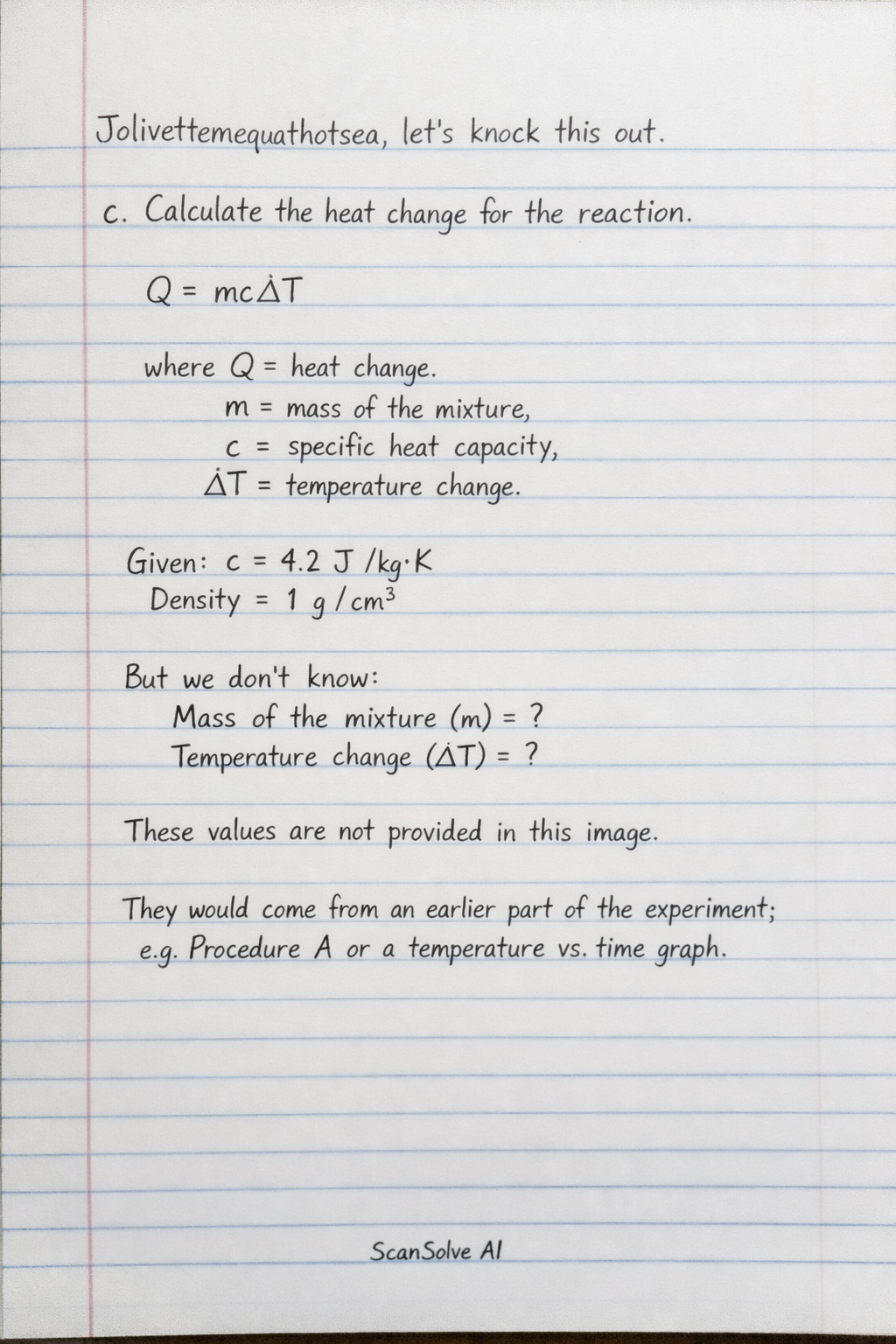
c. Calculate the heat change for the reaction. To calculate the heat change (), we use the formula , where is the mass of the mixture, is the specific heat capacity, and is the temperature change. The specific heat capacity () and density () are given. However, the mass of the mixture and the temperature change () are not provided in this image. These values would typically come from a previous part of the experiment (e.g., Procedure A or a temperature vs. time graph).
-
PROCEDURE B and subsequent calculations (i, ii, iii, iv). The table for titrations (Table 2) is empty. To perform calculations i, ii, iii, and iv, the following data is required:
- Final burette readings for titrations 1, 2, and 3.
- Initial burette readings for titrations 1, 2, and 3.
- Concentration of sodium hydroxide (D), which is used in the burette.
Without these values, it is impossible to:
- i. Calculate the average volume used.
- ii. Calculate the number of moles of sodium hydroxide used.
- iii. Calculate the number of moles of hydrochloric acid in 25cm³ of solution C.
- iv. Calculate the number of mole of hydrochloric acid in 250cm³ of solution C.
Please provide the missing temperature data (for part c) and the burette readings along with the concentration of sodium hydroxide (for Procedure B) so I can help you solve these problems.
Still stuck on this one?
Ask a follow-up, and the answer starts from this question.
More Chemistry Questions
Handwritten Step-by-Step Solution
Get this as a handwritten image on WhatsApp — like a tutor wrote it for you.
Try on WhatsApp