
We read your photo as:
Calculate the degree of ionization of a weak acid with Ka = 10⁻⁴ and initial concentration C = 0.01 M. Also, analyze the provided neutralization reaction based on Brønsted-Lowry theory.
ScanSolve AI Answer
Answer
Step-by-step solution
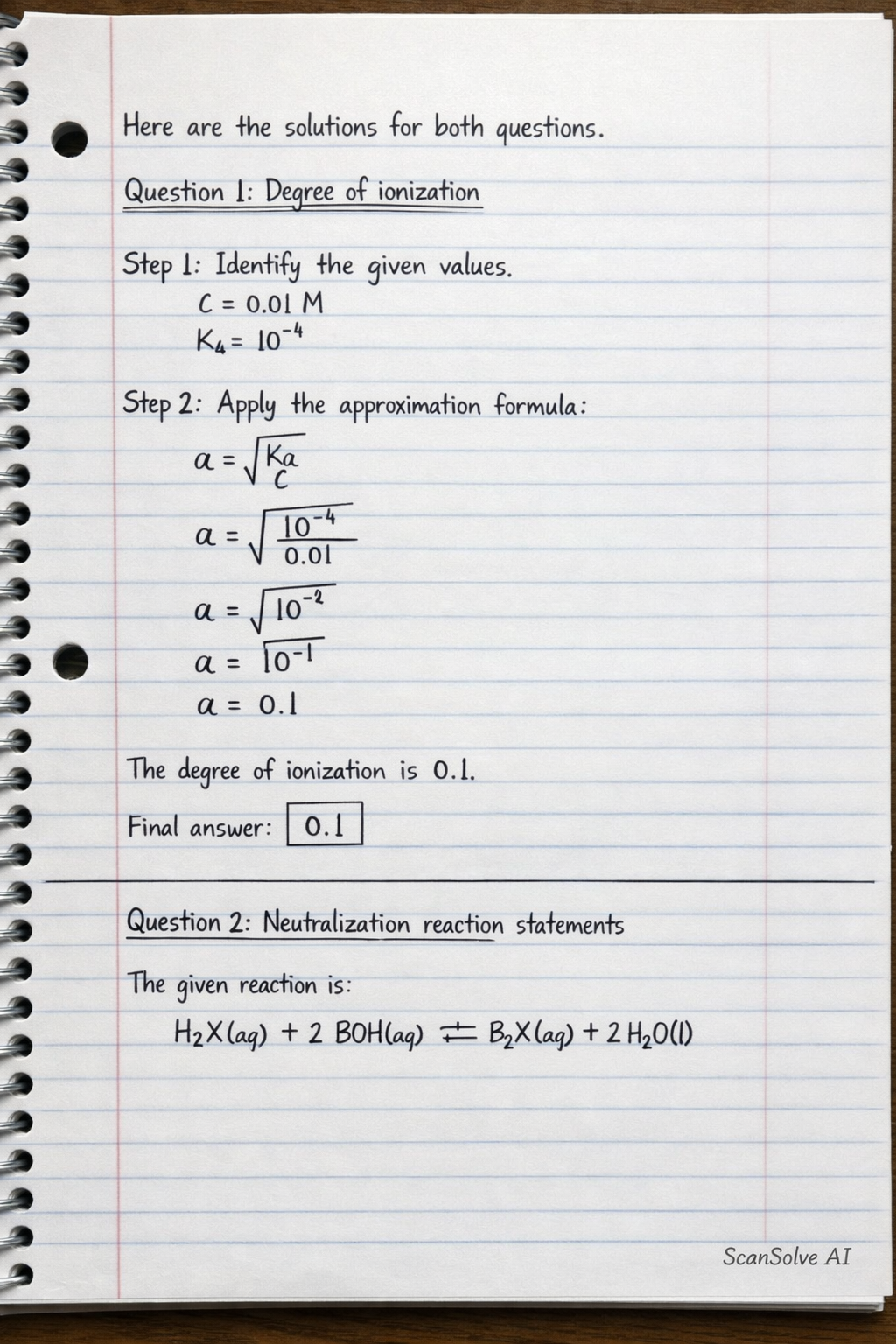
3 stepsHere are the solutions for both questions.
Part 1· 3 steps
Degree of ionization
To calculate the degree of ionization () for a weak acid, we can use the approximation , where is the acid dissociation constant and is the initial concentration of the acid.
Identify the given values.
The initial concentration of the acid is .
The acid dissociation constant is .Apply the approximation formula for the degree of ionization.
Calculate the degree of ionization.
The degree of ionization is 0.1.
The final answer is .
Part 2
Neutralization reaction statements
The given hypothetical neutralization reaction is:
Let's analyze each statement based on Brønsted-Lowry acid-base theory:
- A Brønsted-Lowry acid donates protons ().
- A Brønsted-Lowry base accepts protons ().
- A conjugate acid is formed when a base accepts a proton.
- A conjugate base is formed when an acid donates a proton.
In the reaction:
- donates protons to (specifically, its part). Thus, acts as an acid.
- (or from ) accepts protons from . Thus, acts as a base.
- When donates protons, its conjugate base is (which forms with ).
- When accepts a proton, its conjugate acid is .
Now, let's evaluate each statement:
- I. is conjugate acid. is a salt formed from the cation and the
Try one yourself
A new problem that tests the same skill.
Still stuck on this one?
Ask a follow-up, and the answer starts from this question.
More Chemistry Questions
Handwritten Step-by-Step Solution
Get this as a handwritten image on WhatsApp — like a tutor wrote it for you.
Try on WhatsApp