
Do for compound intersection
ScanSolve AI Answer
It seems there might be a slight misunderstanding in the term "compound intersection." In mathematics, "intersection" usually refers to the common elements between sets, while "compound" often relates to financial calculations like compound interest.
Assuming you meant compound interest, here is the explanation and formula:
Compound interest is the interest calculated on the initial principal and also on the accumulated interest from previous periods. It means that the interest earned in each period is added to the principal, and then the next period's interest is calculated on this new, larger principal.
The formula for compound interest is:
Where:
- is the final amount (principal + accumulated interest)
- is the principal amount (the initial amount of money)
- is the annual interest rate (as a decimal)
- is the number of compounding periods (usually years)
For example, if you invest R1000 at an annual interest rate of 5% compounded annually for 3 years:
The final amount would be R 1157,63.
Still stuck on this one?
Ask a follow-up, and the answer starts from this question.
More Chemistry Questions
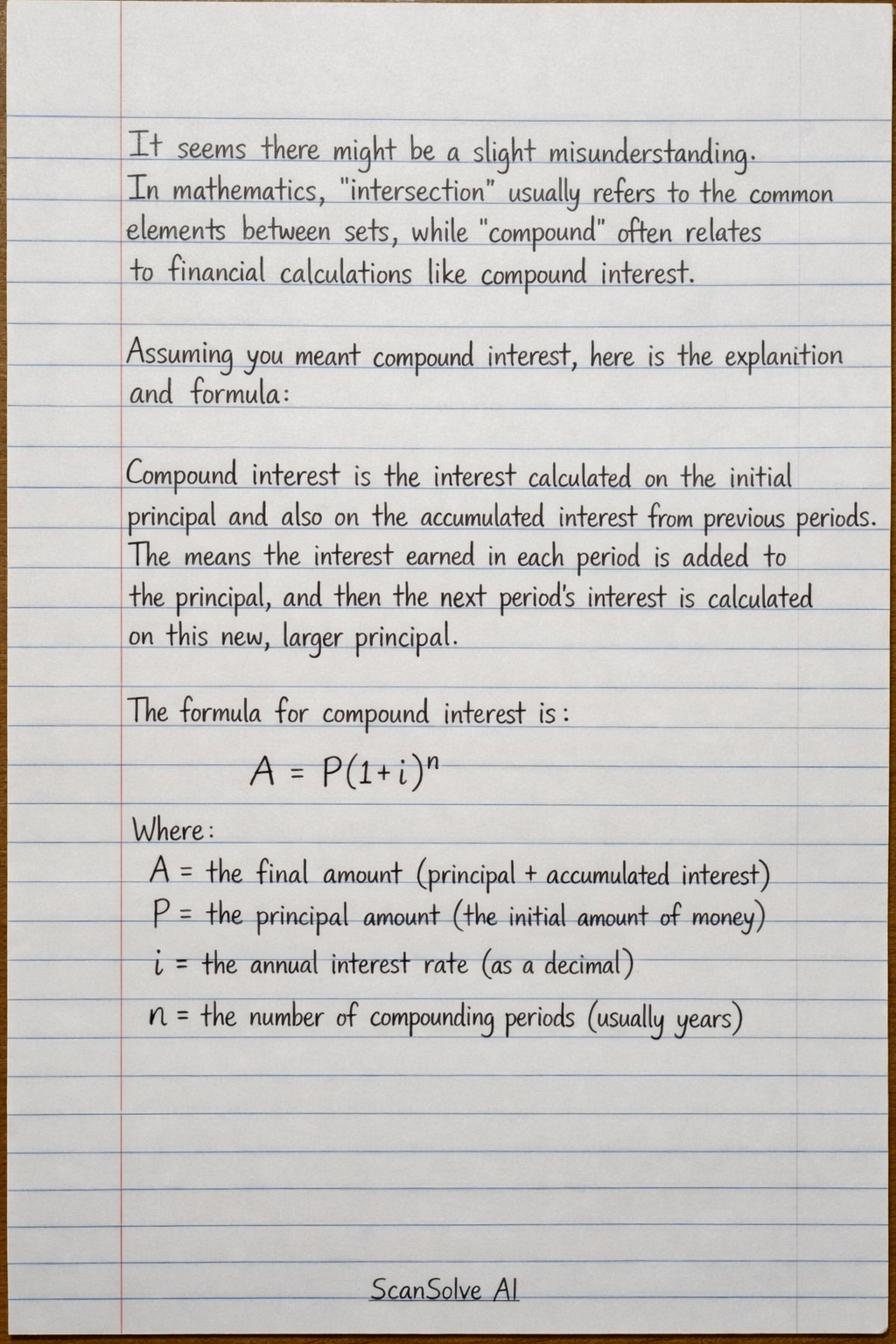
Handwritten Step-by-Step Solution
Get this as a handwritten image on WhatsApp — like a tutor wrote it for you.
Try on WhatsApp