

This chemistry question involves key chemical concepts and calculations. The detailed solution below walks through each step, from identifying the reaction type to computing the final answer.
ScanSolve AI Answer
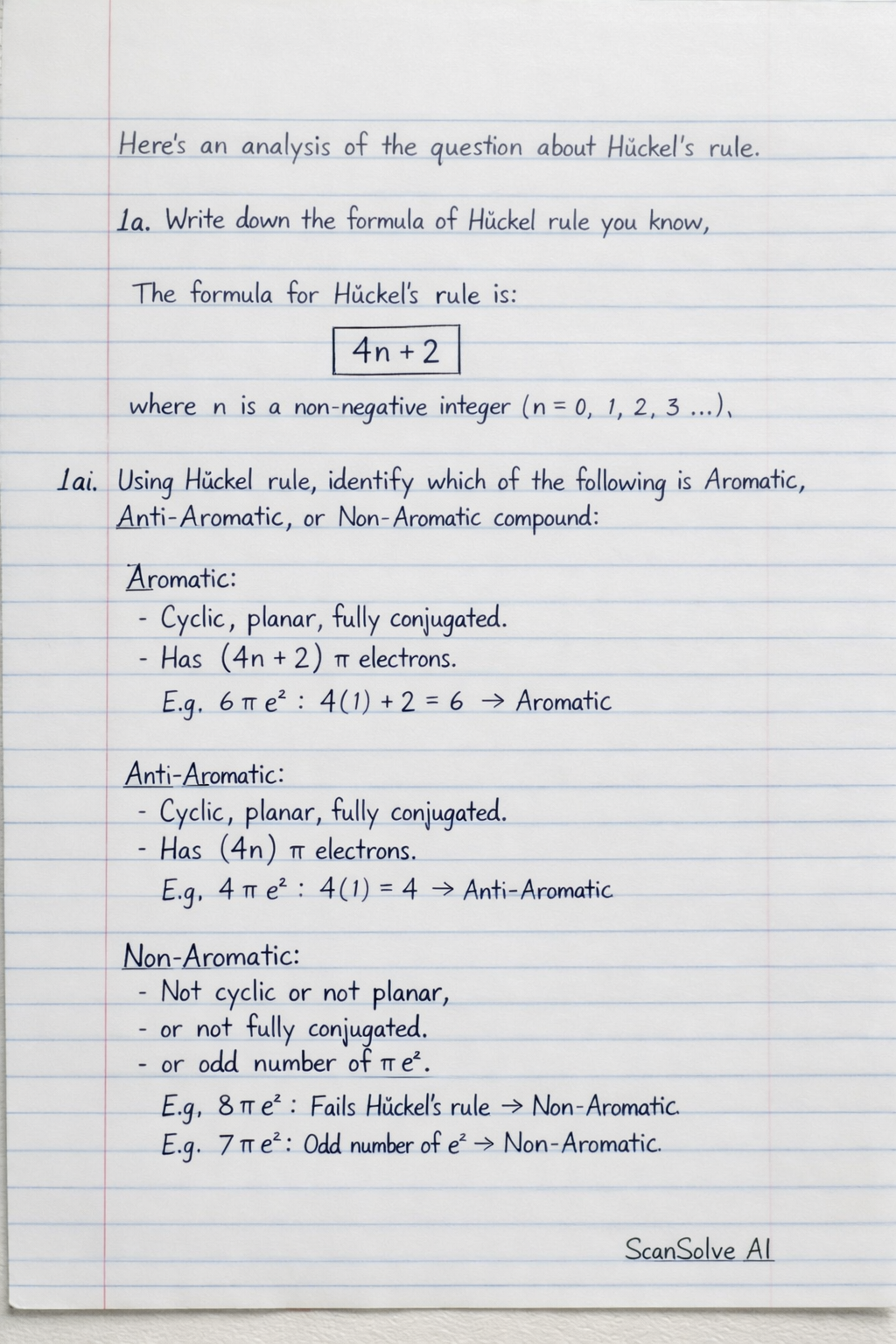
let's break down this question about Hückel's rule. 1a. Write down the formula of Hückel rule you know The formula for Hückel's rule, which determines the number of pi electrons required for a compound to be aromatic, is: 4n + 2 where n is a non-negative integer (n = 0, 1, 2, 3, ). 1ai. Using Hückel rule, identify which of the following is Aromatic, anti-aromatic or non-aromatic compound To classify each compound, we need to consider if it is cyclic, planar, fully conjugated, and then apply Hückel's rule. We will assume the most common cyclic, conjugated structures for these formulas. Aromatic: Cyclic, planar, fully conjugated, and has (4n + 2) pi electrons. Anti-aromatic: Cyclic, planar, fully conjugated, and has (4n) pi electrons. Non-aromatic: Fails any of the above criteria (not cyclic, not planar, or not fully conjugated), or has an odd number of pi electrons. a) C₄H₅N Step 1: Assume the compound is pyrrole, a 5-membered heterocyclic ring containing nitrogen. Step 2: Pyrrole is cyclic, planar, and fully conjugated (the nitrogen's lone pair participates in conjugation). Step 3: Count the pi electrons. Pyrrole has two double bonds (2 × 2 = 4 pi electrons) and one lone pair on the nitrogen atom (2 pi electrons) that contributes to the pi system. Total pi electrons = 4 + 2 = 6. Step 4: Apply Hückel's rule. For 4n + 2 = 6, we get 4n = 4, so n = 1. Since n is an integer, C₄H₅N (pyrrole) is aromatic. b) C₁₄H₁₀ Step 1: Assume the compound is anthracene or phenanthrene, which are polycyclic aromatic hydrocarbons. Step 2: Anthracene/phenanthrene are cyclic, planar, and fully conjugated. Step 3: Count the pi electrons. Anthracene has 7 double bonds, contributing 7 × 2 = 14 pi electrons. Step 4: Apply Hückel's rule. For 4n + 2 = 14, we get 4n = 12, so n = 3. Since n is an integer, C₁₄H₁₀ (anthracene/phenanthrene) is aromatic. c) C₄H₄ Step 1: Assume the compound is cyclobutadiene, a 4-membered ring with two double bonds. Step 2: Cyclobutadiene is cyclic, planar, and fully conjugated. Step 3: Count the pi electrons. It has two double bonds, contributing 2 × 2 = 4 pi electrons. Step 4: Apply Hückel's rule. For aromaticity: 4n + 2 = 4 4n = 2 n = 0.5 (not an integer). For anti-aromaticity: 4n = 4 n = 1 (integer). Since it has 4n pi electrons and is cyclic, planar, and fully conjugated, C₄H₄ (cyclobutadiene) is anti-aromatic. d) C₄H₂O Step 1: This molecular formula is highly unsaturated. If it were a simple cyclic, planar, fully conjugated system, it would be extremely strained or impossible to form. For example, a 5-membered ring with an oxygen and two double bonds is furan (C₄H₄O), which has 6 pi electrons. C₄H₂O has two fewer hydrogens, implying an additional degree of unsaturation (e.g., a triple bond or another double bond). Step 2: A 5-membered ring cannot accommodate three double bonds. A triple bond within a small ring like a 5-membered ring would introduce significant strain, preventing the molecule from being planar and fully conjugated. Step 3: Since it is unlikely to be planar and fully conjugated, it does not meet the criteria for aromaticity or anti-aromaticity. Therefore, C₄H₂O is non-aromatic. Here's the summary: a) C₄H₅N: Aromatic b) C₁₄H₁₀: Aromatic c) C₄H₄: Anti-aromatic d) C₄H₂O: Non-aromatic What's next?