
We read your photo as:
Write down the formular of Huckel rule you know. Using Huckel rule, identify which of the following is Aromatic, anti-aromatic or non-aromatic compound. What is the meaning of (i) EDG, (ii) EWG. Give three (3) examples each of be above.
ScanSolve AI Answer
Step-by-step solution
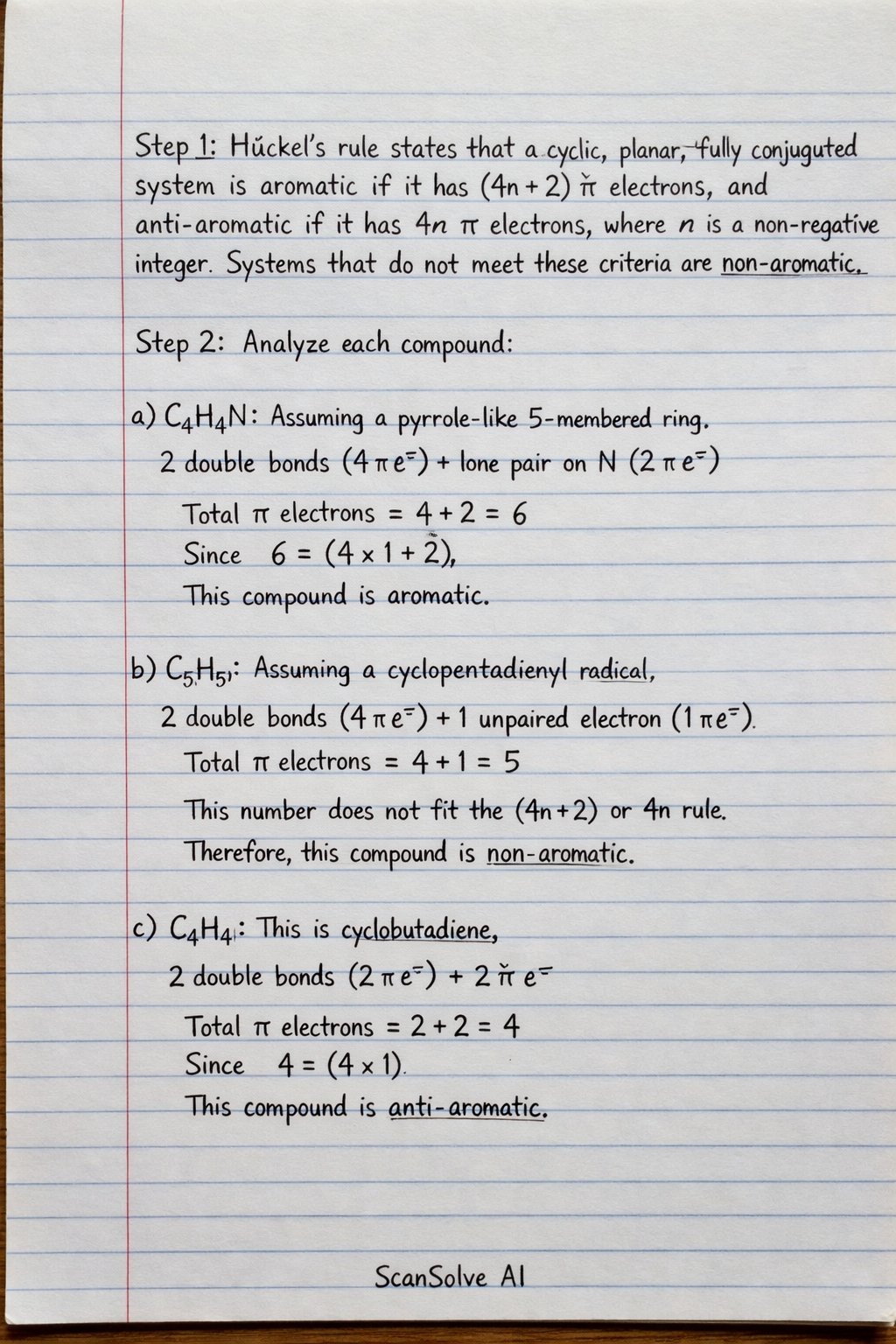
3 stepsHückel's rule states that a cyclic, planar, fully conjugated system is aromatic if it has pi electrons, and anti-aromatic if it has pi electrons, where is a non-negative integer.
Systems that do not meet these criteria are non-aromatic.
Analyze each compound
-
a) C₄H₄N: Assuming a pyrrole-like 5-membered ring structure, it has two double bonds (4 pi electrons) and a lone pair on the nitrogen atom (2 pi electrons) that participates in conjugation. Total pi electrons = . Since , this compound is aromatic.
-
b) C₅H₅: Assuming a cyclopentadienyl radical, it is a 5-membered ring with two double bonds (4 pi electrons) and one unpaired electron (1 pi electron). Total pi electrons = . This number does not fit the or rule. Therefore, this compound is non-aromatic.
-
c) C₄H₄: This is cyclobutadiene, a 4-membered ring with two double bonds. Total pi electrons = . Since , this compound is anti-aromatic.
-
d) C₄H₂O: This is furan, a 5-membered ring containing an oxygen atom. It has two double bonds (4 pi electrons) and one lone pair from the oxygen atom (2 pi electrons) that participates in conjugation. Total pi electrons = . Since , this compound is aromatic.
-
Classification
- a) C₄H₄N: Aromatic
- b) C₅H₅: Non-aromatic
- c) C₄H₄: Anti-aromatic
- d) C₄H₂O: Aromatic
Still stuck on this one?
Ask a follow-up, and the answer starts from this question.
More Chemistry Questions
Handwritten Step-by-Step Solution
Get this as a handwritten image on WhatsApp — like a tutor wrote it for you.
Try on WhatsApp