
We read your photo as:
Draw the Lewis dot structures for H₂S, CH₃Br, and HCN.
ScanSolve AI Answer
Step-by-step solution
22 stepsHere are the solutions to your chemistry homework questions.
.3
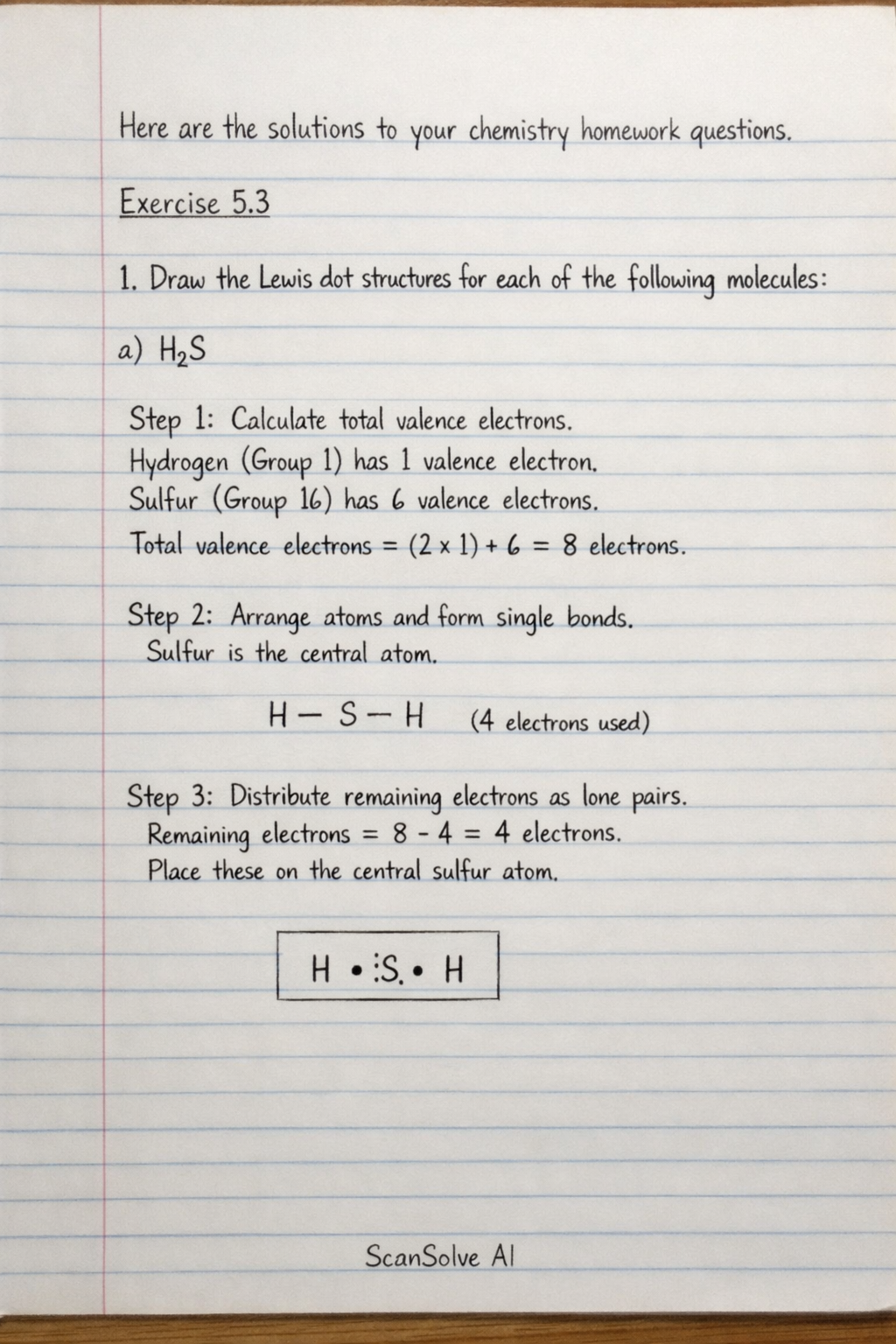
1. Draw the Lewis dot structures for each of the following molecules:
a) H₂S
Calculate total valence electrons.
Hydrogen (Group 1) has 1 valence electron. Sulfur (Group 16) has 6 valence electrons.
Total valence electrons = electrons.Arrange atoms and form single bonds.
Sulfur is the central atom.
H-S-H (4 electrons used).Distribute remaining electrons as lone pairs.
Remaining electrons = electrons. Place these on the central sulfur atom.
b) CH₃Br
Calculate total valence electrons.
Carbon (Group 14) has 4 valence electrons. Hydrogen (Group 1) has 1 valence electron. Bromine (Group 17) has 7 valence electrons.
Total valence electrons = electrons.Arrange atoms and form single bonds.
Carbon is the central atom.
C-H (3 bonds) and C-Br (1 bond) = 8 electrons used.Distribute remaining electrons as lone pairs.
Remaining electrons = electrons. Place these on the more electronegative bromine atom.
c) HCN
Calculate total valence electrons.
Hydrogen (Group 1) has 1 valence electron. Carbon (Group 14) has 4 valence electrons. Nitrogen (Group 15) has 5 valence electrons.
Total valence electrons = electrons.Arrange atoms and form single bonds.
Carbon is the central atom.
H-C-N (4 electrons used).Distribute remaining electrons as lone pairs and form multiple bonds to satisfy octets.
Remaining electrons = electrons. Place these on nitrogen.
Carbon needs 4 more electrons, and nitrogen has a full octet with 6 lone pair electrons. Move two lone pairs from nitrogen to form a triple bond with carbon.d) K₂O
Identify as an ionic compound (metal K and nonmetal O).
Potassium (Group 1) forms a K⁺ ion. Oxygen (Group 16) forms an O²⁻ ion.
Show the electron transfer and resulting ions with their charges and octets.
Two K atoms each lose 1 electron, and one O atom gains 2 electrons.
e) Al₂O₃
Identify as an ionic compound (metal Al and nonmetal O).
Aluminum (Group 13) forms an Al³⁺ ion. Oxygen (Group 16) forms an O²⁻ ion.
Determine the ratio of ions to balance charges.
To balance the charges, two Al³⁺ ions (total +6) combine with three O²⁻ ions (total -6).
Show the resulting ions with their charges and octets.
2. In the Lewis structures listed below, M and X represent various elements in the third period of the periodic table. Write the formula of each compound using the chemical symbols of each element:
The third period elements are Na, Mg, Al, Si, P, S, Cl, Ar.
a)
Identify M and X based on their charges and electron configuration.
M has a +1 charge, indicating it is an alkali metal (Group 1). In the third period, this is Na (Sodium).
X has a -1 charge and an octet, indicating it is a halogen (Group 17). In the third period, this is Cl (Chlorine).Write the chemical formula.
b)
Identify M and X based on their charges and electron configuration.
M has a +2 charge, indicating it is an alkaline earth metal (Group 2). In the third period, this is Mg (Magnesium).
X has a -2 charge and an octet, indicating it is a chalcogen (Group 16). In the third period, this is S (Sulfur).Write the chemical formula.
c)
Identify M and X based on their charges and electron configuration.
M has a +3 charge, indicating it is from Group 13. In the third period, this is Al (Aluminum).
X has a -2 charge and an octet, indicating it is a chalcogen (Group 16). In the third period, this is S (Sulfur).Write the chemical formula, ensuring charge neutrality.
The given structure implies two X²⁻ ions for one M³⁺ ion, which is incorrect for charge balance. For M³⁺ and X²⁻, the formula should be M₂X₃. Assuming the structure meant to represent the ions that form M₂X₃.
d)
Identify M and X based on their charges and electron configuration.
M has a +2 charge, indicating it is an alkaline earth metal (Group 2). In the third period, this is Mg (Magnesium).
X has a -1 charge and an octet, indicating it is a halogen (Group 17). In the third period, this is Cl (Chlorine).Step 22
Still stuck on this one?
Ask a follow-up, and the answer starts from this question.
More Chemistry Questions
Handwritten Step-by-Step Solution
Get this as a handwritten image on WhatsApp — like a tutor wrote it for you.
Try on WhatsApp